


Ancient Building Complex in the Wudang Mountains









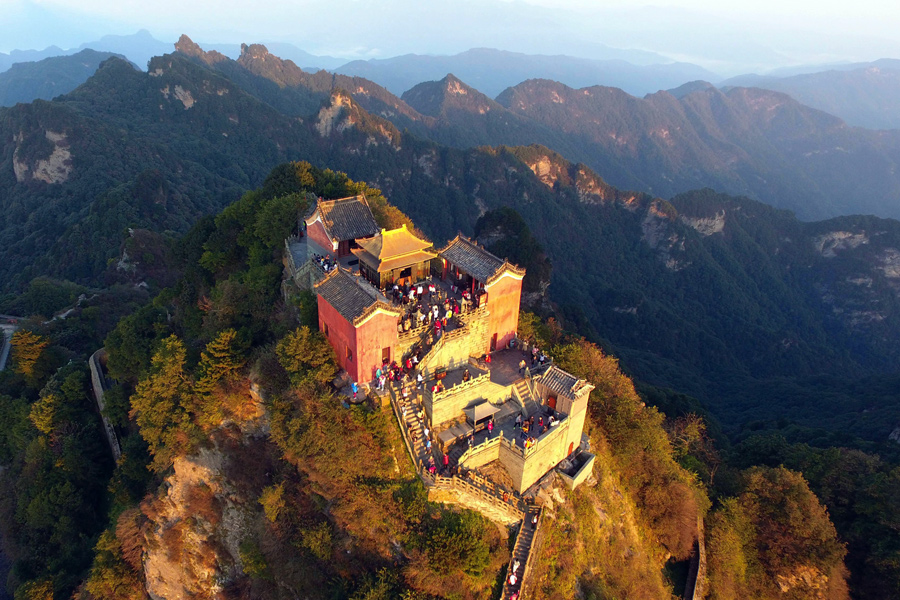
Category of site: Cultural site
Brief introduction
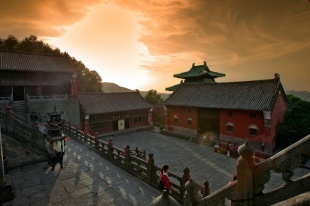
Located near the city of Danjiangkou in central Hubei province, the Wudang Mountains are home to a famous complex of ancient palaces, temples and Taoist buildings dating back to the 7th century. It represents the highest standards of Chinese art and architecture over a period of nearly 1,000 years.
There are 72 peaks, 36 cliffs, 24 gullies, three lakes, nine springs and 10 ponds. The main peak, Tianzhu Peak, has an altitude of 1,612 m. The Wudang Mountains are well vegetated and boast rich plant resources. Due to the large number of Chinese herbs growing on the mountains, they are also famous as a natural drugstore.
The ancient building complex was added to the World Cultural Heritage List in 1994.
Cultural heritage
Established as a Taoist center from the early Tang Dynasty (AD 618-907), some Taoist buildings can be traced back to the 7th century. They exemplify the architectural and artistic achievements of China's secular and religious buildings of the Yuan, Ming and Qing dynasties. There are four Taoist palaces, remains of two other palaces, two temples and a number of cliff temples and halls of worship remaining on the Wudang Mountains. The original features of these sites are well preserved in terms of layout, design, style, materials and technique. Taoist halls are mainly built in secluded nooks or on terraces, surrounded by nunneries and halls of worship. And cliff temples are usually built on prominent peaks. The temples and halls are architecturally superb, and have great cultural and technological value. They are invaluable material for the study of the politics of the early Ming Dynasty, the religious history of China and ancient Chinese buildings.
The major characteristics of the ancient building complex on the Wudang Mountains can be summed up as follows:
a) Superb techniques
The buildings vary in style, and are constructed with different materials. There are wooden temples, copper halls and stone cliff temples. Statues made of copper, wood, stone and earth are known for their delicate techniques and artistic creativity.
b) Treasure house of Taoist architecture
The Taoist buildings on the mountain were designed by emperors, and managed by imperial officials. The buildings were designed on such a grand scale, constructed with so much care, and furnished lavishly with statues and items of worship that they are regarded as unprecedented masterpieces among China's existing Taoist sites.
c) Historical significance
The extensive construction on the Wudang Mountains was carried out when Emperor Zhu of the Ming Dynasty was working hard to expand external contacts and promote Taoism in the country. He intended to consolidate his rule by instilling into his subordinates the idea that the imperial power is endowed by heaven. Therefore, these Taoist buildings are of great significance for the study of the history and religious beliefs of that period.
Taoist culture and Wudang wushu
The history of Taoism on the Wudang Mountains can be traced back about 2,000 years. It began to prosper in the Tang and Song dynasties, and reached its heyday during the Ming Dynasty. Taoism witnessed a decline in the ensuing Qing Dynasty, but it was revitalized after the founding of New China in 1949.
Taoist ritual activities follow a set of procedures handed down through generations of Taoist priests. The priests recite ancient scriptures and play Taoist music, following a centuries-old formula. Scholars and experts extensively studied Taoist music.
Wudang wushu, noted for its exercise of the internal organs and breathing techniques, developed with Taoism. Taoist priests put equal emphasis on religious practice and promotion of health. They derived the principles of wushu from Taoist theories and applied Taoist practical approaches to wushu skills, thus gradually developing Wudang wushu which integrates ancient Chinese philosophy with extraordinary wushu skills. In the Ming Dynasty, Wudang wushu reached its height through the efforts of a Taoist priest named Zhang Sanfeng, and gradually became one of the major schools of Chinese wushu