It's a go ahead









Chinese experts urge the development of artificial intelligence in higher learning, Wang Ru reports.
"Since following the matches between the winning Google AI program, AlphaGo, and the world's top human Go player Ke Jie in 2017, I see artificial intelligence as becoming popular," says Yuan Jiaqi, 24, a postgraduate student of computer studies at East China's Zhejiang University.
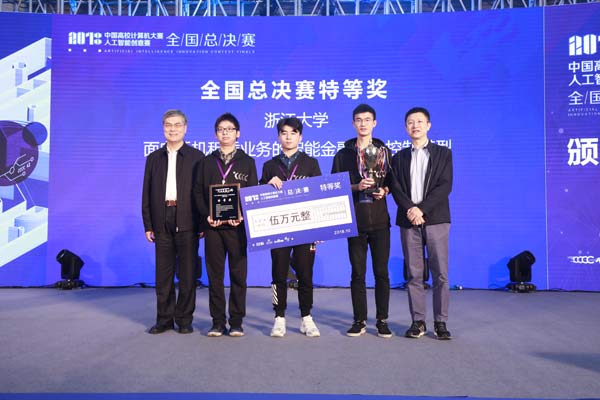
Yuan, with two other fellow students, Hu Sihao and Wu Zetian, participated in this year's China Collegiate Computing Contest-AI Innovation Contest and won the top prize. The awards ceremony and an AI-related forum were held in Deqing county in Zhejiang province on Oct 27, sponsored by Zhejiang University, the AI innovation experts team affiliated with the Ministry of Education, Baidu Inc and Huawei Technologies, among others.
A total of 1,049 teams from Chinese and foreign universities joined the contest, with 33 of them winning prizes. All of the participants were required to develop their models-designed for use in medical treatment, public security, environmental protection, agriculture, art, advertisement and finance-based on a Baidu-developed deep-learning framework named PaddlePaddle.
"AI is quite popular today, and many of the students around me would like to study it," says Yuan.
Their winning model is a risk-control one, which tries to test and predict in advance if potential users of a deposit-free mobile phone renting platform are credible or not. Backed by a large database, the model is said to be able to analyze the users' personal information and foresee the possibility of them returning the phones or not after a period of use.
AI is also used in medical science, as was seen in the design by another prize winner, Yan Yu, a communication engineering major from Southwest Jiaotong University, who designed an AI-related auxiliary diagnostic platform with his teammate, Xu Shu.
"Through our model, doctors can see if a patient has hippocampus atrophies and thus predict the possibility of Alzheimer's disease," Yan says, adding that they chose to design such a model as their focus of research as the university is related to medical science. They worked on the model mostly in their free time since they found out about the contest online.
Another model by Wen Shibo and his teammates, Fan Kun and Zheng Weiqi, undergraduates from Northeastern University who study computer science, used the AI-included deep learning algorithm, focusing on recycling takeout tableware, since young people ordering takeout food on their smartphones is on the rise, and disposable tableware causes pollution and is also a waste of resources.
In their model, they've made tableware that can preserve heat, and a takeout pickup machine that resembles a self-service package locker, like Hive Box. On getting a takeout food order, the courier will put food in the heated container and in the pickup machine, to be collected by the person who placed the order. After the meal, the container can be returned to the machine, which is designed to be put in communities, schools and other places where people can easily find them.
"The machine's AI related image identification system can automatically check if the tableware is damaged, and decide whether to receive it back or not," Wen says, adding that the received tableware will be taken away to be washed and re-distributed.
"Such tableware can be used multiple times, which is much more environmentally friendly.
"In the next 20 years, AI will change people's lives, especially in the fields of transport, medical treatment, education and so on," Wen says.
Pan Yunhe, who is from the Chinese Academy of Engineering and a leader of an AI-related consultative committee under the Ministry of Education, says the recent forum enabled discussions on AI education.
"By gathering efforts from experts and enterprises, it promotes the development of AI and new changes in China's economic growth."
Li Bo, a professor of Beihang University and member of an AI-related panel of the Ministry of Education, says, "China still lacks high-level AI talent, especially those people who have worked in this field for over a decade."
Last year, the State Council, China's Cabinet, released a plan to accentuate the development of AI, which requires having AI as a major subject in higher institutions, recruiting more postgraduates and doctoral candidates to study AI-related topics and hold some lessons related to AI in primary and middle schools.
Some universities have begun to explore more. Xi'an Jiaotong University, for example, has opened an experimental class for AI. Those who graduate will gain a bachelor's degree of computer science, automation or electronic information. So far, 38 higher education institutions in China have applied to the ministry for AI course accreditation.
But since computer majors can also learn about AI, why it is necessary to establish a separate AI major?
Li explains the difference.
"Computer majors focus on computer software, hardware and their applications. Students are supposed to have the ability to use them and improve their ability to deal with data," he says. "An AI major focuses on the technology and the methods of perception, cognition and interaction."
He also discussed the curriculum system for AI majors at the recent forum and encouraged higher institutions to develop AI programs according to their own characteristics and strengths.
Wu Zhaohui, president of Zhejiang University and member of the Chinese Academy of Sciences, says AI will promote profound changes in education.
"AI will save teachers from tedious repetitive work like checking students' homework since such work can be done by AI, so that teachers can focus on improving their teaching with creative ideas," Wu says.
"It will also make students the center of teaching activities, and thus personalized learning will be the mainstream in future teaching activities."
AI will help to form a human-machine learning system, which will enable people to learn at any time, Wu says.
"We would like to cooperate with higher institutions and contribute to the cultivation of AI talent," says Wang Haifeng, Baidu's senior vicepresident.
"I hope more people will pay attention to AI and promote AI talent, so that we can make a better life through its development," he adds.
Contact the writer at wangru1@chinadaily.com.cn