



Balancing act between economy and environment









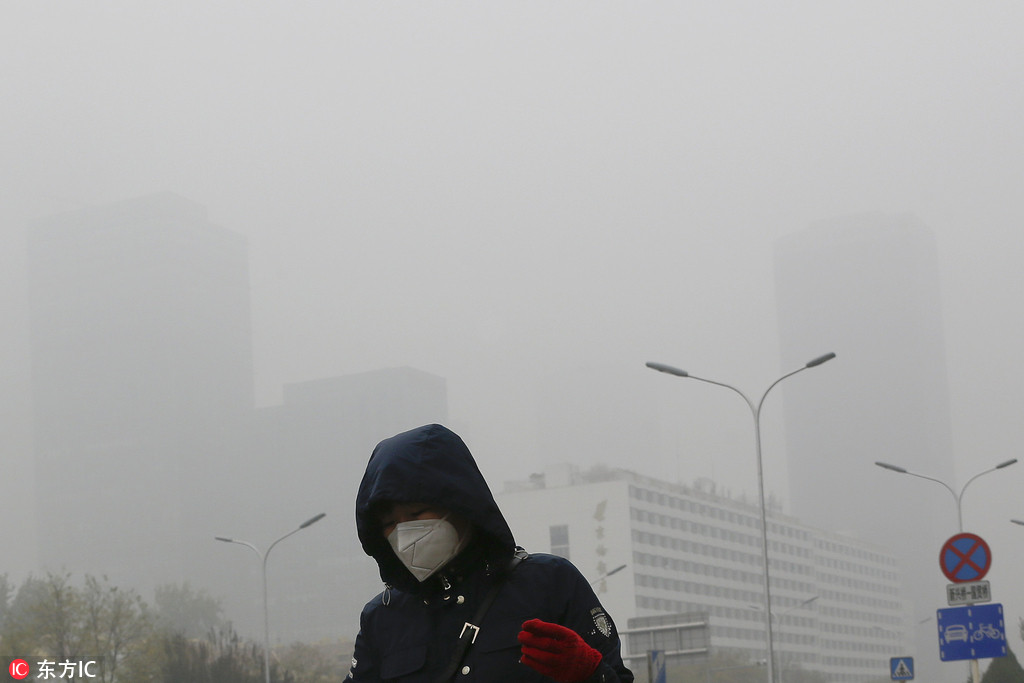
Over the weekend, the Beijing-Tianjin-Hebei region in North China, known as Jing-Jin-Ji, saw the resurgence of alarming air pollution, with some forecast saying heavy smog could be on the way.
We have experienced relatively "clean blue sky" since last winter, compared with two or more years ago when the air quality index at times crossed 500.
In recent years, the strong public reaction to poor air quality reflects the increasing public awareness about the harm caused by air pollution and people's demand for" blue sky". The same was evident this month when forecasts signaled the return of smog.
But the air quality has not worsened for no reason. According to experts, the surrounding areas of Beijing are still home to many highly polluting industries such as coal power plants, iron and steel factories, as well as chemical plants. Motor vehicles, particularly heavy trucks running on diesel, are also a major source of pollutants. Statistics show that sulfur dioxide (SO2) emission intensity in Jing-Jin-Ji is 3.6 times higher than the national average, while that of nitrogen oxides (NOX) is four times higher.
In winter, the heating supply, coal burning of households and seasonal stalk burning in Beijing and its surrounding areas emit tons of pollutants resulting in the return of smog. In Beijing, according to the Beijing municipal environmental protection bureau, mobile sources contributed 45 percent of local PM2.5 in 2017.
Over last few years, the governments at the national and local levels have taken very active measures to clean the air and have achieved success. The most pro-active measure is the nationwide environmental protection inspection launched by the Ministry of Ecology and Environment.
Following the "Air Pollution Prevention and Control Action Plan", which was introduced in 2013, and the "three-year action plan" publicized earlier this year, polluting factories have been shut down and coal burning replaced with gas or electricity in many industries. As a result, the air quality has improved a great deal in the key targeted areas-Jing-Jin-Ji, and the Yangtze River Delta and Pearl River Delta regions.
To sustain the success of the "battle for blue sky", we must understand the causes of the problem. Experts at home and abroad say fossil fuels are the biggest source of air pollution, responsible for almost all SO2 and NOX emissions and the source of 85 percent of particulate matter. Fossil fuels account for 86.7 percent of China's energy mix. Last year's data show that the three biggest consumers of fossil fuels and thus the biggest sources of air pollution in China are industry (64.3 percent), buildings (16.9 percent) and vehicles (15.3 percent).
Also, the six most pollution-intensive industries consume more than 50 percent of energy. In the first three quarters of 2017, the building materials industry, power plants, iron and steel plants, and chemical factories accounted for 85 percent of the total coal consumption-and most of these industries are associated with the real estate sector.
So the solution to the problem is to reduce the consumption of fossil fuels. For that, we need a structural change in industries, that is, a shift from fossil fuel-intensive businesses to cleaner and greener businesses. And more investment should be made to develop renewable energy and improve energy efficiency while supporting green development.
The demand for transport will continue growing. But we expect technological breakthroughs to bring us the most effective solution. In fact, slight changes in human behavior will make a big difference. Proper urban planning can effectively avoid unnecessary transport needs in cities. Shifting to public transport and non-motorized transport from driving private cars will reduce fossil fuel consumption. The multiple benefits of "avoid" and "shift" also include less traffic congestion and improved public health.
The fundamental solution to air pollution is a change in people's behavior. Environmental protection is a self-serving and self-saving action.
The author is chief representative of World Resources Institute (USA) Beijing Representative Office.





