



Maldivian people will suffer most without Chinese investments









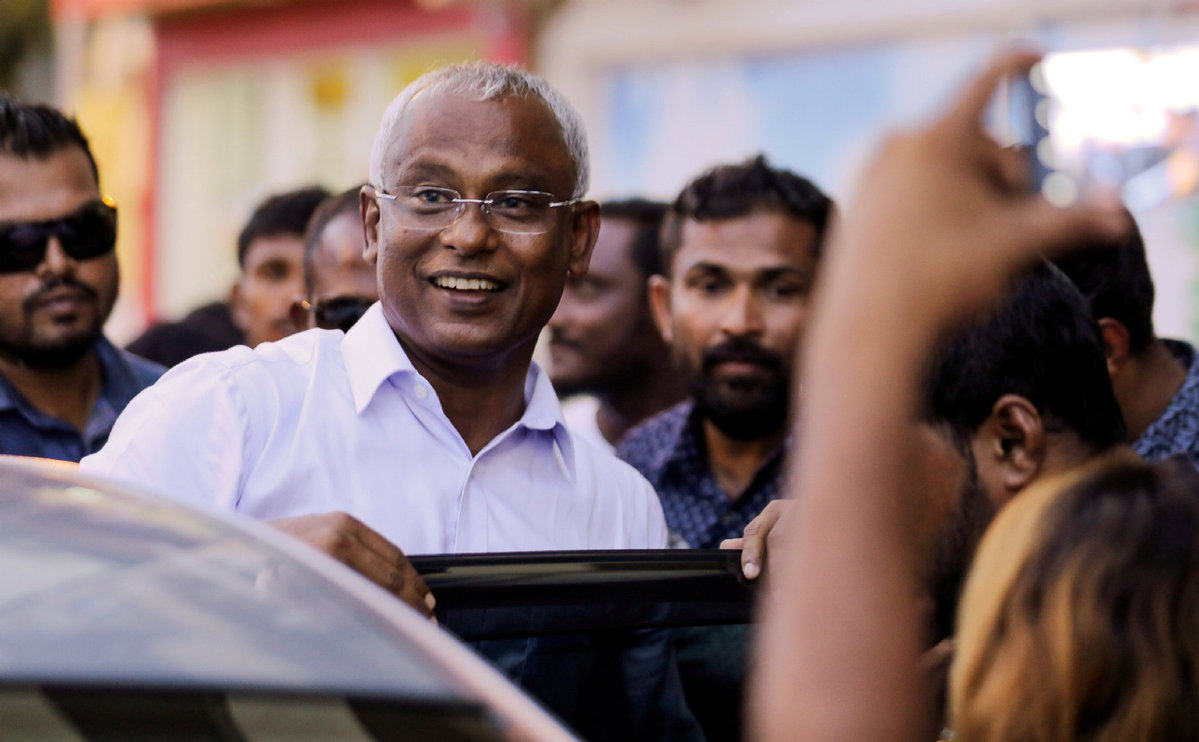
After newly elected Maldivian President Ibrahim Mohamed Solih accused China of raising his country's debt by investing in it, some media outlets have been sensationalizing the issue of China creating "debt traps" in the countries along the Belt and Road.
How much debt does the Maldives have? The data of the CIA and the International Monetary Fund are apt reference sources to get a clearer picture.
The CIA's official website says the Maldives' national debt accounted for 68.1 percent of its GDP in 2017-53rd highest in the world but lower than that of neighboring India and Sri Lanka, which respectively had national debts of 70.2 percent and 79.4 percent. The Maldives' GDP was $4.505 billion in 2017, to which the service industry (tourism) contributed the most (81 percent).
But the Maldives had a lower national debt according to the IMF: 34.7 percent of GDP in 2017, which is likely to rise to 51.2 percent by 2021.
In economics term, there is a difference between national debt and foreign debt. National debt pertains to the bonds issued by a country's central government to raise fiscal funds. And national debt can be divided into national domestic debt and national foreign debt contingent on the region or regions where the bonds are issued.
To be precise, the Maldives' foreign debt at the end of 2016 was $848.8 million.
Therefore, the Maldives' 68.1 percent national debt to GDP ratio means it has issued bonds at home and abroad to raise fiscal funds, and the number of bonds issued is a decision the Maldives alone has made. It has nothing to do with China.
A moderate amount of foreign debt can accelerate a country's economic growth, while a heavy foreign debt-beyond a country's repaying capacity-could spell doom for its economy.
Therefore, if the new Maldivian president believes China's investments and loans have created a "debt trap", he should publish the Maldives' latest debt data. For example, of its $848.8 million foreign debt, how much does it owe to China? And how much of its GDP growth has been driven and how many jobs have been created by Chinese investments and loans?
As for the "land grab" by China which the Maldivian president has referred to, according to available data, China has developed or is developing 17 islands in the Maldives but India, Singapore, and European and Middle Eastern countries also hold stakes in its tourism industry, and have developed many of its islands.
In fact, the Maldives is made up of more than 1,200 coral reefs and islands, 202 of which are inhabited, and the Maldivian government holds island auctions every few years, giving investors the right to use the islands for 25 years. Anyone can lease and develop islands in the Maldives as long as they complete the relevant procedures and pay taxes and rent.
Therefore, equating the development of Maldivian islands by Chinese enterprises with "plunder" and "exploitation" contradicts facts. More importantly, tourists from China are a considerable source of income for the Maldives, especially because Chinese tourists account for the largest number of the more than 700,000 tourists who visit the country every year.
In recent years, more than 300,000 Chinese tourists have visited the Maldives every year, with their number increasing to 400,000 last year. Provided that each Chinese tourist spends $1,000 directly or indirectly on the islands, the Maldives can earn at least $300 million in tourism revenue from Chinese tourists every year. If the country can sustain this stable source of income, it can easily pay off its $848.8 million foreign debt in a matter of years.
A country that can continuously attract a large amount of foreign capital will gain a sharp competitive advantage in global competition. The financing capacity of a country reflects its development prospects. Take China as an example. Thanks to its rapid economic growth, it has become the world's second-largest economy. In turn, its continuously improving reform and opening-up policy has ensured the continuous inflow of foreign investment.
If the Maldives' policies keep changing, it may not be able to attract low-cost and sustained foreign investment and its economic development prospects would suffer. In such a case, the Maldivian people will be the biggest victims.
The author is president of China Silk Road iValley Research Institute and a visiting scholar to Princeton University.





