From the extraordinary to the ordinary: A story about KFC in China









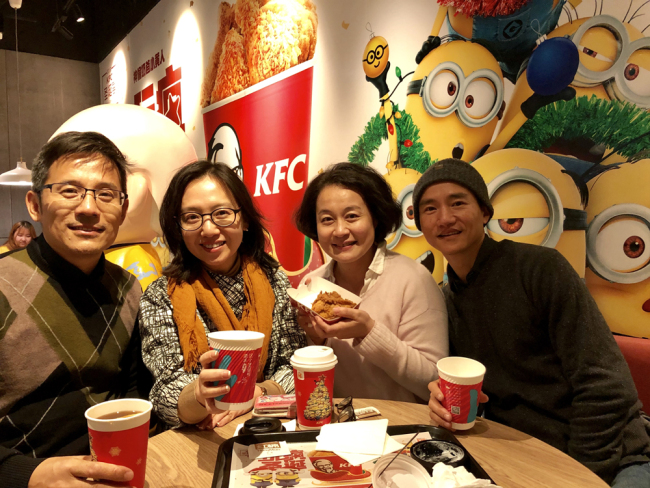
When a couple of my old university classmates came to Beijing last week, we planned to do the same thing we usually did when we reunite: Find a restaurant that's decent, maybe even a bit fancy, where we could catch up to chew the fat. So we laughed when one of us suggested going to KFC, because we knew she didn't mean just any outlet.
Qianmen, which means "Frontal Tower", is like the Champs-Elysees in Paris. It lies south of Tiananmen Square and is packed with cultural and commercial establishments. After parking nearby on a chilly December evening, we went for a walk to find the store we visited together 30 years ago. The store here looks similar to all the other KFCs, except its door is flanked by three-meter high wooden boards bearing the words "NOVEMBER 12, 1987. THE FIRST CHINA STORE" in English and Chinese, alongside the iconic image of Colonel Harland Sanders, the founder of the international franchise.
Was this really the grand destination we came to all those years ago? We all had our doubts, including me, and I've lived in Beijing the whole time since it opened. But a server behind the counter assured us that the store hadn’t moved. We realized that it wasn't so easy to recognize because many new buildings have cropped up around it, and the store’s second and third floors have become a Pizza Hut and a hotel. But once we finally ordered our meals – our classmate Liang is a fitness fanatic and it took him a while before he finally settled on the chicken breast – and we settled into a booth, it didn't take long for us to start our journey down memory lane.
It was headline news in China when this first China-U.S. joint venture store opened. The U.S. ambassador and high-ranking Beijing officials were invited to cut the ribbon at the opening ceremony. A performance of the Yangko, a traditional group dance used to celebrate a harvest, added to the festive atmosphere. So many customers were keen to enter the store, the police had to help keep the waiting queues in order. People lined up for up to two hours for their chance to experience the novelty of American fast food.
KFC was far from affordable for most people in China back then. One piece of chicken cost two and half yuan, which made it a luxury when the average government worker was paid around 100 yuan a month. But people flocked there because it was an accessible symbol of the Western lifestyle, which had a great appeal for people eager to learn something about the modern and advanced West. For many years to come, it was fashionable to dine at the restaurants of overseas fast food chains. Some Beijingers even got married on the third floor of that store in Qianmen, because it was a decent venue that could earn them a lot of face.
It was only a few months after the Qianmen store opened that my English teacher, who was in Beijing from the United States, invited all 18 students in our class to go and experience "American culture." We burst into a round of applause at the news. I'd never seriously considered going there by myself: it would have cost me four days of my food budget!
As we sat there eating our chicken in that same place thirty years later, we had vivid memories of that first visit in our mind. We remembered the long queue, and lining up for more than an hour to get in. Yin, my classmate from Guangzhou who is now a PR executive for a Chinese automobile company, liked the fried chicken so much she used her bread roll to scoop up all the tiny crunchy scraps of batter at the bottom of the box. I ate everything on offer: chicken, mashed potato, the bread, even the coleslaw, which was a bit too sweet for my tastes, but I finished it anyway because I thought it was too good to waste.
Our classmate Guan, who is now a professor at a university in Chicago, remembered when her father visited Beijing on business and offered to take her out to dinner. Guan didn't hesitate when suggesting KFC. At that store in Qianmen, her father ordered a meal for her, but nothing for himself, making excuses that he had eaten already. Guan shared the smile her father had as he watched her devour the meal. "But I think he hadn't eaten anything that day," said Guan guiltily.
We'd been talking for so long it took us a while to realize that it was almost 11 p.m. I looked around the quiet store. Two teenagers at another table shared a set of earphones to listen to something on a cell phone. Above them was a poster announcing that in the year 2010, KFC had 3,000 outlets in China. Now, the chain has more than 5,300 stores in more than a thousand cities and towns.
Despite its success in opening new stores, over the years the chain has lost its shine as an upmarket destination. Now, it's much like many of the other restaurants in the neighborhood that offer cheap fast food, a quiet place outside their family's apartment where students can sit and study, and a place where passersby pop in to use the bathroom. Thirty years ago, the Qianmen store was a special place, a hive of activity and noise. Now, it feels removed from the hustle and bustle of the commercial area that surrounds it.
A simple KFC meal used to cost an average worker four days' pay, but now it's a mere one-seventh of his daily wage. As people in China became wealthier, their taste buds were no longer satisfied by the simple pleasure of fried chicken. An increasingly long list of food choices is available that represents the cuisines of different countries along with different ethnic or geographical regions from across China itself. A short walk along the main street in Qianmen will take you past Italian, German, Spanish, Mexican, and Japanese restaurants, not to mention the outlets offering Chinese specialties like hotpot and Peking roast duck.
And because food takes up only a small portion of their expenditure, especially among urban dwellers, people in China have a broader range of ways to spend their money, such as buying a house or a car, going on holiday at home or abroad, or sending their children overseas to study. This is to say nothing of the daily pleasures that we often take for granted now that were extraordinary luxuries a few decades ago, like going to the gym, getting a massage, or going to the cinema to watch the latest Hollywood blockbuster.
The fried chicken might taste the same, but our choices and tastes have changed.