



Endangered cranes welcomed by Tibetans during migration









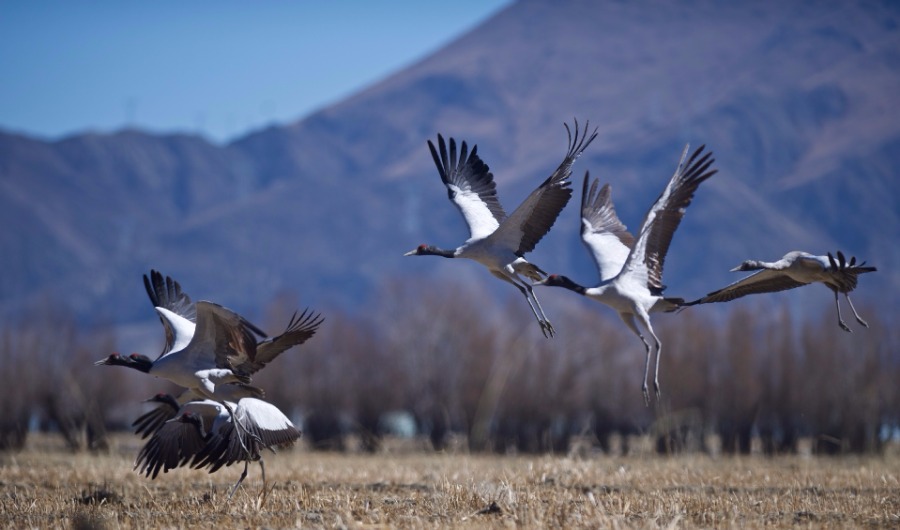
LHASA -- Every year, black-necked cranes arrive in Southwest China's Tibet autonomous region, where they are welcomed by locals and tourists.
"This is the only time of the year when we can see flocks of these birds. It's spectacular!" said Toinzhub Cering, a wildlife ranger in Lhundrup county, which is about 87 miles northeast of Lhasa, Tibet's capital.
Black-necked cranes are often seen in Tibet's river valleys and the region's barley and wheat fields in winter. And Toinzhub knows exactly where to find them.
For ten years, the 42-year-old has patrolled the nature reserve in Lhundrup, one of the major habitats of black-necked cranes.
With an estimated population of around 10,200, the species is classified as "vulnerable" by the International Union for Conservation of Nature (IUCN) and is listed among more than 90 endangered species on China's top protection list, along with the giant panda and golden monkey.
The black-necked crane is the most recently identified among 15 kinds of cranes worldwide. They are also the only kind that inhabits plateau areas with an altitude of 2,500-5,000 meters.
Toinzhub Cering feels passionate about protecting the species and has been doing his part to help. He is always the first person to call media and authorities each year when the rare birds come and go.
Now that he has learned how to use social media, he often shares photos of the cranes with his friends.
Thanks to efforts made by locals and authorities, these exhausted birds, after flying for over 1,000 km, don't have to face hunger, pesticide, or poachers.
Instead, they can now easily find pollutant-free highland barley and wheat left by farmers.
But endangered animal protection efforts in Tibet cover more than just birds, with the Tibetan antelope also under people's watch, among other wildlife.
As for damage and losses caused by such animals, residents can claim compensation from the government.
Between mid-March and late April, black-necked cranes migrate to northern Tibet to reproduce in the lakeside marshes, far beyond human touch.
Yet not all journeys go so well for some cranes. Wounded birds are often left behind by the flock.
Two cranes with broken wings were found in Dazi county near Lhasa this spring. The local forestry authority has been caring for them ever since, and, hopes they can catch up with their flock during next year's migration.
There have also been cases whereby wounded cranes have become permanent residents after recovery.
Black-necked cranes mainly live in the highlands of China, India, Bhutan, and Nepal. Tibet is home to about 80 percent of the world's total.


- Jiangsu awash in Lantern Festival joy
- Shehuo celebration kicks off Lantern Festival in Changji, Xinjiang
- Suzhou classical gardens bring Spring Festival cheer to the world
- Quzhou Dragon Lantern show captivates in Beijing
- Yuexiu Temple Fair opens Lantern Festival in Guangzhou
- Galloping into joyful fair in Weifang this Lantern Festival





