



Chang'e 4 writes space technology history









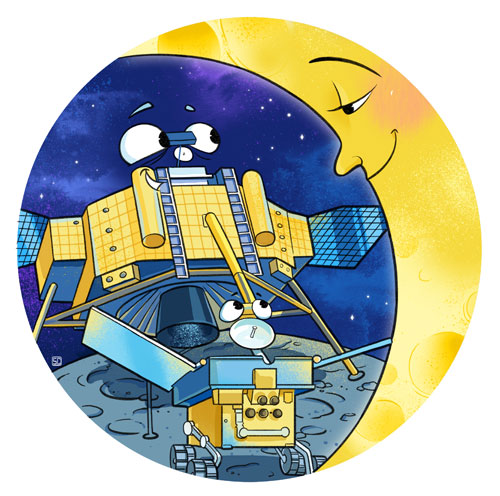
Editor's note: On Thursday, China's Chang'e 4 lunar probe made a soft landing on the far side of the moon, the first such landing in space history. Three experts share their views on this major scientific achievement with China Daily's Zhang Zhouxiang:
A major breakthrough in exploration of moon
Shi Hao
The successful landing of Chang'e 4 marks a giant step forward in not only China's lunar probe, but also its space technology as a whole. The soft-landing was made possible by several breakthroughs in space technology.
For example, Chang'e 4 lunar probe is the first of its kind, as it carries a radioisotope thermoelectric generator that ensures sustainable supply of electricity and heat. This is a breakthrough that will offer strong support to China's future mission to Mars and other space programs.
The terrain of the moon's far side is more rugged than the side facing the Earth. Chang'e 4 also has an advanced guidance, navigation and control system, which helped it to evade all obstacles and land softly on the moon.
Besides, to be able to communicate with Chang'e 4 after it landed on the far side of the moon, China had launched the Queqiao relay satellite in May, the first relay satellite in the halo orbit around Earth-Moon Lagrangian point L2. The launch of Queqiao was itself a major breakthrough in space technology.
Moreover, as a small satellite, Queqiao carries a deployable high-gain parabolic antenna with a diameter of 4.2 meters, the largest in the history of deep space exploration.
Some have questioned China's achievement in the Chang'e 4 mission to the moon, saying the lunar probe is built with quite a number of foreign devices. Such allegations are not even worth refuting. All the major parts of the Chang'e 4 system, including its lander, rover and the relay satellite, were designed and made in China.
It does have some foreign payloads, though, such as Lunar Lander Neutrons and Dosimetry from Germany and Advanced Small Analyzer for Neutrals from Sweden, but they provide an opportunity for all space scientists to conduct research. And the fact that Chang'e 4 carries international payloads shows China is open to the world when it comes to research and cooperation in science.
Shi Hao, a scientist in the space mission engineering program at the China Aerospace Science and Technology Corporation
Chang'e 4 helps reveal history of the moon
Xu Luyuan
The Chang'e 4 lunar spacecraft landed in the Von Karman crater in the South Pole-Aitken basin. The landing area was not selected at random but under careful considerations because of its rich scientific meanings.
SPA is one of the biggest known impact basins in the solar system, and an in-situ study of it will help us learn more about the super-large impact processes in the solar system. Chang'e 4 will help study its surface.
SPA is 12 kilometers deep, making it the deepest impact basin on the moon. With such a depth, it is highly possible that the basin-forming impact might have dispersed upper mantle materials of the moon. These materials will provide a window to the lunar interior.
Besides its size and depth, SPA is also one of the oldest impact basins on the moon, with its history dating back 3.92 billion years or more. Studying it might give us key clues to the history of the Earth's only satellite.
Xu Luyuan, a post-doctoral researcher at the State Key Laboratory of Lunar and Planetary Sciences, Macau University of Science and Technology
A difficult mission accomplished
Shou Tuo
We always see the same side of the moon, the near side, because the moon is in synchronous rotation with the Earth. In other words, the moon is tidally locked to the Earth so its same side always faces us.
That's why, for decades scientists have been trying to explore and study the far side of the moon. And this quest has intensified with the advancement of space technology.
But compared with the near side, it is much more difficult to study the far side because communication can hardly be established between the command center on the Earth and any probe landing on the far side of the moon. Even the Apollo Plan of the United States in the 1960s and 1970s could send astronauts to only the near side of the moon.
That's also why the success of Chang'e 4 is worth cherishing. It is indeed a giant step for China-as well as for the rest of the world.
Shou Tuo, an expert on aerospace research, and one of the top 10 microbloggers on pop science





