



On way to realizing ecological civilization









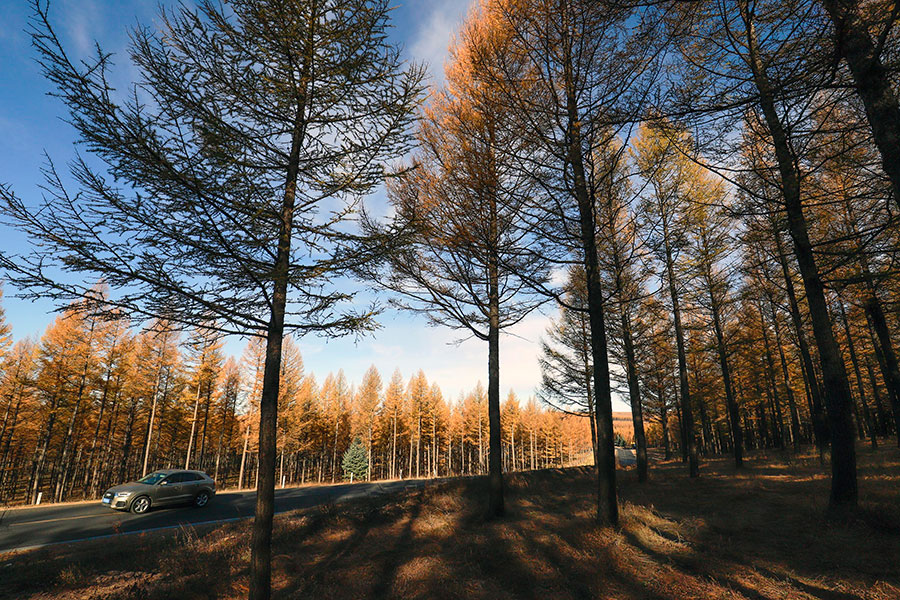
A lot of achievements have been made on the ecological transformation front over the past four decades. China faced the "Malthusian trap" when society was overwhelmingly agricultural in nature. The "Malthusian trap" refers to a condition when excess population stops growing because of shortage of food supply.
During the industrialization period, China confronted "environmental pollution, ecological bottom line and the upper limit of resources". It has eventually stepped into the third stage of ecological civilization in the new era that pursues harmony between human beings and nature.
Two factors made this transition possible. First, after farmers were freed from the land, ecological protection was strengthened, and the pressure the ecological environment had suffered was eased. And thanks to actions such as reconverting farmland to forests and grasslands, the ecological environment has been improved and almost restored to its natural state.
Second, setting the farmers free from the land facilitated the increase in productivity on a large scale.
The two factors were possible because of reform and opening-up. Without reform and opening-up, ecological environment management could not have been achieved. China's technological standard, which is synchronous with the international level, has also benefited from opening-up.
But we still face some problems in ecological environment management, especially in terms of resource constraint. For instance, although Beijing receives 120 million cubic meters of water every year through the South-North Water Transfer Project, it still suffers serious water shortage. In addition, Beijing's underground water table has been declining.
Some construction projects also affect ecological protection. For example, in a city such as Beijing that seriously lacks water, there are many golf courses and lawns that consume huge volumes of water.
These problems are the side effects of urbanization and industrialization. But it is urbanization that has set the farmers free from the land, which helped improve the ecological environment.
China faced the "Malthusian trap" in the 1960s and 1970s when there was a huge gap between production capacity and people's demands. With the intensifying urbanization drive, a huge number of farmers have shifted from rural areas, which has helped improve the natural ecology. Similar changes have been witnessed during the industrialization process, as the resource utilization ratio has continuously increased with urbanization and industrialization.
Innovation in technology, which has already made major breakthroughs, will further promote the ecological civilization construction. For instance, from incandescent light bulbs to fluorescent lamps, there has been a nine-fold increase in energy-saving efficiency. And coal-fired power generation has increased from 500 grams per kilowatt-hour to 270 grams per kilowatt-hour. But despite such innovations being progressive, they cannot be applied without consumption of energy, which causes pollution.
Theoretically, natural asset transformation has a ceiling effect, so do per capita material consumption and fixed asset stock. The GDP growth rates of Japan and European countries have remained low, at around 2 percent, over the past three to five decades because they have all become "saturated" economies.
As China approaches the "saturation" point, it would be ideal for it to maintain a GDP growth of about 6 percent. There is still enough room for a large-scale increase in demand and growth as China has 500-600 million of rural population. But this demand and growth would be released after technological efficiency is further improved.
We are on way to building a moderately well-off society in an all-round way by 2020, and achieving "socialist modernization" by 2035, in order to realize the goal of building an ecological civilization by the middle of the century.
The author is director of the Institute for Urban and Environmental Studies, the Chinese Academy of Social Sciences. This is an excerpt from his speech in December.





