China, Russia will explore moon water









Joint research aims to develop lunar and Martian programs in the future
Chinese and Russian scientists will work together to explore water and ice on the moon, according to a Russian scientist.
Vladimir Khmelyov, a professor at the Altai State Technical University, said on Tuesday that the ultrasonic drilling project has won financing from Russia's Fundamental Research Fund and China's National Natural Science Fund.
In this project, the scientists will explore and develop the physical principles of the ultrasonic drilling of extraterrestrial surfaces to discover water and ice, including on the far side of the moon and on Mars, which will help develop lunar and Martian research in the future, Russia's Tass News Agency reported.
"The project is designed for two years," said Khmelyov. "It relates to joint work: We will carry out preliminary research for the Chinese side to study the process of ultrasonic drilling."
The professor said the project means a lot for the exploration of underground water on the moon, because in the current missions, holes on the moon and Mars were drilled by ordinary, mechanical devices, which cause strong heat, and water and other volatile materials evaporate.
"Ultrasonic drilling is quite delicate and it should keep water and ice intact and will help us discover the presence of water on the moon or under the lunar surface," he said.
According to data from the Altai State Technical University's press office, scientists are planning to determine the optimal modes of ultrasound drilling to maximally preserve water and ice, which will ensure the authenticity of discovering the traces of water. The project will help develop the scientific basis for creating ultrasonic drilling instruments.
The Russian-Chinese research in this area is one of the prospects of developing the lunar and Marian programs: To find water so that a station can be built on the moon where humans can live, the researcher said.
Based on indirect explorations, it is assumed that water is located close to the surface of craters up to 10 kilometers deep on the reverse side of the moon. Ultrasonic equipment can be eventually installed on lunar and Martian rovers, Khmelyov said.
Khmelyov said the rapid development of China's aerospace industry and the success of the recent lunar mission attracts more international attention as well as cooperation.
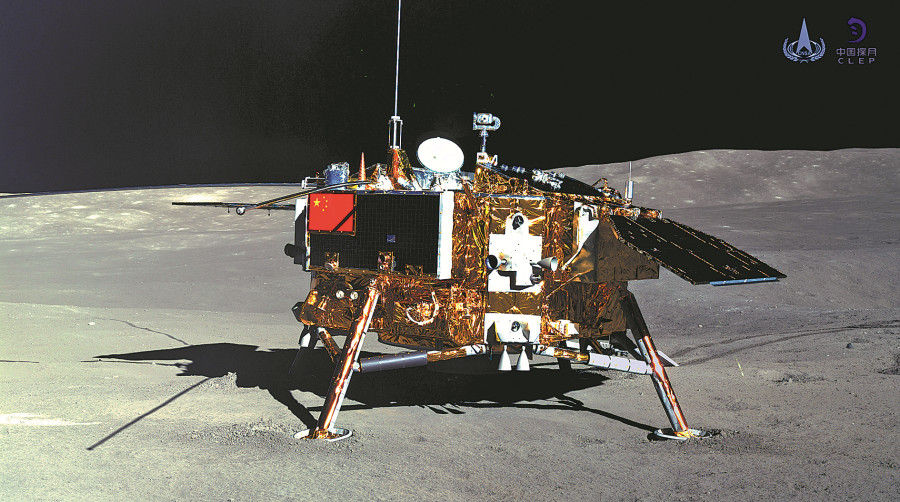
China's unmanned Chang'e 4 robotic spacecraft touched down in the South Pole-Aitken Basin, the far side of the moon on Jan 3.
The landing is being seen as a major milestone in space exploration. There have been numerous missions to the moon in recent years, but the vast majority have been to orbit, fly by or impact. The last crewed landing was Apollo 17 in 1972, according to the BBC.
Far-side touchdown
Previous moon missions have landed on the Earth-facing side, but Chang'e-4 mission was the first time any craft had landed successfully on the unexplored and rugged far side.
Li Guoping, the secretary-general of the China National Space Administration, said Russia is one of China's main partners in space cooperation, and "lunar studies are one of the guidelines in our cooperation", according to Sputnik news agency.
The two countries held annual meetings devoted to cooperation in space exploration, he added.
Both countries were pushing ahead with joint aerospace projects in accordance with China's program for 2018-22, Li said.
Khmelyov said so far no flights to the reverse side of the moon are planned by Russia.
"Therefore we appreciate, and were attracted by the landing plan on the far side of the moon so that we could start conducting preliminary research with China, and we are going to work jointly with a university in Harbin (of Heilongjiang province) which is participating in China's lunar program," the Russian researcher said.