



US reformulating its Middle East policy









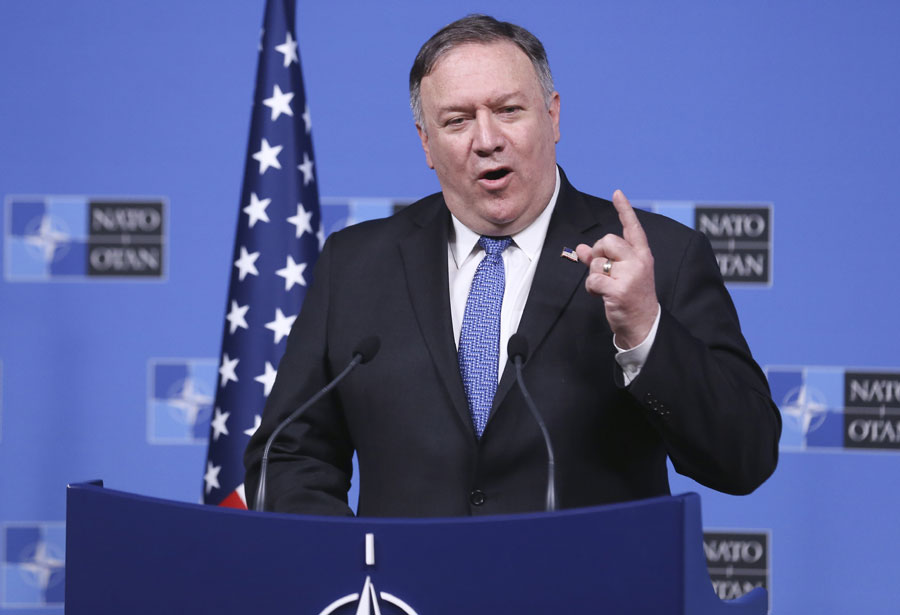
The United States does not want to be a regional policeman; instead, it wants a new alliance to play that role. To give shape to this alliance, US Secretary of State Mike Pompeo recently visited Jordan, Iraq, Egypt, Bahrain, the United Arab Emirates, Qatar, Saudi Arabia, and Oman, starting on Jan 8. Emphasizing the purpose of his visit, Pompeo said Washington is working to build a strategic alliance in the Middle East that would include the members of the Gulf Cooperation Council, as well as Egypt and Jordan.
Before that, on Dec 19, US President Donald Trump announced the withdrawal of troops from Syria, saying the US forces had achieved their goal of destroying the Islamic State group, leaving the US allies in the region perturbed, especially Saudi Arabia and the Kurds in Syria. He also gave the impression that the coming days would see an increase in Iranian-Russian influence in the region.
So Pompeo's visit to the Middle East was essentially an attempt to explain the dimensions of the new US policy and to reassure the US allies of its support.
US has new strategic view of Middle East
The importance of oil in the Middle East has been decreasing since the beginning of this century thanks to the discovery of shale oil. The US has become a leader in this fields.
Since the region is no longer as important to the US as before, Washington refuses to directly intervene even in critical situations such as those in Yemen and Libya, apart from deciding to withdraw its troops from Syria.
Washington believes it is capable of achieving its objectives in the region through its allies and without having any physical presence on the ground, as it no longer wants to bear the burden of resolving the conflicts in the Middle East.
US decision will have serious repercussions
But the fact is, the US' image has been damaged by Trump's decision to withdraw its 2,000-strong troops from Syria to the Iraqi border. The decision also prompted former US secretary of defense James Mattis to resign.
It has also increased concerns that Turkey would exploit the US troop withdrawal to attack Kurdish forces in Syria in an attempt to eliminate them. Syria and Russia, too, could exploit the withdrawal to take over the oil fields controlled by the US troops and earn substantial profits, which in turn could enable Russia to spread its influence throughout Syrian territory.
As for Iran, the withdrawal provide it with an opportunity to further expand its influence in Syria and link its forces in Iraq and Syria to those in Lebanon, and thus supply more weapons to Hezbollah in Lebanon posing a serious threat to both Saudi Arabia and Israel.
As a matter of fact, Pompeo said Iran dreams of controlling the region with the help of Hezbollah, which has amassed a big arsenal of weapons in Lebanon in flagrant violation of international law. But calling on all partner countries to continue working together to contain Iran's malicious activities and prevent them from spreading terrorism in the world, Pompeo said the US can hit any target inside Syria from the sea or air, which it has done previously, and therefore such fears should not be entertained.
Pompeo also said the US plans to hold a global summit focused on the Middle East, specifically Iran, in Poland next month.
Trying to keep allies away from Russia
Thanks to its constant support for Bashar al-Assad, Russia's image has improved compared with that of the US in terms of protecting allies, which can be attributed to the Trump administration's "America First" policy and reluctance to come to aid of US allies.
Russia's influence in the region has widened of late, because Saudi Arabia, Israel, Iran and Turkey all are trying to reach an understanding with it, and many other Arab countries want to deepen cooperation with it.
This has made the US worried, hence Pompeo's visit to reassure allies, especially Riyadh, Cairo and Amman, of Washington's support in order to keep them away from a rapprochement with Moscow.
The US believes, that by building a new strategic alliance between Saudi Arabia, Egypt, Jordan and Israel, it can help resolve the Palestinian issue as well as deal with the Iranian threat. Delivering a speech at the American University in Cairo on Jan 10, Pompeo said: "The Trump administration is also working to establish the Middle East strategic alliance to confront the region's most serious threats, and bolster energy and economic cooperation."
Egypt is important to the new alliance, as it has proven its seriousness in fighting the IS group in Sinai. Also, Egyptian-Israeli relations are at their best thanks to the security coordination between the two countries and Cairo's attempt to push for a final resolution to the Palestinian issue. That's why the US wants Egypt, along with Saudi Arabia, to play a bigger role in countering Iran's influence in the region.
Washington wants to end the divided Gulf nations
In fact, the US has brought harm to itself by failing to resolve the Gulf dispute earlier, which caused the situation to deteriorate. After highlighting the role of Kuwait as an important and effective mediator during the Gulf crisis, the US is now trying to use it to launch a new initiative to push for the resolution of the Gulf dispute. But there is no guarantee its attempt would succeed.
The US is also trying to bring Saudi Arabia and Egypt closer to Qatar and seek Kuwait's help to end the division in the Arab world, which does not suit the American project in the region. But the Gulf conflict cannot be resolved easily, given the many differences between Egypt and Saudi Arabia and Qatar. Also, thanks to Turkey's support, the impact of the boycott on Qatar has been limited.
The Trump administration will find it difficult to realize its new policy in the region, as the position of the forces on the ground, from Iraq and Yemen to Syria and Lebanon, favor Iran, and also because Pompeo's visit couldn't convince the people in the Middle East that the US would really build a new alliance.
The author is the first economics researcher at the Central Department for Export & Import Policy, Ministry of Foreign Trade and Industry of Egypt.





