



Policy support, strong demand fuel eye care sector boom









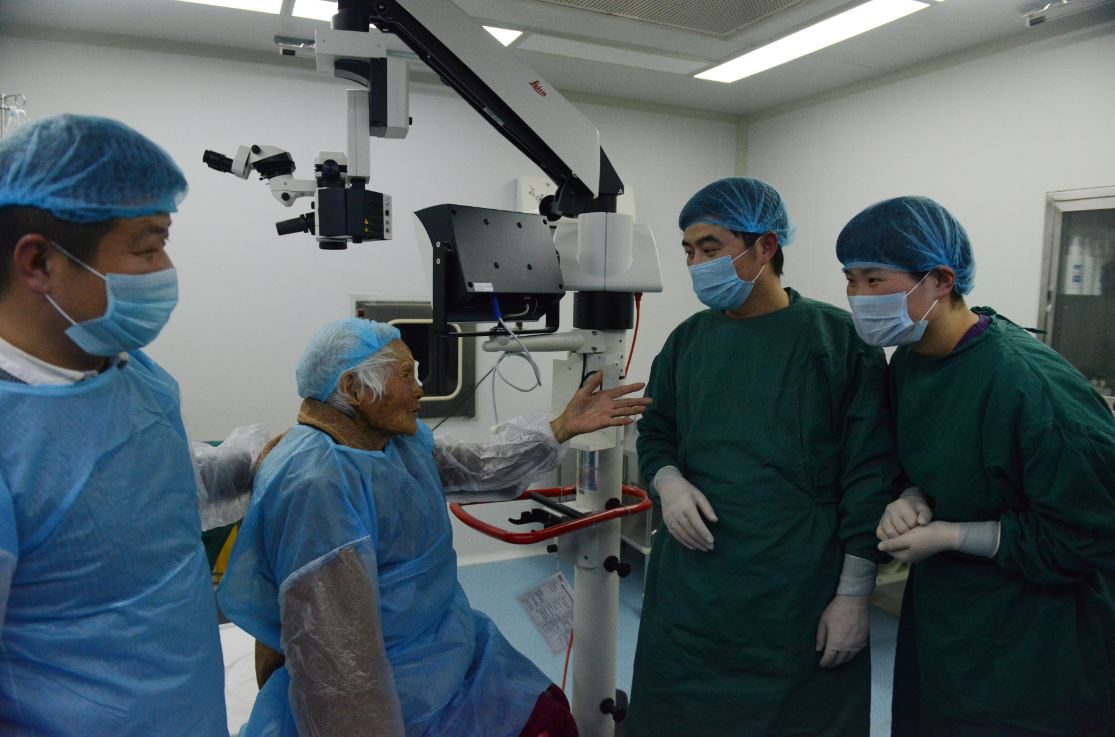
In 2015, Beijing resident Zhao Min had refractive surgery at Ming Shiguang, a private eye clinic, rather than a public hospital.
Three years later, the 39-year-old has never regretted the decision.
"I thought about going to a well known public hospital, but it was too difficult to make an appointment with a renowned doctor, and the air quality was also poor due to the huge number of patients gathered there, making me feel uncomfortable," she said.
"Besides, many of my friends have had such operations at private hospitals or clinics, and I chose Ming Shiguang because a renowned doctor practiced there."
Zhao and her friends are among the fast-growing number of Chinese patients who choose private eye care facilities over their public counterparts, fueling the growth of private eye care in China.
Guangdong province-based Askci Consulting estimated that the private eye care market in China will reach 32.8 billion yuan ($4.86 billion) in 2021, having an annual compound growth rate of 18.4 percent from 2016 to 2021, while the rate for public eye care will be 13 percent.
Its report showed that the size of the private eye care market in China increased from 6.4 billion yuan in 2012 to 14.1 billion yuan in 2016, with an annual compound growth rate of 21.7 percent, while the size of the public eye care market was 39.7 billion yuan in 2012 and 68.6 billion yuan in 2016 respectively, with an annual compound growth rate of 14.6 percent.
Healthcare Report, a think tank under China's leading medical information website Yxj.org.cn, said investors are becoming increasingly interested in the sector.
In 2018, mergers and acquisitions took place in 48 hospitals in China, in deals worth 7.76 billion yuan, and 56 percent of them were specialist hospitals, of which private eye care hospitals took up 53.8 percent, according to the think tank.
Aier Eye Hospital Group Co Ltd, China's largest private eye care hospital chain, recently announced that its revenue in the first three quarters of 2018 totaled 6.12 billion yuan, up 39.75 percent year-on-year.
Zhou Yuehua, one of the most acclaimed eye surgeons in China, who operated on Zhao at Ming Shiguang, said that private eye care was developing very fast and was increasingly helpful to patients.
He recently left Beijing Tongren Hospital, a leading public hospital where he worked for more than 20 years, to work full time in private hospitals.
Zhang Haozhi, vice-president of Huaxia Eye Hospital Group Co Ltd, China's second largest private eye care hospital chain with about 60 hospitals, said the company's hospitals had more than 4 million patient visits and performed more than 300,000 operations in 2018.
"Supportive government policies, strong demand for eye care, and the fact that eye care is undervalued as a medical division in public hospitals all contributed to the fast development of private eye care in China," he said.
The government has issued a series of policies and documents that facilitate private healthcare in recent years, which now is recognized as an "important part" of the healthcare system, while in the past private healthcare was merely considered a "supplement" to public healthcare services, according to Zhang.
The development of private eye care is assured as reforms to the registration system allow doctors to practice freely in different hospitals and regions, simplified administrative procedures make it less time-consuming to establish a private medical facility, and private eye care services are increasingly covered by public medical insurance programs, he said.
Besides, eye care usually is a small department in a public general hospital, lacking financial support, yet it needs large sums of money to develop, due to the high cost of equipment and doctor training. As a result, when private capital is introduced, there is little resistance from the public hospital system, according to Zhang.
That is also an important reason why many established doctors are leaving public hospitals for the private eye care sector, he said.
Public eye care services are particularly weak in small cities and rural areas, but as living standards and life expectancy rise, the demand grows quickly and provides opportunities for private facilities to develop, he added.
Zhao Heng, founder of consulting company Latitude Health, said that short supply of specialists remains a major obstacle to the expansion of private eye care.




















