



Italy's embrace of BRI called 'sensible move'









Experts also call on USto 'lend a hand' rather than stand back on China's Belt and Road Initiative
Italy's decision to join the China-proposed Belt and Road Initiative is a sensible move that will help boost its economy, and for the BRI projects, the United States would do "better to lend a hand than stand back and criticize", several American researchers have said.
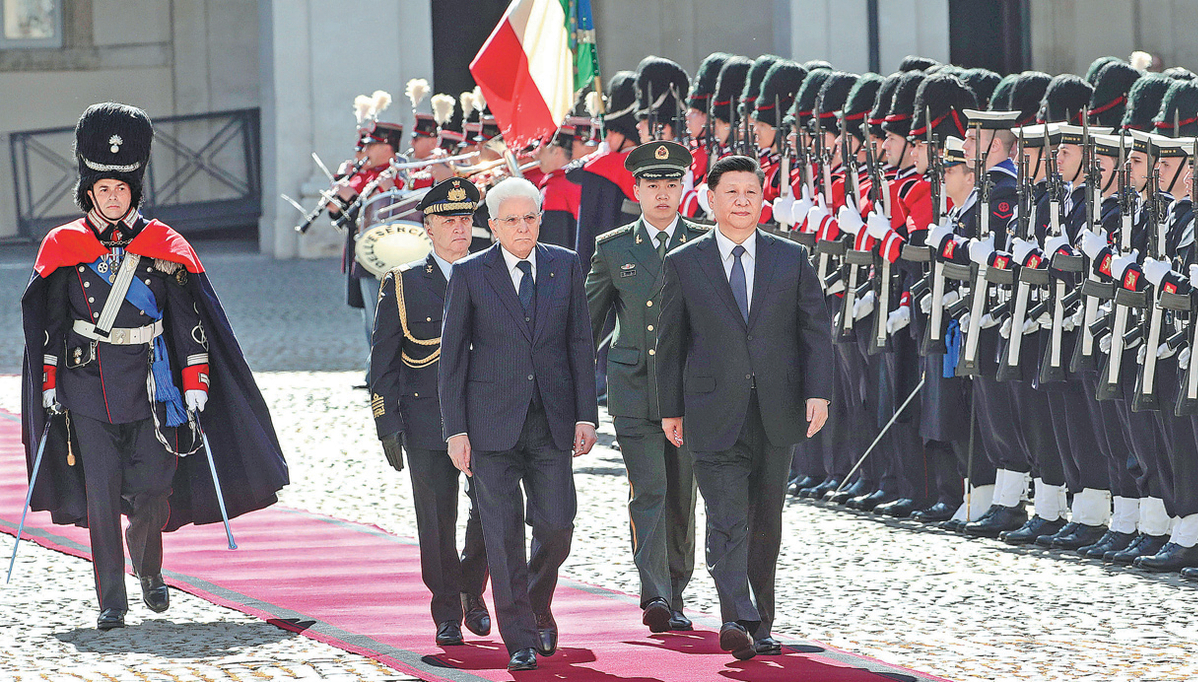
With the signing of a memorandum of understanding on BRI cooperation Saturday during Chinese President Xi Jinping's visit to Rome, Italy became the first member of the Group of Seven major developed economies to formally join the Belt and Road Initiative.
Italy's decision was based on practical economics, as its economy has lagged its G7 counterparts, particularly European neighbors Germany, France and the United Kingdom, according to Jon Taylor, a professor of political science of the University of St. Thomas in Houston, Texas.
"Simply put, the decision to join the BRI was too great of an opportunity for Italy to pass up," Taylor told China Daily on Monday.
A meaningful benefit to joining the BRI will be an effort to improve trade connectivity between Italy and China, primarily by investing in the ports of Genoa, Palermo, Trieste and Ravenna, according to Taylor.
During their talks on Saturday, President Xi told Italian Prime Minister Giuseppe Conte that China and Italy were at the two ends of the ancient Silk Road, thus they have every reason to carry out cooperation on the Belt and Road.
Conte said that with a special geographical advantage in building connectivity, Italy is glad to seize the historic opportunity in joining the Belt and Road construction.
"It was a sensible move designed to foster relations between Beijing and Rome," said Gary Hufbauer, a senior fellow and trade expert at the Peterson Institute for International Economics in Washington.
The Belt and Road Initiative, referring to the Silk Road Economic Belt and the 21st Century Maritime Silk Road, was first proposed by President Xi in 2013 to build a trade and infrastructure network connecting Asia with Europe, Africa and beyond.
At least 150 countries and international organizations, including some European countries like Greece and Hungary, have signed BRI deals with China.
While China's Foreign Minister Wang Yi said the BRI is an "economic pie" that benefits the local people rather than a "debt trap", the White House National Security Council tweeted on March 9 that "endorsing BRI lends legitimacy to China's predatory approach to investment and will bring no benefits to the Italian people".
Hufbauer said he disagreed with the White House tweet. He suggested China work to "release all the details of the terms with its borrowers".
Douglas H. Paal, vice-president of the Asia Program at the Carnegie Endowment for International Peace, another think tank in Washington, said the BRI is "still a work in progress".
"The Trump administration overstates the record and the outlook for the future of BRI, but they overstate and distort just about everything, so this is not special, just unfortunate," Paal said.
While the US is not ready to join the BRI, its experience, plus financial and environmental services, should be "readily available" to advise and support BRI projects, Paal said.
"Better to lend (or rent) a hand than stand back and criticize," he said, adding that the world needs infrastructure, and it does not become the US to stand in its way if China is working to improve the connectivity with improved "standards of implementation".
Taylor also said that if the US were thinking strategically, it would be willing, at a minimum, to be pragmatic and broadminded about the BRI.
"Since the US has failed to slow down or impede the BRI, why not 'flip the script' and offer to work with BRI participants to broaden global economic development efforts and improve the lives of millions of people?" he said.
Susan Shirk, chair of the 21st Century China Center at the University of California, San Diego, said the Belt and Road Initiative could be a real way of building many friends for China.
"Now everybody needs more infrastructure," Shirk said in a speech "Overreach and Overreaction: The Crisis in US-China Relations" at the University of Pennsylvania on Jan 31.
"I'd much rather have China and the United States competing to see who can be more helpful to countries in Africa or Latin America than building up their militaries and preparing to fight one another," she said.










