



Multilateral talks help DPRK denuclearization









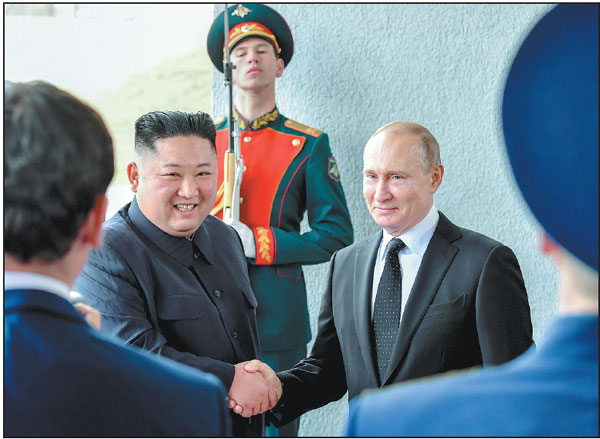
Kim Jong-un, leader of the Democratic People's Republic of Korea, had a one-to-one meeting with Russian President Vladimir Putin in Vladivostok on April 25, after which a high-level meeting between the DPRK's delegation and Russian officials was held. The two countries said the meeting was substantial for bilateral cooperation and peace on the Korean Peninsula. Will they realize the goals when both are under international sanctions? Three experts shared their views with China Daily's Pan Yixuan. Excerpts follow:
Denuclearization needs multilateral talks
Kim's trip is a friendly visit to review the traditional friendship with Russia as a part of the DPRK's series of neighborhood diplomacy that started last year.
Russia is an important historical friend of the DPRK and they presently have much common in bilateral and regional development, such as in a need to expand economic cooperation and diplomatic communication when both are under international sanctions led by the United States. The DPRK farm labor can help Russia to develop its Far East and the DPRK needs Russia to help reinforce its security after the second DPRK-US summit broke down in late February and Washington adhered to tough stances on Pyongyang's complete denuclearization.
The DPRK talking with Russia is a way to bargain with the US before the third US-DPRK summit they still hope to realize. And Russia grasped this chance to remind its role in regional issues when the DPRK turns to it.
Pyongyang maintains the will to talk with Washington for it has not broken its promise with the US that to cease tests of nuclear weapons and mid-term and long-term missiles, showing respect to US President Donald Trump, though after the second Trump-Kim summit, it tried to impose pressure on Washington by restarting missile tests and asked the US to remove US State Secretary Mike Pompeo from the negotiation team.
But as the nuclear issue plays a major role in the DPRK, the US and the DPRK have insisted on their own conditions so that substantial agreements can be reached.
Russia reiterated the Six-Party Talks where more countries involved can mediate and promote compromises between Pyongyang and Washington so that the two countries can advance their talks for some results. Besides, only with multilateral negotiation can the results guarantee the interests of neighboring countries. The breakdown of the second US-DPRK summit raised the possibility of the restart of Six-Party Talks.
Ba Dianjun, head of the Institute of International Politics at and deputy director of the Northeast Asia Research Center of Jilin University
Four-party talks and Six-Party talks both important
Although cooperation in economy, security and other fields can hardly be fully realized against both countries are under strict sanctions, the summit between the DPRK and Russia was important for the Peninsula denuclearization.
Russia conveyed Pyongyang's requirement for security guarantee, which may be a way to make Washington treat Pyongyang more fairly and the problem should be solved in a way that balances and respects all parts' interests.
Washington and Pyongyang seek different goals in the nuclear disputes as Washington wants the DPRK's complete denuclearization while Pyongyang wants a peace mechanism of the Korean Peninsula. Both goals require a first step should be whether the US easing sanctions against Pyongyang or the DPRK makes concrete efforts of complete denuclearization such as allowing supervision of its nuclear sites and a nuclear list.
Such a parallel approach was proposed in 2015 by China but Pyongyang and Washington remained at a standstill that which country should take the first step.
In this circumstance, multilateral mechanisms are significant for a solution, not only Six-Party Talks whose goal is to promote the DPRK to denuclearize, but also four-party talks aiming to promote peace restoration on the Korean Peninsula made up of the US, the DPRK, the Republic of Korea and China. The two mechanism are complimentary with each other.
All parties' concerns need attention and discussion. The US and the DPRK still have a strong will to reach achievements on Peninsula denuclearization. Russia, China, and Japan have shown concerns on the issue vital for the development of Northeast Asia, letting that the ROK has taken a rather active role to mediate between Washington and Pyongyang. The room for multilateral talks' resumption has been enlarging.
Wang Junsheng, an international relations expert at the National Institute of International Strategy, the Chinese Academy of Social Sciences
US still the key in Peninsula issue
To some extent, relations with other countries cannot impact Russia-DPRK traditional relations too much. The two countries are complementary in economic structure especially in Russia's Far East development that the DPRK can obtain foreign exchange through DPRK laborers working there who meet Russia's needs for labor forces.
But Moscow and Pyongyang's agreement on bilateral cooperation for co-development will be restricted by international sanctions. It is hard to say how much will regional development advance when tensions over the DPRK nuclear get relieved.
The peace restoration on the Korean Peninsula is a long-term structural problem intertwined with Korean reunion so it will take a lot of time to be resolved.
Therefore, the problems currently lie in denuclearization disputes where progress stalled because Washington has charged a high price from Pyongyang.
The denuclearization game will continue with great uncertainties since Washington has announced a deadline for potentials third Kim-Trump summit within 2019. Meanwhile, the DPRK is willing to continue talks and played pressure tactics including a missile test and unclear moves in nuclear sites.
One thing for sure is the address of the denuclearization issue must involve other countries' joint efforts, and patient cooperation and negotiation. Some of these countries participated the signing of the Korean War Armistice Agreement, and joint efforts can guarantee better implementation of later agreements. More countries must involve the process on the basis that Washington and Pyongyang can reach an agreement and establish mutual trust in advance.
However, the Six-Party talks were abandoned for about a decade and Washington and Pyongyang are so insist on their requirements that it is uncertain for multilateral talks to resume.
Yang Mian, a professor at the Institute of International Relations, Communication University of China
The views don’t necessarily represent that of China Daily.





