



US ports prepare for trade war storm









Schinfeld said he was particularly concerned about farmers from Eastern Washington, some of whom grow cherries for a living.
"This is their livelihood, and many of these crops don't have a long shelf life. For example, you can't put cherries in a refrigerator and keep them for six months until the tariffs are gone. These are crops that will perish," he added.
"You really worry that they (the farmers) will not be able to make it through. They won't be able to survive the tariffs even if they are removed in six months. They make all of their money for the year in the few months when crops are grown and harvested," Schinfeld added.
There is also the long-term effect on future business opportunities for farmers and producers.
"If people can't buy US cherries because they are too expensive, they will buy cherries from Europe instead. When the tariffs have gone, long-term contracts will have been signed with Europe instead of the US, and those customers don't necessarily come back right away," Schinfeld said.
China, the US' third-largest trading partner, represents 13.1 percent of its total foreign trade so far this year, the US Census Bureau reported.
According to the United States Trade Representative Office, China is the US' largest goods trading partner, with total two-way trade last year reaching $659.8 billion.
Some port executives fear the trade war will further exacerbate an ongoing trade imbalance between the US and China and pose additional challenges to supply chains at ports around the US.
Sanfield, the Port of Los Angeles media relations director, said: "These tariffs have created uncertainty in the global market. What we saw last year at the Port of Los Angeles was an increase in imports, and a decrease in exports. In terms of trade with China, imports were up 9 percent last year, while exports were down by nearly 20 percent, and that's also the case for the first quarter as well."
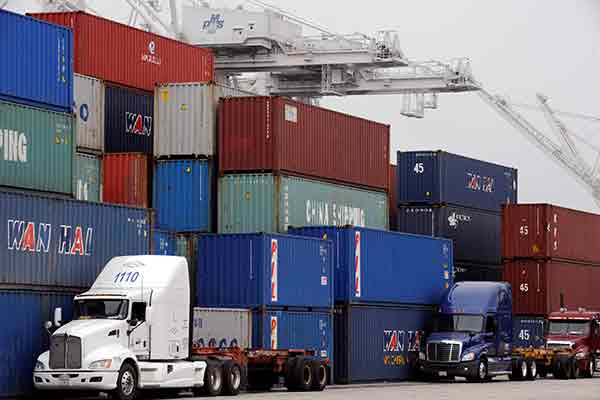
The top five imports at the Port of Los Angeles are furniture, auto parts, clothing, footwear and electronics. The top five US exports are waste paper, pet food, scrap metal, fabrics and soybeans.
According to the US-China Economic and Security Review Commission, US exports to China fell by 18.8 percent year-on-year in the first quarter. The country's exports to China reached $25.99 billion in value in the first quarter, a $6 billion drop compared with the same period last year.
Schinfeld said the impact of the fall in exports had also spilled over to income and employment opportunities for domestic shippers and farmers.
While imports continue to rise at the Port of Seattle, in part due to a strong US economy and demand from consumers, which have compensated for rising import costs, exports have fallen significantly.
Schinfeld said: "Whether you are talking about soybeans, seafood, dairy products, apples or cherries ...the numbers are down. We are definitely concerned that the impact of the retaliatory tariffs - those that China has placed on US exports - are having a strong effect on some of our local producers, manufacturers and exporters."
As the threat of a US-China trade war loomed last year, producers rushed to get their items shipped before the tariffs took effect, contributing to the surge in imports.
But this year, O'Connell fears that producers will have a shorter window in which to move their products, compared with last year, because the US is becoming impatient.
He said there are two considerations regarding the decision to impose tariffs. One is the trade conflict with China, the second is the plan to increase manufacturing jobs in the US.
By imposing tariffs, which makes it economically difficult for companies to import goods to the US, the country's authorities hope to attract more businesses to manufacture their goods, O'Connell said.
As a result, he said the trade war will probably last for a while, at least until the election next year.
"There is every indication that Beijing is digging its heels in, and is not going to be bullied into an agreement. Right now, there doesn't seem to be much immediate hope for a resolution," he said.
But despite the escalation in tension and the pessimistic views of some observers, some port executives are still hopeful about the prospects for US-China trade.
Cordero, the Port of Long Beach executive director, said: "I remain optimistic that the two countries will resolve their differences, because no one wins in a trade war, and everybody wins with a resolution of the issues that the two countries have reported."



















