



New opportunity to restore peace on peninsula









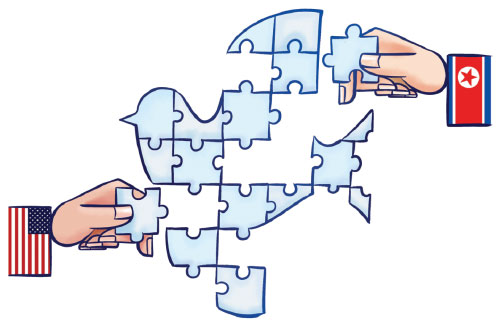
The meeting between US President Donald Trump and Democratic People's Republic of Korea top leader Kim Jong-un on June 30 has helped resume the talks to denuclearize the Korean Peninsula.
Still, hindrances to a smooth denuclearization process remain. The DPRK has become economically and politically more stable, and its consumer goods prices and currency exchange rate in terms of the US dollar have been relatively stable. In fact, contrary to inflation forecasts, consumer goods prices have even declined in the DPRK. But the DPRK's foreign trade has suffered severely due to the UN sanctions.
Pyongyang has built a stable political foundation that will help boost its economic development. And Kim has reformed the economic management structure by appointing many highly qualified professional officials in different positions, who have brought foreign experience and a profound understanding of the global situation to their work.
However, despite Washington and Pyongyang starting the peace talks last year, the denuclearization process has not proceeded as expected. Yet it is necessary to continue the talks, instead of imposing more sanctions on the DPRK, because the DPRK is genuinely working to get the United Nations sanctions lifted. For instance, even when the situation on the peninsula became volatile after the failed second Trump-Kim summit in February and there were increasing calls to impose stricter sanctions on the DPRK, it exercised restraint and created room for the resumption of the talks.
At the February summit, Washington demanded that Pyongyang conduct complete and verifiable denuclearization before January 2021, while Pyongyang insisted on phased denuclearization in return for easing of sanctions and security guarantee from the US. After the talks failed, Pyongyang reportedly rebuilt a missile launch base while the Republic of Korea, the principal mediator between the US and the DPRK, was busy addressing internal and external issues.
But thanks to the efforts of all sides, the third Trump-Kim summit has created a new opportunity for the denuclearization of the peninsula.
Three factors have influenced (and will continue to influence) the situation on the peninsula. The first is the DPRK economy. The country has shifted from planned economy and developed a more adaptive socialist economy, as Kim has prioritized economic development over the nuclear program, and reformed the country's agricultural and industrial systems while giving more importance to the role of the market.
Thanks to these developments, the DPRK can now better cope with external economic pressures. To some extent, sanctions have helped bring Pyongyang back to the negotiations table, but continuing to put pressure on it could force it back into isolation and develop nuclear weapons to safeguard its security.
Second, the presidential elections in the US and the ROK could change the situation. The denuclearization talks started because of the meeting between Trump and Kim, as well as the efforts of ROK President Moon Jae-in. But the presidential elections could see new leaders taking office in both Washington and Seoul and a subsequent change in their policies toward Pyongyang, which has been Kim's major concern. Only if the new US and ROK administrations continue the peace talks can the denuclearization process advance.
And third, since both China and Russia are stakeholders in the peninsula issue, denuclearization cannot be complete without their participation. In fact, their efforts and mediation have played a key role in maintaining peace on the peninsula.
The denuclearization of the Korean Peninsula is a complicated issue that will take time and multilateral contributions to resolve. The third Trump-Kim summit has created a new opportunity for the denuclearization process, so all stakeholders should make efforts to promote long-term dialogue to advance the peace process.
The author is a researcher at the Northeast Asia Studies Institute, Jilin Academy of Social Sciences.
The views don't necessarily represent those of China Daily.





