



China to EU, the US tariff game continues









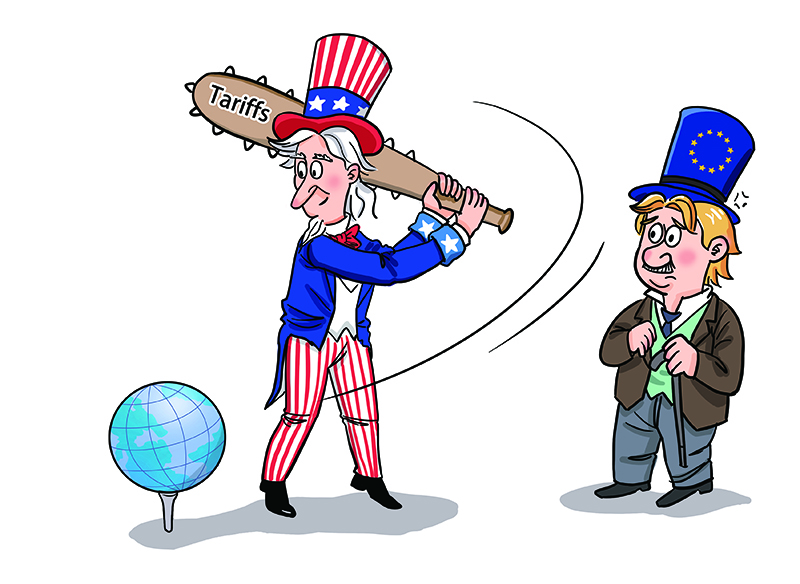
With the Office of the United States Trade Representative threatening to impose new tariffs on $4 billion worth of European Union goods, the trade conflict between the US and the EU has intensified. And if the US makes good the threat it issued on July 1, the additional tariffs would cover $25 billion of EU goods-in April the US had decided to impose additional tariffs on $21 billion of EU products. In addition, the US administration launched a Section 301 investigation against the digital service tax of France on July 10.
Washington's move seems to have roots in the 15-year-old dispute over the subsidies given to Boeing by the US and to Airbus by the EU. The US is using tariffs to exert pressure on the EU to reduce subsidies to Airbus so Boeing can maintain its competitiveness in the global market and the jobs in the US plane manufacturing industry could be protected.
The US is wielding tariff as weapon also to increase its bargaining chips in the negotiations over "three zeros"-zero tariff, zero tariff barriers and zero subsidy-for non-auto industrial products.
Since the US and the EU have wide differences over auto and agricultural products, the negotiations remain mired in uncertainty, although Washington compelled Brussels to continue the talks by threatening to impose fresh tariffs on EU goods in April.
As US President Donald Trump prepares to launch his re-election campaign, he is trying to mitigate US farmers' sufferings, as the votes from the agricultural belts helped him win the 2016 presidential election. The US administration has provided numerous subsidies for farmers to help offset their losses due to the US' trade disputes with China, the EU and other economies, but subsidies alone cannot solve the farmers' problems. So Washington has put some EU agricultural products on the tariff list in an effort to protect its agricultural products market.
However, the fact that the EU has agreed to resume negotiations on subsidies to the plane manufacturing industry does not mean it will not take countermeasures if the US does impose more tariffs on EU goods. In April, when the US levied additional tariffs on $21 billion of EU goods, Brussels responded by imposing tariffs on€20 billion ($22.43 billion) of US products.
But despite the tit-for-tat actions and the sapping of mutual trust, the two sides seem to be exercising restraint, perhaps because they don't want the situation to worsen and develop into a full-fledged trade war. Which makes perfect economic sense given that the US doesn't seem very confident about the growth of domestic consumption and investment, and the EU still faces sluggish growth while global economic prospects remain relatively uncertain thanks, to a large extent, to rising trade protectionism and unilateralism.
Since the US and the EU are very influential economies, the trade conflict between them would seriously harm global trade and investment. The tariff threats and counter-threats would lower the confidence of enterprises and consumers, prompting the enterprises to wait for the situation to improve before investing in projects.
It is possible that the tariff threat could help the US settle the subsidy dispute with the EU, not least because the two sides hope to resolve the issue under the supervision of the World Trade Organization. In fact, the WTO can help standardize the subsidy for the plane manufacturers and set competition criteria for the industry.
By levying excessive tariffs on imports, the US is harming not only other economies but also its own economy. For example, the US has imposed punitive tariffs on Chinese, Canadian, Mexican and EU goods in the hope of reducing its trade deficits with these economies. But these economies' countermeasures have dealt a blow to the US economy. Besides, the US' unilateral actions have also soured its relations with its traditional allies in Europe.
The US administration is likely to continue using protectionist policies and wielding tariffs as a weapon to get the upper hand in trade negotiations with other economies. And the threat of tariffs could compel the other economies to yield to some of the US' demands in the short term, but in the long run the tariffs will come back to haunt the US and take a serious toll on US taxpayers and consumers.
Bai Jie is an associate professor at the School of Economics, Shandong University of Finance and Economics, and Dong Yan is a researcher at the Institute of World Economics and Politics, Chinese Academy of Social Sciences. The views don't necessarily reflect those of China Daily.





