



Politics behind Japan's commercial whaling









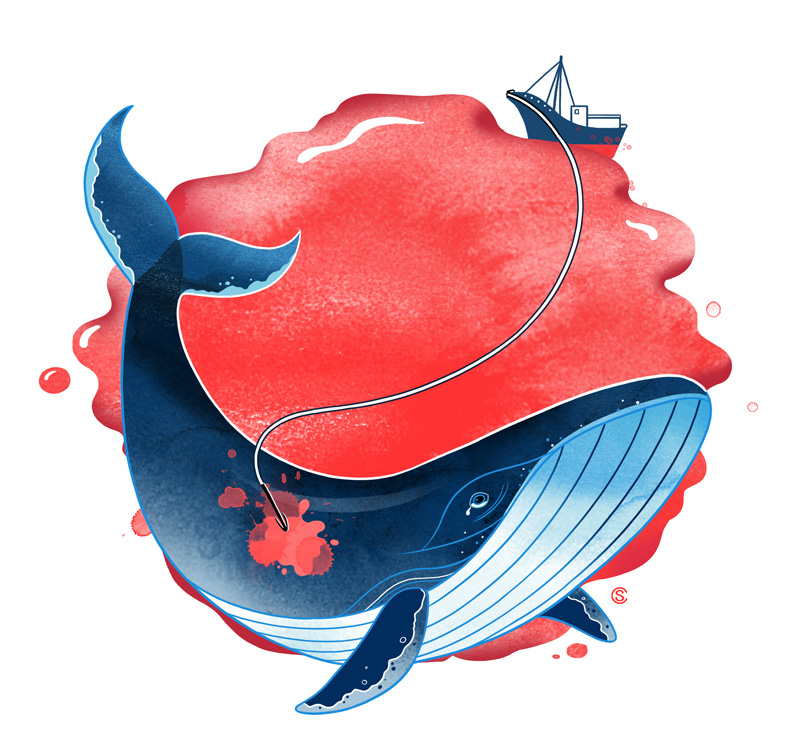
Editor's Note: Japan resumed commercial whaling on July 1, the very next day its membership to the International Whaling Committee expired and six months after its withdrawal from the organization. Why does Japan ignore the international community's opposition to commercial whaling? And what will be the impact of its move on the marine environment? Two experts share their views on the issue with China Daily's Liu Jianna. Excerpts follow:
Whaling will damage the marine ecology
Despite dating back to 875, Japan's whaling industry has very few takers today. Still, several factors have contributed to Japan's seemingly baffling obsession with whaling.
First, US President Donald Trump's decision to pull out of a dozen or so international agreements and organizations seems to have given a license to Prime Minister Shinzo Abe's administration to flout international rules, especially because Japan is the most loyal US ally in the Asia-Pacific region. Realizing that the US' withdrawal from multiple global accords and organizations, including the United Nations Educational, Scientific and Cultural Organization and Universal Postal Union, has not caused it any visible harm, the Abe administration was emboldened to follow the US' example and pull out of the IWC.
Second, the Japanese government has tried to prove whaling is part of its tradition and food culture since whale meat used to be an important source of nutrition when food was in short supply.
And third, the Abe administration encouraged the whaling industry in the hope that it would help it win the votes of fishermen and other people involved in the whaling industry in Sunday's election to the upper house, so it could secure a two-thirds majority in the upper house, which it needed to try and amend the country's pacifist Constitution and have a regular military.
Yet contrary to some Japanese fishermen's belief that whales are giant pests because even some medium-sized whales could devour one to two tons of fish and crustaceans per day, marine researchers found that whales are not responsible for the depletion of fish stocks in the ocean. Instead, they promote the development of the ocean food chain.
Therefore, by resuming commercial whaling, Japan will harm the marine ecology even though it claims to have set a bar on whaling.
Given that the corpse of a large whale is a sort of habitation cluster for marine life and helps sustain the marine food chain, the damage the killing of whales would cause to the ocean ecology could be much more than imagined.
Zhou Yongsheng, a professor at and deputy director of Japanese Studies Center, China Foreign Affairs University
Vested interests behind decision
The whaling industry in Japan may have hundreds of years of history, but large-scale whaling was prevalent only between 1940 and 1960 because of the drastic rise in the demand for protein. The market for whale meat began shrinking around 1965 as the Japanese economy recovered from the effects of World War II, with per capita consumption of whale meat dropping to 30-40 grams in 2015. The output of and market for whale oil also fell sharply.
Also, a Greenpeace investigation found that Japan dumps huge amounts of whale meat into the sea sometimes. As such, the claim that Japan has restarted commercial whaling to protect its tradition and food culture does not hold water.
Given the support for whaling within the ruling Liberal Democratic Party and the demand of hundreds of officials in the whaling-related departments, the Abe administration adopted a pro-whaling stance to garner the votes of those in favor of whaling in Sunday's election to the upper house. Not to mention that Abe comes from Shimonoseki, the base of Japan's whaling expeditions.
Moreover, the Institute of Cetacean Research, which gets government subsidy of about 1 billion yen ($9.27 million) per year, has become the regular host for retirees from Japan's Fisheries Agency. So a circle of vested interests backing whaling has been established in Japan's political field.
But if Japan restricts commercial whaling within a certain limit, the impact of commercial whaling could be limited. Nevertheless, the international community, including NGOs such as Greenpeace and World Wide Fund for Nature, should continuously monitor Japan's commercial whaling to ensure the sustainability of marine ecology.
Zhou Weisheng, a professor at College of Policy Science, Ritsumeikan University and director of Research Institute of Global 3E
The views don't necessarily represent those of China Daily.





