China's contributions to global health considerable









For most of the 19th and much of the 20th century, China was called, "the sick man of Asia". But those days are over. As President Xi Jinping observed, "China has bid farewell to the problems that plagued its people for thousands of years, including hunger, shortages and poverty." In a matter of decades, China has successfully transformed itself from a closed and relatively backward country into a global economic and political power.
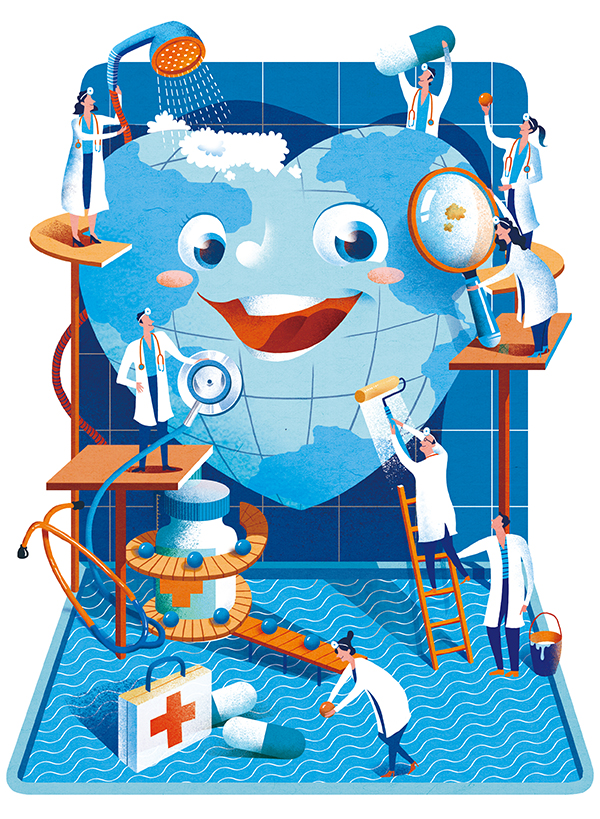
China's ascendency is generating some questions. One question centers on the country's role in global health. This is because China is making rapid progress in all four primary domains of global health-h(huán)ealth aid, health security, health governance and health information exchange.
China's health aid was launched in 1963 when its first medical teams were dispatched to Algeria. Today, Beijing has medical teams in more than 40 African countries and dozens of others posted elsewhere around the global South. Employing a project approach, the largest share of China's health assistance is spent on medical teams and donated facilities. A small number of foreign critics allege that Beijing uses such aid to prop up "authoritarian regimes".
However, a group of more than 100 researchers at major universities located in the United States and Europe teamed up to shed some light on the matter. The so-called "AidData Project" found that China's health assistance "does not discriminate based on the recipient countries' governance". It also concluded that, contrary to popular misperception, Chinese aid is not inferior to Western aid. Yet another reputable study punctured the myth that China channels its aid preferentially to resource-rich countries.
In the past decades, the world has confronted periodic crises generated by infectious disease. As President Xi observed, these pandemics have "sounded the alarm for international health security". Each has cost countless lives and billions of US dollars to combat. Given the situation, China has invested in various initiatives designed to detect emerging health threats early, develop and stockpile vaccines and drugs, and establish more robust health systems to deliver preventive tools and cures.
The basic idea is to get out ahead of new health threats before they become global disasters. Disease control and international cooperation is accelerating to unprecedented levels. Especially noteworthy is China's partnership with the World Health Organization to strengthen health security along the Silk Road Economic Belt and the 21st Century Maritime Silk Road. And its response to the 2014-15 Ebola epidemic in Africa drew praise from WHO. Some also find it significant that China has bolstered domestic, regional and global health security by addressing commodity and food safety issues and aggressively tackling its problems with air pollution.
Since the early 2000s, China has played a more active role in global health governance. The country participates in all of the United Nations' specialized bodies relating to health-including WHO, UNICEF, UNFPA, UNAIDS-and other multilateral health forums.
Moreover, as discussed in the government's 2017 White Paper on Public Health, China is now energetically, "taking part in the formulation of international medical and health rules". In recent years, China has attended and/or hosted numerous regional and global summits in an effort to boost cooperation and combat disease. Many focus on using the Belt and Road Initiative to improve global health. And often overlooked are Beijing's efforts to establish international standards on products related to global health such as food additives and pesticide residues.
With respect to health information exchange, China has much to share with the world-particularly knowledge about its spectacular health care accomplishments. For example, more than 95 percent of China's population now enjoys basic health care coverage. And life expectancy has climbed to 76.7 years compared with 35 years in the 1940s.
China's successes in controlling tropical disease, reducing infant mortality, containing malaria and schistosomiasis, and battling deadly infectious diseases (particularly tuberculosis) are truly remarkable and deserving of study as valuable lessons for the global community. Not surprisingly, Chinese universities are accelerating research in health policy and expanding cooperative programs with foreign universities.
Unfortunately, however, some cooperative programs in the US have fallen victim to the "anti-China hysteria" that has swept parts of Washington. Medical programs at prestigious institutions ranging from the M.D. Anderson Cancer Center to Johns Hopkins University-h(huán)ave been pressured by the US National Institute for Health to scuttle exchange programs.
In sum, five decades after China launched a modest health assistance initiative in Algeria, it has made rapid progress in each domain of global health. In many respects, the country has followed its own distinctive approach in each area. Understandably, this practice confuses and confounds some foreign observers. But one fact is perfectly clear. Namely, observers should anticipate that in the future China will play an increasingly important role in shaping the contours of global health. As Tedros Adhanom Ghebreyesus, director-general of WHO, observed, this is good news because "we can all learn something from China".
The author is a distinguished professor and the James F. Morris endowed professor of Political Science at Missouri State University. The views expressed in this article are the author's own and do not necessarily reflect those of Missouri State University, the state of Missouri, the US government or China Daily.