



Yuan depreciation is market's response









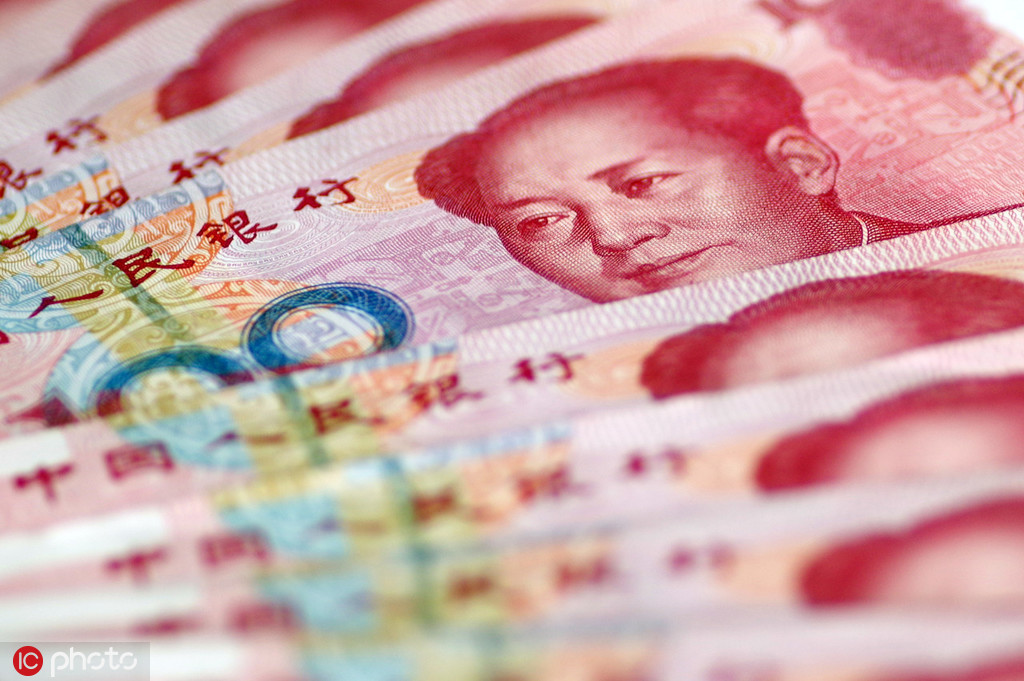
The yuan weakened beyond 7 per US dollar on Monday for first time since 2008 driven by market forces and escalating Sino-US trade conflicts. But the yuan does not have much room for further depreciation, because the fundamentals of China's economy are good, the yuan's value is basically stable and China's foreign exchange reserves are high.
As such, there is no need to over-interpret the yuan's depreciation. What's important is to find a way to properly deal with China's foreign exchange reserves, although fluctuations in the exchange rate are conducive to hedging the risk of a possible decline in exports and rise in unemployment.
The fact is not that China is unable to keep the yuan exchange rate below 7 against the dollar, but that it doesn't have to do so. Since China is committed to market-oriented reform of the yuan's exchange rate, it should not be so sensitive about whether its currency's value is below or above 7 per dollar. To a large extent, seven has more of a psychological than real meaning in terms of the yuan's value vis-à-vis the dollar. Even if the yuan has weakened beyond 7 per dollar, it doesn't mean a drastic fall in China's economic fundamentals.
The yuan's exchange rate against the dollar was beyond 7 for a long time. Besides, China does not have to worry about the yuan's exchange rate against the dollar too much because its exchange rate against a basket of currencies is stable.
In fact, the yuan's exchange rate against the dollar reflects market-oriented demands. First, the yuan weakened because of the unsuccessful Sino-US trade negotiations and the US' threat on Aug 1 to impose 10 percent tariffs on an additional $300 billion of Chinese goods starting Sept 1. The worsening Sino-US economic relations have led to a further decline in exports and undermined domestic enterprises' business environment, and thus increased concerns over China's economic downturn.
Second, China and the US are at different stages of the economic cycle: China faces downturn pressure while the US economy is comparatively robust, which means there is a certain degree of expectation for the yuan's depreciation. This makes fluctuations in the exchange rate a natural market reflection, which in turn shows the exchange rate is gradually becoming more resilient and giving positive feedbacks of institutional reform.
In the long run, there's no basis for a large-scale depreciation of the yuan, because the fundamentals of China's economy are strong, and the continuous growth of China's economy and competitiveness will ensure the yuan remains stable in the long run.
China had $3.1 trillion of foreign exchange reserves in June. Moreover, China has not completely opened its capital account, which means domestic capital outflow is controllable. In addition, China has accumulated abundant experiences and learned valuable lessons in the "exchange rate war" in 2015-16.
Since the current exchange rate fluctuation is in response to market demands, China should use its foreign exchange reserves judiciously to stabilize the yuan's exchange rate.
The major risk to the yuan's exchange rate comes from the worsening Sino-US trade frictions. The US' imposition of and threat to impose new tariffs on Chinese products recently has sparked worries in the market again. The "America first" policy of the US will cause a further decline in Chinese exports to the US, increase the downturn pressure on Chinese export enterprises and thus the Chinese economy.
Under such circumstances, the market should be allowed to play a bigger role in the yuan's pricing mechanism, because it would be conducive to hedging the risks of a possible economic downturn and rise in unemployment.
More important, it is ridiculous that the US has labeled China as a "currency manipulator", because China has reduced its intervention in the foreign exchange market.
In recent years, the yuan's exchange rate reform has been aimed at establishing a floating exchange rate system. But in contrast to China, which has reduced its intervention in the foreign exchange market, the US administration has intentionally devalued the US dollar, which is more like currency manipulation.
By putting "maximum pressure" on China, the US will gradually lose international support, because investors in major economies will gradually realize the US' arbitrary policy is a major source of the uncertainties in the global economy. Given these facts, China should deepen multilateral cooperation to resist the US' unilateral trade policy.
The author is chief economist at Founder Securities and an associate professor at Guanghua School of Management, Peking University.
The views don't necessarily reflect those of China Daily.





