Capital park held up as green model









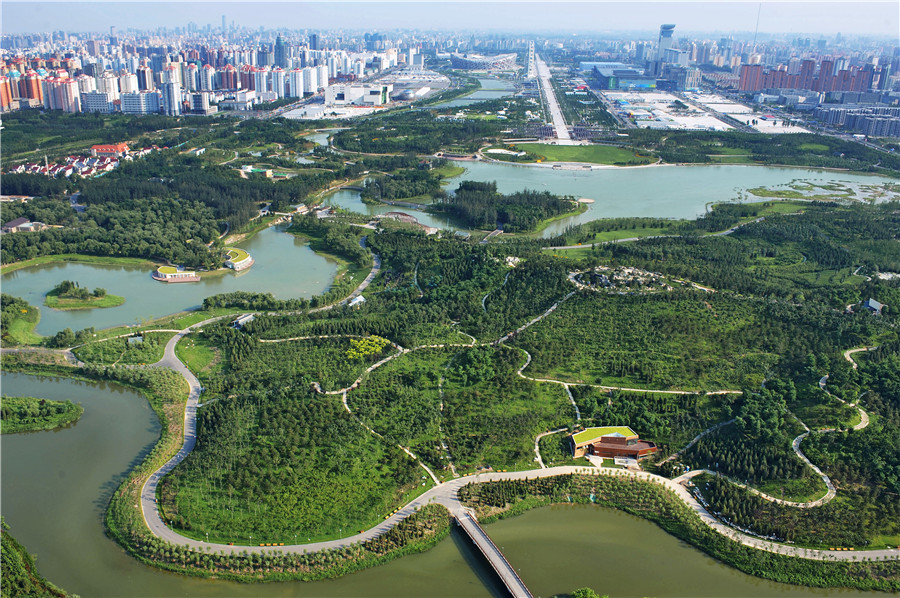
Beijing's Olympic Forest Park, where athletes, coaches and officials of the 2008 Summer Games could relax from tense competitions, has grown into a major public recreational facility, with architects and city planners from home and abroad lauding it as a beacon of the Chinese capital's green legacy.
The park in northern Beijing covers 6.8 square kilometers, making it the largest urban green space of its kind in Asia. Its features, including a wetland area of small lakes and reed beds, and forested zone of mature pine, juniper and birch, part of more than 300 flora varieties, were carefully chosen to help nurture habitats reflecting local biodiversity, according to park designers.
Apart from the numerous park users who jog and stroll or the families who swarm it on weekends, bird lovers also head there to look out for the thrushes, flycatchers and buntings during the animals' migration season. Rare bird sightings now include the Siberian chiff-chaff, long-tailed tit, streaked reed warbler, red-breasted flycatcher and chaffinch, according to international bird specialist Terry Townshend.
The park is also hailed as a green lung for the city. Its greenery can produce 5,400 metric tons of oxygen a year, help the area hit a sulfur dioxide absorption rate of 32 tons and contribute to a humidity level that is 27 percent higher than elsewhere in the capital, according to the Beijing Tsinghua Urban Planning and Design Institute. The institute has received an award from the American Society of Landscape Architects professional organization for its role in designing the forest park.
The park serves as a major way to help improve the livability levels of Beijing, which continues to face many urban challenges, city planners said. Under its plans to become a world-class metropolis, the city aims to increase its green area from the current 41.6 percent to 44 percent by the end of this year and no lower than 45 percent in 2035.
Cui Kai, chief architect of the China Architecture Design and Research Group, said the capital's rapid development has been accompanied by problems such as air pollution and traffic congestion. Beijing can improve its landscape and protect its ecosystem significantly by constructing more environmentally friendly buildings that incorporate green features, he said.
"It helps a lot since the presence of a large number of plants, trees and shrubs helps clean the air and contributes to carbon dioxide absorption and oxygen production," Cui said.
"And what is important is that the large presence of plants is a great contribution, in terms of absorbing the dust produced by urban traffic."
Beijing can learn from Singapore, a city-state that started making efforts very early on to turn itself into a "garden city", he said.
Yeo Meng Tong, senior director of design research and development at Singapore's National Parks Board, said: "The urban green structures in Singapore have formed its special way in establishing city linear parks that include streets, pavilions, stools and boulevards."
"Due to the limited land in our country, Singapore makes full use of vertical spaces to plant all kinds of plants on the walls of skyscrapers," he said.
Office blocks, homes and hotels draped in shrubbery and plant life mark the island city, Yeo said.
"The tree-covered high-rise buildings largely improve the environment in the city as large trees absorb more carbon dioxide," he said. "The vertical 'forests' also help reduce the distress caused by a dense population in the metropolis."
London, which received the accolade of world's first national park city on July 22, can also be an example for Beijing, planners said.
The capital of the United Kingdom, with its population of 9 million, always tries to integrate an ecological environment and natural elements into urban architecture, said Sara Everett, UK commissioner general and project director for the 2019 Beijing International Horticultural Exhibition.
London is filled with urban-jungle wildlife and nearly 15,000 species live in the city, including bats and birds, according to Everett.
"Trees there are as many as human beings, and half of the urban regions are covered with green plants, rivers, canals and reservoirs."
A recent study by researchers in Denmark found that children's connection with green spaces, including urban nature, also reduces the risk of developing an array of psychiatric disorders during adolescence and adulthood.


- China opens draft regulations on data protection to public consultation
- Veteran French physicist elected to Chinese Academy of Sciences
- Former Polish deputy PM praises China's economic rise, growing influence
- HK powers the nation's equestrian development
- Forum hailed for promoting Global South modernization
- Wushu needs more events in GBA, coaches in Macao say