



China will never manipulate its currency









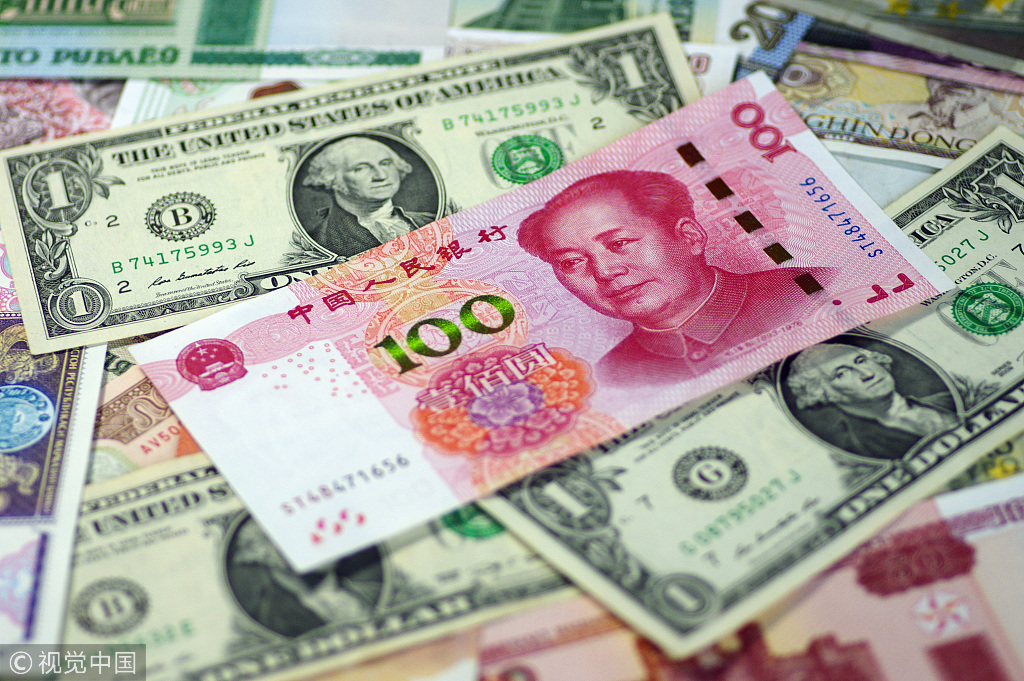
The United States accused China of currency manipulation last month, saying it intentionally depreciated the renminbi, or yuan, against the US dollar to put US exports in an "unfair" position. While it was the fifth attempt by the US to label China a currency manipulating country, the accusation is untenable and unreasonable. China never manipulates its currency.
The US has three criteria for calling a country with a trade surplus-the value of exports exceeding the cost of imports-a currency manipulator. First, the country's current account surplus over the GDP ratio should be higher than 3 percent for several consecutive years. Second, the country's central bank will have intervened in the foreign exchange market to depreciate its own currency against the US dollar within the previous six months. Third, the country should have a trade surplus of more than $20 billion for many years. A current account surplus is a positive current account balance, indicating a nation is a net lender to the rest of the world.
According to the US Department of Treasury, a country should satisfy all three criteria, rather than one or two, to be called a currency manipulator.
First, China's current account surplus over the GDP has been lower than the cutoff level for decades, with the exception of 2015, when the current account surplus was 3.1 percent.
During all the other years in the 21st century, China's current account surplus ranged between 1.6 and 1.8 percent, which is lower than the 3 percent threshold set by the US Department of Treasury.
Early this year, the US lowered the threshold limit to 2 percent. Still, China's current account surplus has been lower than that.
Second, there is no evidence of China intervening in the foreign exchange market to depreciate the RMB. The RMB exchange rate variations and related policy responses of the People's Bank of China, China's central bank, show that the Chinese government takes actions, if any, to support the RMB's appreciation.
The RMB is not a free convertible currency, in the sense that China's capital account is still not freely convertible. The capital account is the part of the balance of payments that records all transactions between entities in one country with entities in the rest of the world. However, China's current account has been convertible for about two decades.
China has maintained a fixed exchange rate against the US dollar for around a decade. The US dollar had an exchange rate of 8.27 RMB between 1995 and 2005.
China adopted a floating exchange rate mechanism in July 2005. Up to last month, the RMB had appreciated more than 15.5 percent, with an exchange rate of 7 RMB against the US dollar.
Third, only the last criterion applies to China, given that China's total trade surplus has been more than $20 billion for some years.
Major US trading partners such as Canada, Mexico, Germany and Japan also have a trade surplus of more than $20 billion, but they are not labeled currency manipulators.
The US Department of Treasury rightly reiterated in January 2017, October 2018 and May 2019 that China is not a currency manipulator.
It is also worthwhile to discuss whether China has enough incentive to depreciate the RMB to gain competitive advantage for its exports. Those who advocate this view see a fast RMB depreciation during the current US-China trade war.
In June last year, just before the first round of the trade war, the US dollar was convertible to 6.5 RMB. In mid-September last year, when the second round of the trade war was launched, the RMB depreciated more than 5 percent, and the US dollar was convertible to 6.97 RMB.
It is important to stress that the RMB depreciation was not manipulated intentionally by China. Instead, the sharp depreciation in the first half of 2018 was because of the market response. The market did not foresee the US-China trade war and the prevailing uncertainty. As a consequence, the RMB witnessed heavy selling and thus depreciated.
China has no incentive to depreciate the RMB, even though a depreciation could boost its exports in the short run. The reason is simple: RMB depreciation is politically unfavorable to China.
Today, China is working hard to establish its reputation as a responsible, pro-globalization player. If China has any intentions to depreciate its currency against the US dollar, it will trigger intense competition with its friends: countries from Southeast Asia, the most important trading partners in the China-proposed Belt and Road Initiative.
During the 1997 Asian financial crisis, China faced a challenge to its economy far more serious than today, but it did not depreciate its currency.
China will never manipulate its currency, since RMB depreciation simply does not suit its interests, either economically or politically.
The author is Boya Chair Professor of Peking University. The views do not necessarily reflect those of China Daily.










