



Striking union could learn from Confucius' middle way









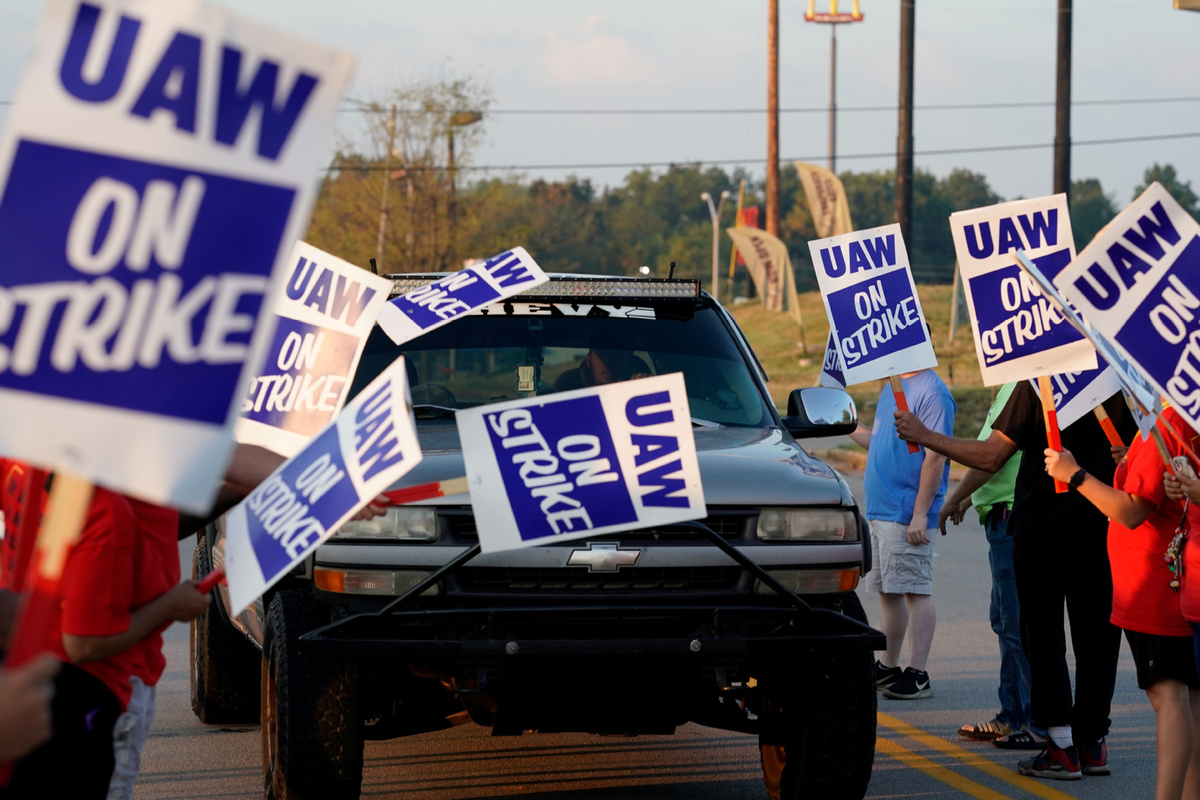
Nearly 50,000 workers in the United States walked off their jobs at more than 50 General Motors plants and other locations across the country's Midwest and South starting on Sunday, striking to get what they see as a fair share of the company's hefty returns.
It was the first by the United Auto Workers since 2007. The UAW believes workers are not getting a fair share of the company's returns, but how much is a fair share?
In negotiations that resumed on Monday morning and continued into the evening, the company offered to invest $7 billion in its US plants and add 5,400 jobs. It said it was willing to increase pay and benefits, without giving details. But the UAW was not pleased.
What if what the union is asking for is too much? It may drain GM of its resources for developing new technology.
Then the 50,000 workers might lose their jobs. That was what had happened in the Rust Belt, a region in the US that saw industrial decline starting in the 1980s.
Such fears made Chinese entrepreneur Cao Dewang turn down the request of the trade union to enter his factory, Fuyao Glass America, an automobile glassmaker in Dayton, Ohio. He said he would withdraw from the US if the union got involved. A majority of workers voted in support of Cao's decision not to let the union in.
On the surface, it is the question of whether workers need the union to protect their interests or whether the union needs to fight with employers on behalf of workers to justify its own existence. The union, it seems, is trying to balance the relationship between employers and employees.
But it is not that simple. It depends on how far the union can play its role.
Maybe the concept of zhong, or the middle course, can be borrowed from Confucianism, a system of philosophical teachings founded by Confucius, to explain the relationship between employers and workers. Zhong means that one should not go beyond what is necessary, while at the same time not falling short.
There should be a balance between how much the employer should give and how much an employee should get.
On one hand, an employer should keep enough money for the smooth running of the company and for technological innovation, which will help the enterprise remain competitive. On the other hand, what an employee gets from the employer should ensure he or she can make a decent living.
It is human nature to expect maximum benefits. It is counterintuitive for an employee to think about how the company will perform if he or she gets high wages or too many benefits, since the employee is not in a position to think on behalf of the employer.
When GM was on the brink of bankruptcy a decade ago, the company's union bore a significant portion of the pain to restore the automaker's financial health.
GM was allowed to hire a number of workers at roughly half the hourly wage of those already on the payroll, and with reduced retirement benefits. In the following years, it also hired temporary workers with even lower wages and little job security.
This made it possible for GM to compete with its rivals and survive in the competitive market, which implies the company cannot afford to pay all its employees, including those hired after the crisis 10 years ago and the temporary ones, the same hourly wages as its senior employees.
In its effort to seek what it believes is the fair and reasonable treatment of workers, the union cannot decide what is most appropriate.
It is impossible for the union to know how much money GM needs for technological innovation to keep it competitive.
According to the documentary American Factory, workers at the GM plant in Dayton, Ohio, made $29 an hour, while the hourly wage is $12.84 for the Fuyao Glass America workers. But the GM plant is gone, rendering workers jobless. Fuyao Glass America provided employment to some of those unemployed.
Zhong, as a code of conduct in Chinese culture, is meant to bring about harmony between people and among different parties.
There is no telling what will happen as a result of the current strike. There is no telling whether GM will give in or whether it will consider moving more of its plants to other countries to bring down the costs. If that happens, the striking workers will be severely affected.
While zhong can provide some food for thought, the UAW should decide what role it should play in the long-term interest of US autoworkers.
The author is a senior writer at China Daily.










