China may be AI leader by next decade









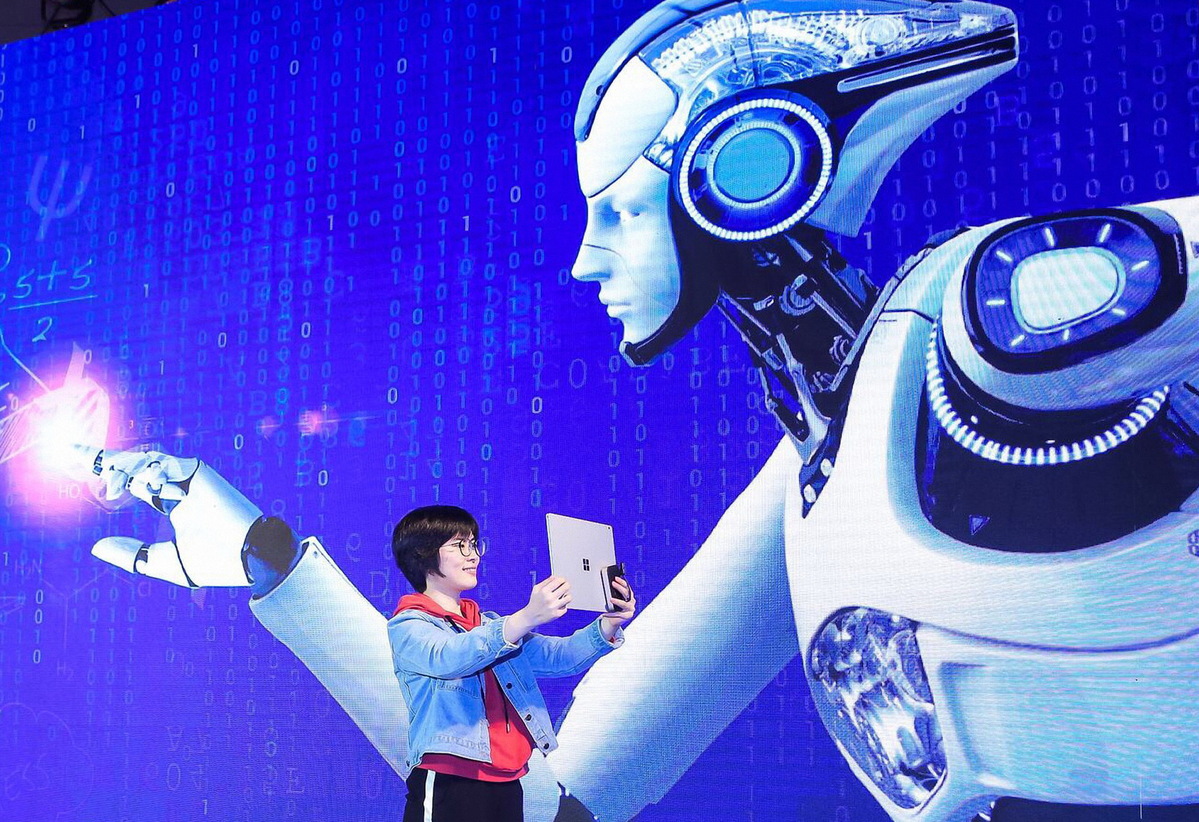
Artificial intelligence has proved to be very good at learning how to do individual tasks based on information derived from enormous pools of data. However, it has been less efficient at learning how to do things from scratch, or creating new solutions for old problems.
The push to achieve artificial general intelligence - providing machines with the ability to learn to perform any task that a human can perform - is the race of today. Whoever grabs this brass ring is likely to lead the world in all fields, from communications to transportation and healthcare.
China is betting it can get to the ring first. It may already have the momentum it needs.
Last year, Chinese scientists authored a little more than one-fourth (26.5 percent) of the 10 percent of AI-related scientific papers cited most frequently around the world. China was behind only the United States, whose scientists authored 29 percent of those papers, according to an analysis by the Allen Institute for Artificial Intelligence in Seattle.
In 1982, the US produced almost half of these papers. According to the institute, China could overtake the US on this metric by next year, given that the US share is falling.
By all accounts, China is on track to meeting these milestones.
Despite all the hoopla around it, AI systems are not very good at learning without enormous amounts of data. They are, in essence, incredibly fast at comparing information. AI is getting more powerful almost on a daily basis.
Healthcare, for instance, is one field that China is looking at to shore up its AI capabilities.
A deal concluded last month suggests how China is strengthening its AI capabilities. In early October, Insilico Medicine, a Hong Kong-based company that uses AI to develop new drugs, announced a collaboration worth up to $200 million with Chinese mainland company Jiangsu Chia Tai Fenghai Pharmaceutical to invest in two AI drug discovery programs. Insilico's approach has turned drug discovery on its head with seemingly incredible results.
The traditional approach to drug discovery using AI is to run the entire libraries of compounds through AI engines that can match the properties of specific compounds with those of particular ailments. The process is time consuming and the results uncertain. To get an idea of what the process is like, imagine taking thousands of giant puzzles and mixing all the pieces together in an enormous pile and then trying to solve one of them by matching one individual piece against another.
Insilico uses a state-of-the-art AI engine known as Generative Tensorial Reinforcement Learning to basically imagine the molecules that are needed to treat diseases. In a paper published in September in the journal Nature Biotechnology, Insilico described how it used the engine to design, synthesize and validate a drug for fibrosis - a condition in which there is an excessive growth of fibrous connective tissue in an organ or tissue, especially because of an injury - in 46 days.
Insilico's drug is not necessarily better than the best drugs in the market, but those drugs took eight years of research and cost tens of millions of dollars. Insilico did it in a month and a half, and at a cost of $150,000.
By investing in this type of initiative, Chinese companies and authorities may be able to overcome the biggest stumbling blocks to emerge as the premier global AI power.
The first stumbling block is the lack of contributions to world-class theoretical research of the kind that helps advance AI globally. China produces more scientific papers than anybody else in the world, but it still lags behind the US and the United Kingdom in contributions to theoretical research.
The second roadblock is that companies in China are often reluctant to invest in research and development that can lead to breakthroughs. That is also changing. Companies like Alibaba and Tencent, not to mention many other smaller players in almost every field, are slowly ramping up investments in AI research.
A third hurdle is the country's relative weakness in advanced semiconductors needed to support AI.
China does have some inborn advantages, not least its huge population and the government's willingness to put vast amount of resources behind the AI endeavor. It is also a world leader in a number of fields, including autonomous vehicles and facial recognition.
All things (investment, willingness, government support) remaining equal, China could well become the world leader in AI, and within the next decade. The trick will be for the country to continue powering research, development and creativity.
The author is managing director of Bahati Ltd, a Hong Kong-based editorial services consultancy. The views do not necessarily reflect those of China Daily.