



Ill will behind rare earth alliance against China









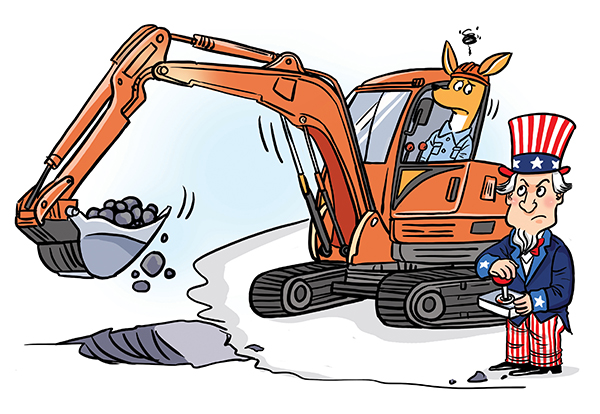
Editor's Note: The United States held talks with Australia recently to strengthen cooperation on critical minerals and rare earths, which is widely seen as a move to reduce its reliance on Chinese rare earths that constitute about 80 percent of the US' rare earth imports. Japan, too, has upped the ante in rare earth mining. Will the US and its allies succeed in building a rare earth alliance against China? Two experts share their views on the issue with China Daily's Liu Jianna. Excerpts follow:
It will take time for US to find a substitute to China
The US is afraid that China may cut the exports of rare earths to choke its development in response to its constant provocative moves against China, due to its false belief that China threatened to cut rare earth exports to Japan amid the heated dispute between the two countries over China's Diaoyu Islands about a decade ago.
As a matter of fact, rare earths are not that rare, and China accounts for only 36.67 percent of the global rare earth reserves. They have become rare elements only because their mining costs are extremely high and processing environmentally damaging.
The US itself has shut down a number of rare earth plants due to these concerns. Given that it is nearly impossible to reopen the plants, the US has turned to its allies and is strengthening ties with other rare earth producers such as Mongolia to ramp up production and secure its imports. It could build a rare earth alliance with Germany, France, four of the "Five Eyes" (Australia, Canada, New Zealand, and the United Kingdom) and other countries to limit China's dominance in rare earth production and exports in the future.
The US seems to boost long-term investment in rare earths in a bid to influence the global industrial chain and rulemaking process. Albeit, it will take a long time for the US to find a substitute to China as a rare earth exporter given China's advantages in rare earth processing.
What's worrying is that both China and the US are proceeding according to global predictions. As for the US, it is worried that it won't be able to contain China's rise if it loses the chance to do so now. China, on its part, is gradually reducing its reliance on the superpower because of the rising fear that the US would "decouple" the two economies.
The world's two biggest economies should take measures to stop this dangerous trend. That rare earth is like an ace in China's hands is a somewhat overstretched view, because reducing or limiting rare earth exports will always be a double-edged sword.
Wang Yiwei, a professor of international relations at Renmin University of China
US seeks trouble by trying to re-invent the wheel
That the US is teaming up with Australia to exploit rare earths reveals its guilty conscience. The US has forced US companies to limit the sale of key parts to Chinese enterprises including Huawei and ZTE. But the White House also fears that China might respond in kind.
Actually, the US' tricks could cost itself dear, not least because of China's mastery of the separation and purification techniques for rare earths, which allows it to provide the highest quality rare earth elements at relatively low costs. And it will enjoy these advantages for a long time to come.
But China will continue to be a responsible and reliable rare earth producer and supplier irrespective of the US' attempt to instigate a new "Cold War", because it remains confident that in the international market, the most capable and competitive player will win.
In fact, China's emergence as a major player in the field of rare earth speaks volumes of the country's resilience and growth potential in the face of Western dominance. It has significantly improved its efficiency and slashed the cost for rare earth processing despite entering the market as a latecomer in the 1970s. Hopefully, it will make more technological breakthroughs in the face of the US-instigated trade war.
Mei Xinyu, a researcher at the International Trade and Economic Cooperation Institute of the Ministry of Commerce
The views don't necessarily represent those of China Daily.





