



Beijing human rights conference promotes unity in diversity









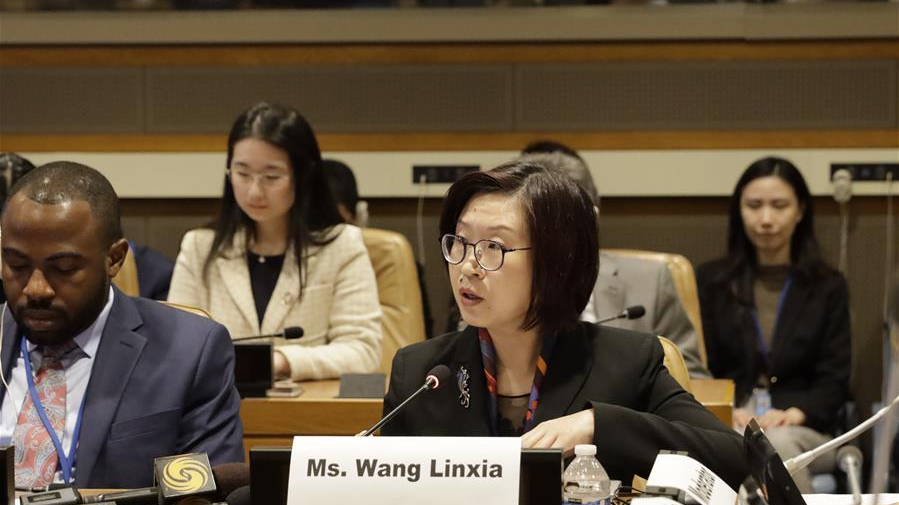
China Society for Human Rights Studies (CSHRS) Deputy Secretary-general Wang Linxia (R, front) speaks during a United Nations (UN) side event on the right to development hosted by China's permanent mission to the United Nations and CSHRS in New York, Oct. 25, 2019. /Xinhua Photo
The South-South Human Rights conference held in Beijing on December 10 had a broad representative character, bringing together parliamentarians, scholars and experts from Pakistan to Palestine, Mauritius to Mongolia and Syria to Samoa. Despite the diversity of cultures, countries and continents, there was an air of camaraderie based on shared experiences as developing countries facing similar problems and pressures.
The context of the meeting is the transformation taking place in the world, which is reshaping global power politics. The balance of economic and political power is shifting from the West, the United States and Europe being in relative decline, to the East, with the 21st century now largely perceived as the "Asian Century."
A defining feature of this epoch is globalization, with China fueling 30 percent of global growth and President Xi Jinping's Belt and Road Initiative (BRI) undoubtedly the most significant developmental and diplomatic effort for globalization in the 21st Century.
Three features of the Beijing Human Rights Forum are noteworthy.
First, the participants took note of China's huge, unprecedented achievement in promoting the right to a prosperous life and freedom from poverty for over 800 million of its citizens, who have been lifted out of poverty after the reform and opening-up policies began in the 1980s. This is the most fundamental of all rights that human beings can aspire to, building a better tomorrow for themselves and their progeny.
During his keynote speech, Huang Kunming, a member of the Political Bureau of the Communist Party of China (CPC) Central Committee and head of the Publicity Department of the CPC Central Committee, announced that in 2020, the last remaining six million Chinese still living in poverty would be lifted out of that condition, making China a society whose citizens have freedom from poverty.
Second, the use of human rights as a political weapon by some countries of the West to push, pressure and demonize China and other countries whose interests may be at variance with those in the West. Politics, not principles, determine their approach to human rights, which is based on double standards. For example, they are silent on human rights in Palestine and Kashmir or the application of United Nations resolutions in both these instances, but jump at the opportunity to pressure China on Hong Kong and Xinjiang, even when they know these are internal matters of China.
Passing resolutions on Hong Kong and Xinjiang is a violation of the principles of non-interference in internal affairs. It would be hard to imagine other countries would ever pass resolutions on the treatment of African Americans, Latinos or the children of immigrants, also known as"dreamers" in the United States.
Third, there is the key question of motives behind the anti-China campaign by the U.S. Two important articles in major American publications, one recent and one from the past, are instructive.
The recent one is an article by the CNN anchor Fareed Zakaria titled "The New China Scare" that was published in the influential Foreign Affairs magazine. The article provides a relevant perspective, where the author believes the American establishment is applying pressure on China, similar to that put on the Soviet Union decades earlier during the Cold War, with the unstated objective of inducing "regime change."
The author goes on to add that during the Cold War, 1947-1989, the United States staged 72 attempts at regime change in various countries of the world!
The other article, published in November 1991, soon after the demise of the Soviet Union and the end of the Cold War, appeared in the New York Times. It was written by Leslie Gelb, a former senior U.S. State Department staffer, and bears the somewhat grand and arrogant title "Breaking China Apart."
The article was published in the aftermath of the triumphalism of the Soviet Union's demise and defeat in the Afghan War when the U.S. had proclaimed its intention of building "A New World Order."
The author threatened to use the political card of "separatism" against China if it was deemed necessary for U.S. national security objectives!
So, when the incumbent U.S. Secretary of State Pompeo says that the U.S. and its allies will try to "put China in its proper place," it is a throwback to the Cold War mentality reflecting an imperial hubris.
Instead of learning to adjust to new realities or coexisting in harmony with China, the U.S. military-industrial complex seems to be on a quest to conjure up an "enemy" they can justify with bloated budgets to "contain and counter."





