



World Leaders in 2019: Narendra Modi, Hindu nationalist or economic reformer?









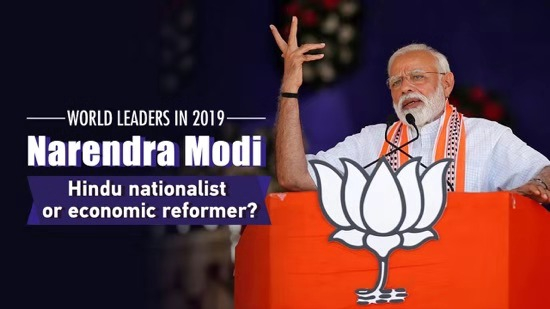
Narendra Modi, who was re-elected to his second term as India's prime minister in May, is steadily pushing forward a Hindu nationalist agenda with the more urgent and crucial economic reforms taking a backseat.
The landslide victory by Bharatiya Janata Party (BJP) in 2019 general election firmly established Modi as the most powerful Indian prime minister in more than three decades. However, unlike in 2014 when Modi first came to power promising economic reforms and development, this year he relied on the plank of Hindu nationalism to consolidate his position as India's undisputed leader.
For decades BJP has championed the cause of Hindu nationalism, but never before has it been so pronounced.
In August, Modi revoked the constitutional autonomy of Indian-controlled Kashmir, a Muslim-majority area, imposing a curfew and communication blackout. Kashmiri politicians were imprisoned and the area was bifurcated into two union territories, directly under the control of federal government.
In November, India's Supreme Court decided that a Hindu temple will be built in a long disputed holy site, where a 460-year-old Muslim mosque was demolished in 1992 by a Hindu mob led by BJP leaders. The verdict was celebrated as a huge victory for Hindu nationalists.
Expanding the Hindu nationalist agenda, Modi earlier this month introduced a new citizenship law that is being decried by critics as "anti-Muslim" with the UN human rights office dubbing it as "fundamentally discriminatory".
The new law has sparked a wave of protests and clashes nationwide. Critics allege that the new law is aimed at marginalizing India's nearly 200 million Muslims, which Modi's government has vehemently denied.
In a multi-ethnic, multi-religious country of 1.3 billion, the politics of majoritarianism and religious identity could often be fraught with uncertainty, and has the potential to reopen historic wounds as the citizenship law is appearing to have prompted in parts of India.
However, the hot pursuit of a populist, majoritarian agenda also offers a convenient cover for Modi to distract people from his lackluster showing in the economic front. The Indian prime minister wants to make India a five-trillion-U.S.-dollar economy by 2024, so he said in July, but hasn't yet provided a roadmap to achieve the goal.
India's GDP growth rate in September plummeted to 4.5 percent, its biggest decline in recent years. The unemployment rate of 6.1 percent is the worst in 45 years.
Chief economist of International Monetary Fund (IMF), Gita Gopinath, recently said that the extent of slowdown of the Indian economy has surprised many, "including us here at the IMF." She advocated for structural reforms, saying that "politically, the time – early in the government's second term – is right" for such a push.
Modi, however, has not introduced any major economic reforms this year. On the contrary, he oversaw India's pullout from the Regional Comprehensive Economic Partnership (RCEP). Analysts say staying away from the world's largest free trade bloc may not be in India's best economic interest in the long run.
Despite facing political and economic challenges, Modi remains the most popular leader in India while maintaining a public image of an economic reformer. No wonder, analysts have paradoxically described Modi as "India's Divider In Chief" and as the country's "Best Hope for Economic Reform" at the same time.
Given the enormous popular mandate Modi enjoys, he has the power to shape India's destiny like none before. India is at a crossroads and Modi will be keenly watched whichever direction he leads his country to – one that is rooted in religious identity and has the prospect of dividing the society; or the other that brings in timely economic reforms enabling the world's second most populous nation to reap its demographic dividend.





