



For a philosophical China-US coexistence









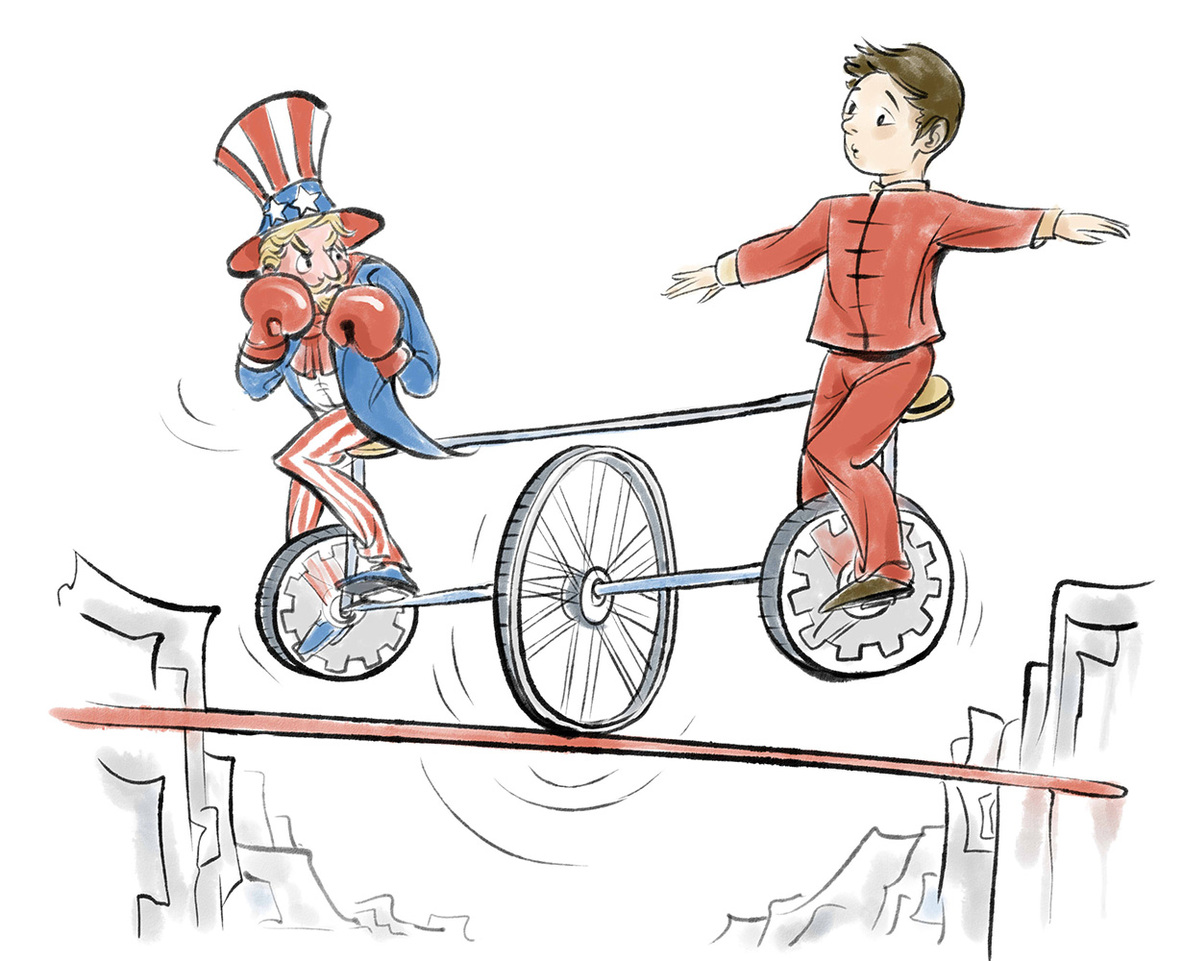
China and the United States are expected to sign a phase-one trade deal in a few days, which will ease trade tensions as well as take the bilateral trade negotiations forward.
That the deal, despite its positive overtones, has invited some criticisms both in the US and China, shows that it, although having a certain balance, cannot satisfy everyone. The two sides have reached a necessary compromise.
Concerns center mainly on the prospects of a "phase-two deal" and smooth progress of the trade talks. In fact, the decisive factor is not negotiating skills or having bargaining chips but how China and the US respond to the significant differences between their economic and political systems and ideologies, which are more complicated than those between the US and the Soviet Union.
Since the global financial crisis, Western analysts have used multiple labels to describe China's political and economic systems. They have even said China's "state capitalism" poses a challenge to the "Washington Consensus".
After 2017, the West's characterization of China's political and economic systems turned even more negative. For example, Peter Navarro, trade adviser to the US president, accused China of intellectual property theft, often using the rhetoric that China is "basically trying to steal the future of Japan, the US and Europe". But the fact is that since China joined the World Trade Organization, its annual IPR licensing fees have exceeded the global average.
In 2000, it paid $1.3 billion in IPR licensing fees, which increased to $35.6 billion by 2018-an average annual growth rate of 20 percent compared with the average global growth rate of 9.5 percent.
In addition, on the issue of industrial subsidies, the US has resorted to double standard. In the US, subsidies for industries such as advanced manufacturing and agriculture are huge. Amazon, for example, received at least $613 million in local government subsidies between 2005 and 2014. And from 2010 to 2016, the US administration invested more than $100 billion in basic research in biomedicine.
Ironically, while the US is asking the Chinese government to reduce its "intervention" in industry, it is learning from China how to use the government to promote innovation, and developing artificial intelligence (AI) by adopting a holistic government approach.
In May 2018, the US administration hosted the Artificial Intelligence for American Industry Summit, emphasizing government coordination in combining the strengths of industry and academia to maintain US leadership in AI. In February 2019, the US announced the American Artificial Intelligence Initiative, which is actually an executive order that requires the federal government to increase investment in the AI industry.
The White House has also formed a "Select Committee on Artificial Intelligence", which comprises officials from government agencies including the Office of Science and Technology Policy, National Science Foundation and the Defense Advanced Research Projects Agency. And the Pentagon has established a "Joint Artificial Intelligence Center" to strengthen the partnership between the US military and Silicon Valley tech giants.
Of course, China has been taking measures to strike the right balance between the roles of the government and the market in the economy. Stephen Roach, a senior researcher at Yale University, said that although China's difficult economic transition is continuing, its reforms have achieved a lot in the past few years. People should pay attention to "next" China, he said, as the US administration's obsession with antiquated perceptions of China isn't helping to solve the problem.
If the US expects the Sino-US trade talks to yield unrealistic results in its favor, it will only be disappointed. And if the US continues to be hostile to the Chinese systems, the pace of China's reform and opening-up may slow, increasing the pressure on reform officials. In fact, the trade war triggered by the US has greatly hurt the interests of Chinese enterprises such as Huawei, which could prompt them to ask the government to set up trade barriers to protect national economic interests. This will not be good for any country.
Whether it likes it or not, Washington has to accept the fact that China will not follow the US economic development model. The US can no longer force China to accept its demands now that it is the world's second-largest economy.
That China and the US have reached a phase-one deal shows they are trying to find a way to ensure their economic systems co-exist peacefully. Which is crucial for the continuation of the Sino-US trade talks.
Of course, competition between the two sides is inevitable, but it should be based on rules that are acceptable to both, and should not cause losses to other economies.
In short, it's wrong to look at the Chinese and US systems as an irreconcilable barrier and unwise to judge China's development model from a static perspective. There is a route beyond the binary of "deep integration" or "decoupling". As China's Ambassador to the United Nations Cui Tiankai said, the resilience of Sino-US relations lies in their ability to solve problems and overcome difficulties.
The author is research fellow at Charhar Institute. Source: Chinausfocus.com The views don't necessarily represent those of China Daily.





