


Floral paintings open door to cultural exchange










Floral paintings open door to cultural exchange
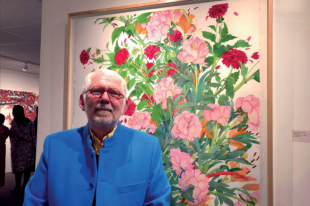
Flower-painting, which was once seen as a lesser form of contemporary art, has helped Gary Bukovnik find new audiences in China.
The San Francisco-based artist has become increasingly popular in China, with a number of museum exhibitions of his floral watercolor paintings in recent years.
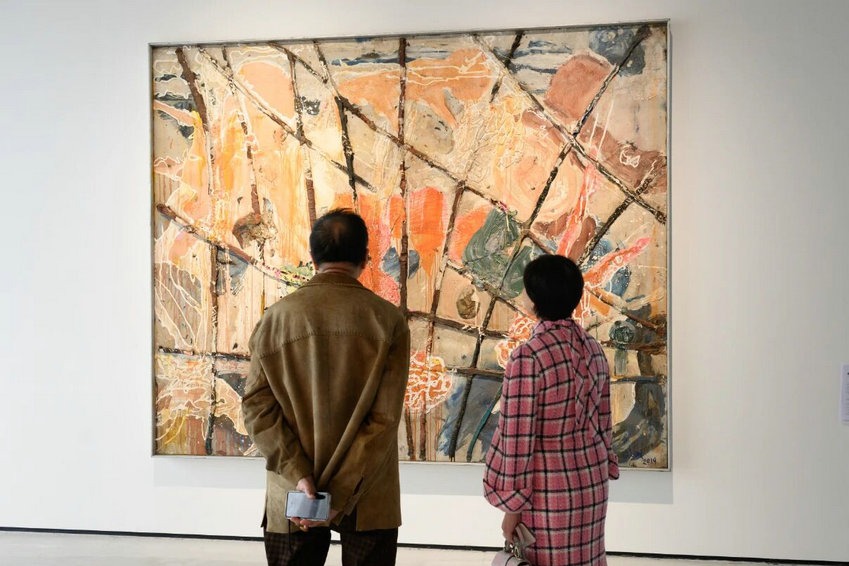
His big paintings depict all kinds of flowers, including peony and lotus — a favorite subject matter of Chinese artists.
It's the colors and the flowers in his painting that appeal to Chinese viewers, said Bukovnik. "They are about happiness. They are about love and joy," he said.
The 73-year-old artist has painted flowers for more than 40 years, but he said there was bias toward flowers when he was trained as an art student.
It was not seen as a legitimate subject in the late 1960s and 1970s, when Abstract Expressionism was held up as the "ultimate expression of an artistic temperament or idea", he said.
In China, there is no preconception about which aspect of art is more meaningful than another, and watercolor essentially shares a kinship with Chinese art, Bukovnik said.
Since they were first introduced to China in 2011, Bukovnik's works have been widely exhibited in the country. He has had 11 solo exhibitions at museums in Shanghai, Beijing, Suzhou, Tianjin, Xiamen and Chenzhou.
His latest book, Forever Spring, a large coffee-table book with more than 120 color illustrations and text in English and Chinese, was published in China by the Shanghai People's Fine Arts Publishing House last year.
His 15 trips to China in the past nine years also gave him an "eye-opening" experience.
"My eyes have been opened to a lot of different ways of seeing life in the world. I have benefited a great deal from a different kind of pragmatic way of viewing things," said Bukovnik.
In the traditional Chinese paintings, especially those poetic and spare in style, one can see much more meaning in it —it's life and love and all the things that are important to everybody, he said.
Birds and flowers comprise one of the three subjects in traditional Chinese painting, which appeared after figure painting and landscape painting, said Shu Jianhua, director of the Silicon Valley Asia Art Center in Santa Clara, California.
"But compared with the other two subjects, birds-and-flowers plays a more significant role in cultural exchange with foreign countries," said Shu. "A good example is Chinese painter Zhang Shuqi's A Hundred Doves."
The painting, titled Messengers of Peace, also known as A Hundred Doves, depicts 100 flying doves with flowers and trees in the background. It was presented to US president Franklin D. Roosevelt in 1941 as a gift from China for Roosevelt's election to a third presidential term.
The painting was said to have graced the White House after its acceptance, and it later was displayed in the exhibition hall of the Franklin D. Roosevelt Presidential Library and Museum in Hyde Park, New York, where it is now permanently held.
"The image of the painting became famous in the US through media reports, and it kindled the love of Chinese birds-and-flowers paintings among American public," said Shu.
Zhang (1900-1957), a renowned painter of birds and flowers, was famous for combining Eastern themes with Western techniques and concepts.
"It appeared to be within Chinese tradition but would appeal to American audiences," writes Gordon H. Chang, son of Zhang and a professor of American history at Stanford University, in his essay "Chinese Painting Comes to America: Zhang Shuqi and the Diplomacy of Art".
"Art is itself a medium, a platform that can serve to advance dialogue across various sorts of boundaries rooted in traditions, beliefs, social practices, geographies, times and values. Art is an avenue of cultural exchange and interaction," Chang wrote in the essay. "He (Zhang) took pride in his contributions to East-West artistic interaction and the diplomacy of art.
"In the San Francisco Bay Area, we're really lucky because there are so many different cultures mixed, so here we have a better view of Chinese culture," said Bukovnik. "Art is the language that needs no translation. You speak mind to mind and heart through art."