Red envelopes deliver happy thoughts









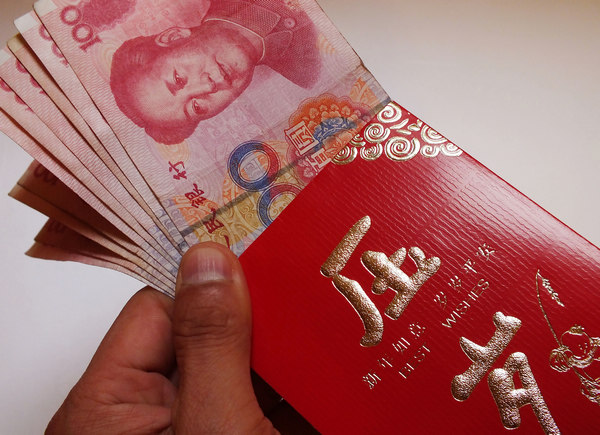
"Best wishes to you; may I have my red envelope, please?"-Gongxifacai, hongbao nalai? in Chinese-is a well-known phrase for harvesting monetary gifts during Spring Festival.
The holiday, also known as Chinese Lunar New Year, starts on Friday, and Chinese always send best wishes to their families, friends and people they meet. Giving or receiving red envelopes, or hongbao, is an important part of the traditional festival.
Hongbao are not only given during the period from Spring Festival to Lantern Festival, about 15 days, but also on other happy occasions, such as weddings, birthdays and the birth of a baby.
As Spring Festival arrives, one can see different types of red envelopes for sale in almost all shops and markets. They usually bear the Chinese character fu, meaning "luck", or one of the 12 animals of the Chinese zodiac, depending on that animal's year. The forthcoming year is that of the rat, so this year's envelopes carry that motif.
Giving hongbao is a way of extending best wishes and blessings to people around you. Envelopes given to a child on New Year's Eve are traditionally called yasuiqian.
There are many tales about yasuiqian. One of the most famous is that in ancient times a devil named Sui came out to harm people every New Year's Eve. If it touched a sleeping child's head three times, the child would become ill and stupid. It was believed that money wrapped in red paper scared and deterred Sui, so a tradition developed whereby children were given wrapped money to wish them health, happiness and intelligence.
Nowadays, people don't differentiate between hongbao and yasuiqian, and call all such gifts "red envelopes". Different cultural areas use different names, so in Cantonese-speaking areas, the envelopes are called laisee.
People in Hong Kong and Guangdong province like to give laisee when with family or friends during Spring Festival, because everyone wants good omens and wishes at the start of the year.
Anyone who fails to hand out the gift is thought disrespectful. Therefore, everyone, from billionaires to regular citizens, is happy to give laisee during the festival, although the amount of money differs.



- Chinese sailor forced to halt Antarctic expedition after robbery
- French, Chinese artists revive industrial heritage in Hunan
- New engineering academicians vow to advance scientific innovation
- Former top railway official expelled from CPC
- Mainland says Taiwan's Lai a 'peace breaker' and 'troublemaker'
- New materials reinforce Nanjing war truth