



We-media shouldn't be a plague of false news









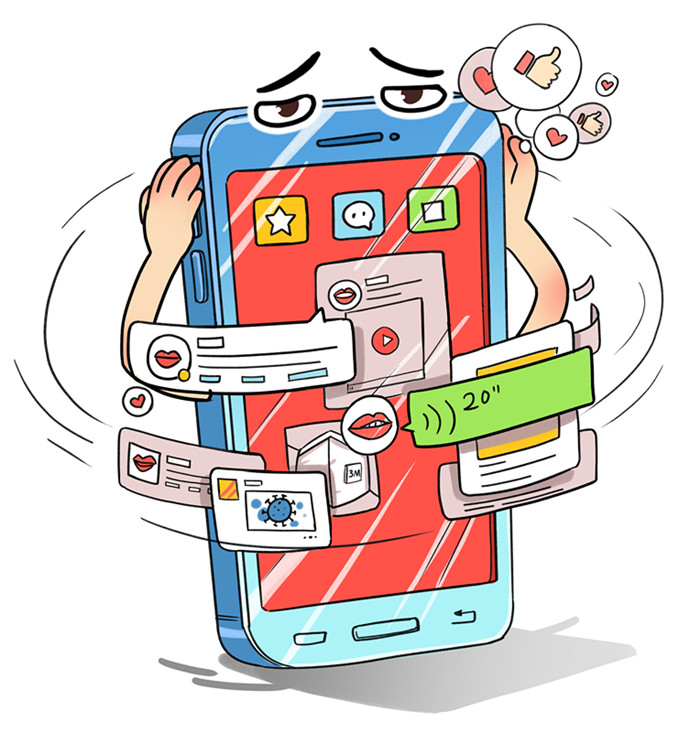
The popularity of social media apps such as Facebook, Twitter and WeChat as alternative news-sharing platforms has also seen them become tools for the circulation of fake news and misinformation. Whenever there is an emergency or crisis, some users of these apps tend to generate and circulate more news and information, and also, inevitably, more fake news and misinformation.
With the outbreak of the novel coronavirus in Wuhan, capital of China's Hubei province, Wechat users have been active in not only editing, modifying and truncating reports from other sources, but also in fabricating and circulating news and information, including fake news and disinformation, that is shared among thousands and potentially millions of people in a variety of forms such as one-on-one, in WeChat groups, each of which is capped at 500 members, in WeChat Moments, in WeChat public accounts and so on.
In this way, one can communicate one-on-one, one to a group, and one to the public using written, audio, visual, audiovisual means in one, two, or even many languages.
People do this for fun, to gain popularity or to make a profit. Wechat users have been actively communicating with their relatives, friends, colleagues, and even strangers to show their concern, love, and support to those infected with the new coronavirus in Wuhan and elsewhere. Social media apps such as WeChat have become an organizing device to collect donations from different communities.
But the positives aside, some WeChat users have also been promoting fake, incomplete, distorted partial and biased news, and misinformation and unreliable information about the virus have spread and so damaged the public information and public opinion environment.
For example, a rumor which won the trust of almost 100 million Chinese netizens claimed that the virus was lab-made, stoking up a conspiracy theory that there had been a biological attack against China. Even with the biologists and health scientists deconstructing the reasoning behind the theory, it has still persisted.
Another notable rumor was that the novel coronavirus is not only communicable via breath droplets and physical contact, but also through eye-contact between two individuals. According to the Dingxiang Medical Team, this is Rumor#23 for which the rumormonger has been arrested. Rumor #24 on the List of Rumors of the Dingxiang Medical Team which currently lists 99 popular rumors, is that China has been designated as a so-called "plague area" by the World Health Organization.
In fact, the WHO has not announced China as "a plague area". As a mere warning, not as a mandatory request for personnel evacuation or personnel move stoppage, the WHO has declared the coronavirus outbreak in China as a Public Health Emergency of International Concern (PHEIC), a designation created by the WHO in its International Health Guidelines (2005). Its goal is to warn the international community to guard against the potential risk of infection.
While China itself has not been designated as "a plague area", self-media such as WeChat have descended into a plague of fake news and misinformation with regard to reporting about the virus. WeChat has become a double-edged sword in the public information and public opinion arena. It has been both an asset and a liability.
WeChat users and WeChat account managers and content creators have different education levels, income levels and ideological orientations. Most of them have received little formal training in journalism and communication. While some of the rumors are concocted out of the political or economic calculations of the WeChat users, most of the rumors probably occur due to the users' lack of sufficient knowledge, absence of logical reasoning and paucity of critical thinking skills.
Thus a majority of the WeChat users who spread rumors are innocent or innocently "ignorant" people. Only a very small number of them harbor malicious or ulterior motives. Compared with traditional media, WeChat communication is more spontaneous, speedier, more personal and compassionate, but less organized, and less professional.
In order to quickly recover from the coronavirus outbreak, and in order to create a trustworthy public arena of information and opinion exchanges in China and the world, the plague of fake news and misinformation should be cleaned up by offering guidelines for users to follow.
The author is professor of communication at Chapman University and distinguished guest professor, Shandong University. The views don't necessarily represent those of China Daily.





