



Smog still a problem amid viral contagion









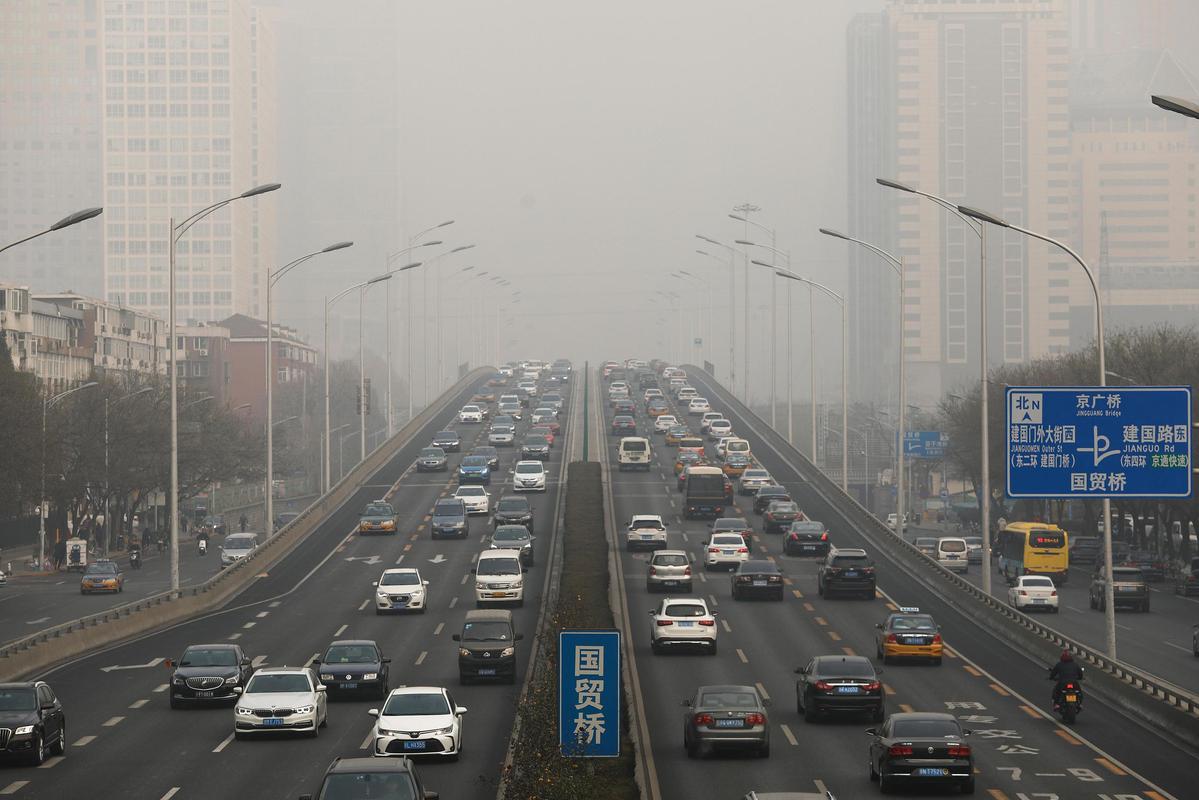
With reduction of activity around the country at the outbreak of novel coronavirus pneumonia, many people expected that air pollution would remain low after the Spring Festival holiday.
The Beijing-Tianjin-Hebei cluster, however, has been shrouded in smog many days this month.
The haze that worsened over the Lantern Festival on Saturday still lingers, with little sign of abating anytime soon. On Wednesday, the hourly density of PM 2.5 — harmful particulate matter that can enter the bloodstream via the lungs — in most districts in the capital remained beyond 200 micrograms per cubic meter most of day.
While air pollution did not ramp up in some other regions, conditions in the greater Beijing area were hampered by unfavorable meteorological conditions that vastly reduced the capacity of the local environment to handle air pollution, experts said.
During the holiday, pollution from many sources dropped in the Beijing-Tianjin-Hebei cluster.
Xu Honglei, director of the Transport Planning and Research Institute's environment department, estimated that from Jan 24 to Feb 2, pollutant emissions in the 28 major cities in the cluster went down by at least 40 percent from the usual levels.
The area saw 77 percent fewer freight vehicles and 39 percent fewer cars on the roads.
Even after the break was supposed to end in the first days of this month, traffic in those cities also didn't get back to normal because of the slowdown caused by the virus, he said.
But the viral disease, which has been named COVID-19 by the World Health Organization, also did not prevent the polluting effect of some smokestack industries as much as it did with many other pollution sources.
He Kebin, dean of Tsinghua University's School of Environment, said high emissions from some sources in the cluster remain generally unchanged despite the slowdown because of the virus outbreak, which led to a suspension of activities by many restaurants and labor-intensive factories.
"The pollutants from smokestack industries and heating production, which contribute two-thirds of air pollutants during autumn and winter, didn't substantially go down," said He, who is also a member of the Chinese Academy of Engineering.
Many of the industries, including steel, nonferrous metals, glass and coke, only slightly reduced production during the Spring Festival holiday or remained unchanged, he said. Many industries that are heavy polluters and heavy energy consumers are based on production procedures that need to be sustained without a halt.
Environmental monitoring showed a drop of only 10 percent in pollutants discharged by steel plants and coal-burning power generation sectors but no decrease in other smokestack industries, he added.
He said that coal consumption for heating in the region's rural areas — a major factor in poor air quality during cold periods — increased.
About 10 million rural households in the region still rely on coal for warmth, even though many have shifted to cleaner energy like natural gas.
The density of carbon monoxide, a key indicator of burning coal, increased in rural areas of the cluster by over 10 percent from last year, he added.
With some emissions remaining high, the unfavorable meteorological conditions for pollutant dispersal — a frequent occurrence during temperature inversions and high humidity — are a major factor in the recent poor air quality in the greater Beijing area, according to Wang Zifa, a researcher at Chinese Academy of Sciences' Institute of Atmospheric Physics.
The temperature inversion lowered the "mixing layer", which refers to the atmospheric height over which pollutants can be dispersed, to only 300 to 500 meters above the ground, half to one-third of its normal height, he said.
The lowered "mixing layer" can at times almost halve the environment's carrying capacity for pollution in the region. "Though social activities have been kept at a very low level, the amount of polluting emissions still exceeds the environment's carrying capacity by over two times. This is the main reason for the frequent smog recently," he said.
Tang Guigang, head of atmospheric monitoring at China National Environmental Monitoring Center, said even though fireworks are restricted in major urban areas, the traditional setting off of fireworks during Spring Festival Eve and the Lantern Festival outside those areas has made the situation worse.


- China details measures to further advance agricultural modernization, rural revitalization
- Researchers uncover key to overcoming drug resistance in breast cancer
- Chinese scientists achieve major breakthrough in scalable quantum networks
- 1,200-seat high-speed passenger ship put into operation in Beihai, China's Guangxi
- Study explores climatic regulation of mercury deposition in plateau lake
- China to step up tough crackdown on telecom scams: senior official












