Measures will pre-empt market risks, but long-term impact in focus









Without doubt, the COVID-19 contagion has had an impact on China's A-share market. Yet, there is no need to panic as the impact is widely expected to be short-lived. And market risks are still under control.
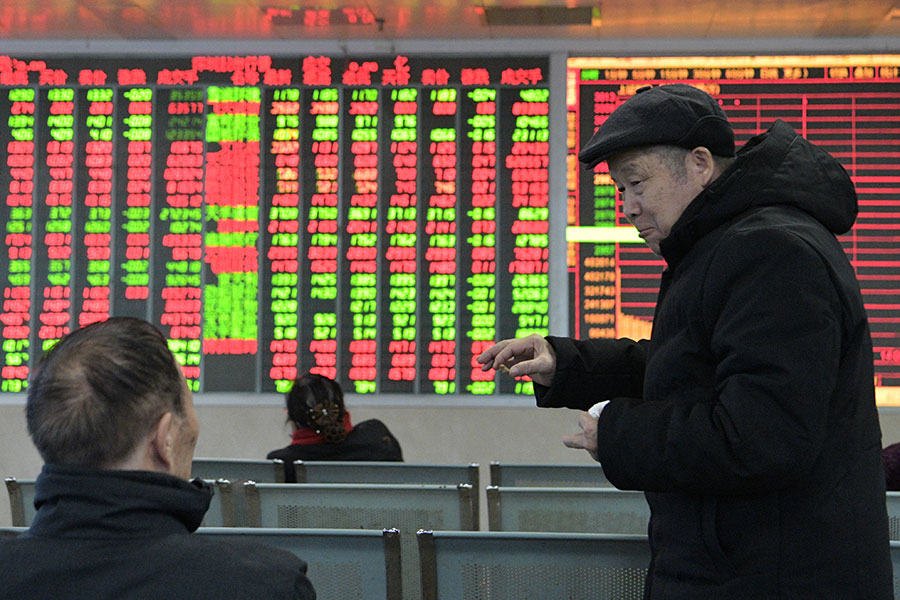
On Feb 3, the benchmark Shanghai Composite Index slumped by nearly 8 percent. It also marked the largest single-day point loss since 2016. Investors had priced in COVID-19 amid the 10-day-long market closure in a one-off way.
The market then staged a recovery, with the SCI closing at 2917.01 points on Friday, erasing 74 percent of the loss registered on Feb 3.
The market decline reflected the short-term effects of the epidemic on the economy. Sectors like catering, tourism, and entertainment have been hard-hit, while the extended Lunar New Year holiday has hurt production at companies in other sectors.
To be sure, the market correction was triggered by COVID-19. Its end depends not only on when the epidemic can be contained but on whether policy efforts can effectively prevent the impacts so far on the economy and the market from transmitting and magnifying themselves.
If the transmission channels cannot be blocked, the impact of the outbreak can become long-lasting and cause far more serious economic and financial losses than the short-term direct shocks.
There are three major transmission channels for the short-term shocks to turn long-lasting: expectation, liquidity, and leverage. Luckily, precautionary policies are either already underway or can be expected in each of the channels, which will help contain the transmission and make market shocks from the epidemic short-lived.
The first channel for the short-term virus shocks to become long-lasting is via the blow to market expectation and confidence. If the market loses confidence in the Chinese economy because of the epidemic, the willingness to consume and invest will get hurt. In other words, pessimistic expectations of economic growth will prove self-fulfilling.
Yet risks from this perspective are quite limited. Based on the policy signals given so far, the government is not going to lose sight of its goal to complete the task of building a society moderately prosperous in all respects by the end of this year.
This unchanged target will help shore up confidence and reassure the market that the government will roll out a slew of measures to ensure steady economic growth this year.
Also, China has once again showed its strong ability to mobilize nationwide resources to achieve joint goals amid the COVID-19 battle. Different regions have rendered solid help to Hubei province, the center of the epidemic, and the public have made substantial voluntary donations to support the battle. All these are encouraging signs for market entities.
The second channel is via the difficulties faced by enterprises in maintaining a steady cash flow amid the sudden slowdown in economic activity. A cooling economic scene caused by the epidemic is expected to be short-lived, but could yet lead to long-lasting damages as many businesses may face liquidity crisis; and some may even go bankrupt.
Policymakers are aware of this risk. Last week, the central bank injected a large amount of liquidity into the banking system to stabilize the market. Meanwhile, top financial regulators have jointly released a circular that directed financial institutions to ramp up lending or credit support for enterprises in the real economy.
Fiscal authorities will provide subsidized loans to reduce financing costs faced by severely affected enterprises. Many local governments also rolled out policies to help businesses, especially small and micro ones, to negotiate the short-term difficulties.
If the policies discussed above pan out as expected, the nation should be able to avoid any major liquidity crisis from breaking out in the real economy and the financial market.
It should be clarified that while a liquidity crisis is a possible fallout of the epidemic, a debt crisis is not.
Some argued that the epidemic will trigger a debt crisis based on the fact that China's debt-to-GDP ratio now stands at about 260 percent, 110 percentage points higher than what it was during the SARS outbreak of 2002-03.
But we should also note that the higher debt level is accompanied by increasing assets. In fact, both the economy as a whole and various sectors within it have healthy balance sheets.
The third channel for short-term shocks to linger is via the possible swift deleveraging in the stock market. During the 2015 market meltdown as well as in the second half of 2018, slumping share prices led to a large-scale sell-off of stocks pledged as collateral for listed firm loans and margin trading. This accelerated market downturn and threatened financial stability. Now, it is conceivable that a virus-triggered market decline may lead to a repeat of such risky deleveraging.
But a much smaller outstanding amount of leverage businesses has alleviated this concern. At present, the outstanding amount of margin trading accounts for about 1.7 percent in total free-float capitalization of the A-share market, much lower than the 3.3 percent during the 2015 market meltdown. The outstanding share-pledged borrowing by listed firms has also dropped significantly from the peak.
The securities regulator has made preemptive arrangements to prevent risks related to the leverage businesses before trading resumed on Feb 3. So, it is reasonable to assume that the possibility of the epidemic causing drastic deleveraging in the stock market may be very low.
In conclusion, investors should closely monitor the developments in epidemic control to estimate short-term market disruptions. Any such impacts will likely prove to be short-lived, given the timely policy reactions to block the transmission channels that prolong short-term shocks, leaving risks to the A-share market under control.
After all, what really concerns investors is not the short-term losses that can be easily calculated, but the long-term risks that cannot be clearly measured.
The writer is the chief economist at BOC International (China) Co Ltd.