



Virus gives rise to sharing of employees









The novel coronavirus outbreak has had a huge impact on the labor-intensive hotel and catering industries. Before the coronavirus outbreak, the hotel and catering sectors employed more than 30 million people in urban areas, of which about 20 million are migrant workers.
Yet, despite media reports saying that catering enterprise Xibei that employed about 20,000 people has suspended business, the COVID-19 outbreak has boosted other forms of businesses including supermarkets, which now face a temporary shortage of employees.
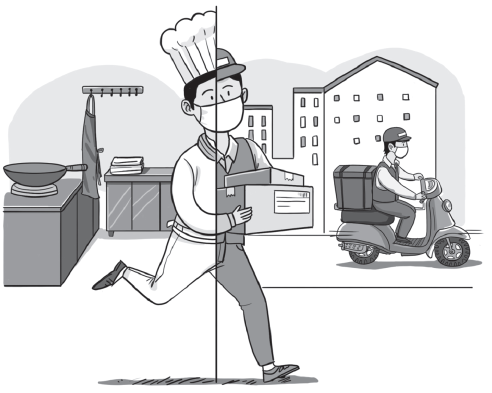
This has given rise to a new phenomenon, of "sharing employees", in the retail industry. For example, fresh delivery service platform Freshhema "borrowed" more than 1,000 employees from Xibei recently. And many online retail platforms such as JD.com and Alibaba have begun to invite other enterprises' workers who are temporarily out of work to make up for the shortage of delivery staff.
Such a new arrangement among enterprises reflects the efficiency of the market, and its efforts to promote win-win cooperation in the time of epidemic. Since "cooperating enterprises" have similar businesses, and the delivery staff don't need high professional skills, it is relatively easy to promote the "sharing employees" trend in the short term.
"Sharing employees" is a form of flexible hiring as part of the sharing economy. Thanks to the giant strides China has taken in the field of high-tech, including information technology and big data, the sharing economy has developed rapidly in the country. And due to the use of artificial intelligence and robots for basic, monotonous work, more and more people in the manufacturing industry have become open to flexible employment.
According to State Information Center data, the trade volume of the sharing economy in China in 2018 was about 2.94 trillion yuan ($418.22 billion), up 41.6 percent year-on-year, with the number of service providers being about 75 million, an increase of 7.1 percent year-on-year.
More important, many enterprises can share their production capacity, office space, knowledge, skills, and medical and other resources with each other. In the sharing economy, a majority of service providers, such as online car-hailing drivers and delivery staff, work part-time. The sharing economy is also an important employment provider for members of some social groups such as poverty-stricken people and veterans.
In the past, the sharing economy was all about sharing "products", but now enterprises are sharing employees. In some sense, anyone employed in the sharing economy is a "shared employee", which indicates the rising flexible employment trend.
In the future, more and more big enterprises are expected to take advantage of the trend of "sharing employees" to reduce the cost of human resources and increase efficiency and flexibility, especially during emergencies such as an epidemic. But since a stable operational team and talent pool are also important to enterprises, they will continue to hire a large percentage of their workers as full-time employees.
Different kinds of workers meet the labor demand of different enterprises. So if the government makes clear regulations on labor relations, the market will work to balance the different kinds of labor demand and supply. For instance, many workers who work by the hour will mainly offer their services to the companies involved in the catering and delivery sectors.
Urban areas are ideal for striking the right balance between the demand and supply of workers, including part-time workers. In urban areas, it is easier to achieve efficient mobilization of resources, including human resources. This in turn is conducive to information sharing and labor mobility, which is crucial for the sharing economy and for promoting the arrangement of "sharing employees".
Given the rising trend of the sharing economy, the "sharing employee" phenomenon is expected to develop rapidly. Workers could participate in different kinds of sharing economy activities to increase their income by working for different employers at different times based on their needs. And enterprises could reduce their human resources cost and improve their flexibility and efficiency, which would be a win-win result for both parties.
The author is a professor at the School of Economics, Renmin University of China.The views don't necessarily represent those of China Daily.


Today's Top News
- Deep sea needs down-to-earth scientific research
- Deeper opening-up promised for steady growth
- China to rebalance growth with domestic demand boost
- Consultative suggestions provide policymakers with essential inputs to finalize five-year plan
- Decoding China: How the people run the country
- AI helping to redefine entrepreneurship





