Wildlife trade ban welcome to protect public health









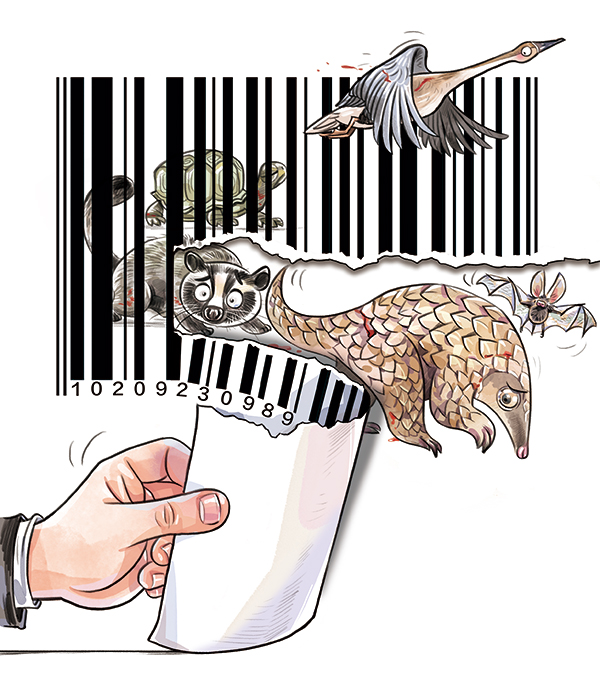
The Standing Committee of the National People's Congress, China's top legislature, on Monday banned the illegal trade in wildlife to stop sale and consumption of wild animals and safeguard people's health in the wake of the outbreak of the novel coronavirus, which is widely believed to have originated in wild animals. The top legislature made it clear that all wildlife on the protection list of the Wild Animal Protection Law and other laws, and all terrestrial wildlife, including those artificially bred and farmed, are banned from consumption.
China formulated the Wild Animal Protection Law specifically to protect wildlife, including wildlife under State level-1 and level-2 protection. The list of wildlife under special State protection was formulated after scientific evaluation by the department in charge of wildlife protection under the State Council, China's Cabinet. The list is adjusted every five years.
Hierarchical protection based on the rarity and importance of wild animals will ensure the law helps protect the ecological environment and prevent the extinction of wildlife, which could have a devastating impact on human beings.
Law meets the needs of the time
Such protection principles meet the needs of the times and are in line with the wildlife protection law of most countries across the world. Still, China's wildlife protection system has some inherent shortcomings, because according to the existing laws, scientists can capture wild animals for scientific research.
If researchers are allowed to use wild animals to conduct experiments, we should plug the loopholes after their research. For example, scientists are allowed to use bats that live in caves to study viruses, but there is no regulation on how should they dispose of them after their research is over? If some scientists conduct experiments on wild animals and sell them illegally to make profits, how to stop such an activity?
Besides, despite the hierarchical management system for wildlife protection, some operators continue to capture wild animals, breed them on a large scale and then sell them for profits. How to regulate such a behavior? For instance, should the law prohibit large restaurants from serving giant salamanders just because they claim the animals were bred in captivity and not caught in the wild?
Top legislature's decision to plug loopholes in law
The NPC Standing Committee's decision will help plug such legal loopholes in the wildlife protection law and address the problem of breeding and selling of wild animals. It will prevent companies as well as individuals from artificially breeding and farming, or selling wild animals, by banning the consumption of wild animals.
Also if artificially bred wild animals appear on the dining table, judicial authorities can hold those involved in such activities responsible. As such, the top legislature's decision will make the wildlife protection law and regulations more stringent.
After the top legislature's decision comes into force, domestic catering enterprises that serve dishes that use wild animals will have to adjust their business models, because the sale and consumption of wild animals would invite severe punishment.
But since the range of wild animals is too wide, given that rabbits, mice, sparrows and all animals that are not domesticated are considered wild, it could become catastrophic for some large farms that breed animals. After all, there is no strict clause in China's wildlife protection law for either wild or domesticated animals or poultry.
Wild animals versus domesticated animals
There is no clear boundary between wild animals and domesticated animals, or wild animals and livestock in the wildlife protection law. The law authorizes the relevant administrative department to adjust the list of wildlife under protection according to the requirements, and the officials in charge strictly enforce the law in accordance with the relevant list of wildlife protection promulgated by the administrative department.
Given that the public may not know the full list of wildlife protected under the Wildlife Protection Law, many consumers may consciously or otherwise violate the law by purchasing animals on the wildlife protection list.
Also, since China is traditionally an agricultural country, people have been artificially breeding a large number of wild animals and birds for hundreds of years. So we should also attach due importance to agricultural development and domestication of some wild animals and birds to do justice to the country's agricultural civilization.
Need to support ban on wild animal consumption
Nevertheless, we need to support the NPC Standing Committee's decision, because before the real source of the novel coronavirus is found, it is necessary to prohibit the artificial breeding and consumption of wild animals to control the further spread of the virus.
As one of the oldest civilizations, China has accumulated plenty of experience in raising wild animals in captivity. And to address the food problem, it is necessary for China to explore newer ways to artificially breed animals, because if artificial breeding of wild animals is strictly controlled, fishing will inevitably intensify, leading to a drastic drop in marine life, even extinction of some marine species.
Many countries, including Canada, have clear laws restricting the fishing of species such as tuna. Their goal is to ensure that fish like tuna continue to thrive and help maintain a balance in the marine ecology. China should learn from other countries' wildlife protection laws and regulations to address the problems associated with its wildlife protection law.
Classification of animals necessary
To begin with, China should classify animals into wild animals, non-wild animals and domesticated animals. Not all wild animals artificially bred can be termed as domestic animals. There should be a clear boundary between wild animals and nonwild animals. If the protection list is adjusted only to increase or decrease the number of wild animals, the protection of wild animals will remain uncertain. Which would be detrimental to the protection of wildlife, as well as the interests of consumers and businesses.
As such, China should change the traditional mode of cataloguing wild animals and implementing hierarchical management for them. If rare or endangered species of wild animals need absolute protection, the authorities should make public their list and publicize the relevant regulations, so that people know which animals are not to be sold, killed or consumed. The goal of the special management of rare and endangered wild animals is to ensure they survive and thrive so as to maintain a healthy natural ecology.
Second, based on an effective classification of wild animals, the regulations on animals that can be used for scientific experiments and kept as pets should be strengthened.
Thanks to the legal provisions of wildlife protection, judicial organs have taken measures against those who kill or sell wild animals, and investigated some perpetrators for criminal responsibility. Which shows China attaches great importance to wildlife protection.
Wildlife protection system with Chinese characteristics
But as China has the highest population in the world, it is possible that some people will encounter wild animals either in the wild or in the market. So it is necessary to develop a wildlife protection system with Chinese characteristics, which can exempt people from legal punishment under specific circumstances.
Judging from a series of wildlife protection cases in Henan province, it is clear that some people do catch and sell wild animals to make money, while others use their skills to catch wild animals as part of their tradition. If artificially breeding of wild animals is strictly prohibited, some traditional skills, such as monkey performances may be lost forever. Whether this would be beneficial or harmful to wildlife conservation needs to be carefully studied, especially because the line between wild and domesticated animals has been changing.
But since it is necessary to better protect wildlife, the top legislature's decision to ban the consumption of wild animals is welcome. And all sectors of society should refrain from selling and buying wild animals. But more specific and scientific research is needed before the authorities decide to amend the wildlife protection law.
The author is a professor of law at Zhongnan University of Economics and Law. The views don't necessarily reflect those of China Daily.