



How the coronavirus outbreak is affecting human capital development









Editor's note: Wang Yan is a senior specialist at the National Institute of Education Sciences; Patricio V. Marquez is a former public health lead specialist of the World Bank Group; Eduardo Velez Bustillo is a visiting professor of Kobe University, Japan. The article reflects the authors' opinions, and not necessarily the views of CGTN.
As the COVID-19 outbreak becomes a global epidemic, the world is starting to grapple with the potential impact on human capital – the key factor that drives productivity, wealth creation, and welfare improvements.
If the virus continues to spread across countries, human loss and social and economic impact could be significant. Previous epidemics like the Ebola in Africa show that large numbers of health workers are negatively affected, which could weaken the health care system in low-income countries.
The novel coronavirus is now in 59 countries across six continents, resulting in more than 87,000 cases and 3,000 deaths as of Sunday.
The disproportionate infection and subsequent mortality of health workers, in turn, might have negative spillover effects on society as a whole. The perceived high risk of being infected while working as a health care provider during an infectious disease outbreak may be a disincentive for young people to enroll into education programs to become doctor, nurse, or other medical workers.
Moreover, the disruptions in day-to-day health care services, compounded by loss or shortage of health workers during the outbreak might cause difficulties in regular treatment for other health needs and thus increase the mortality of diseases overall.
Estimates of an important problem that may affect countries rose when students can't study in their classrooms. Although information and communications technology (ICT) can provide alternative online learning programs, as in the case of the e-learning program in China, quality of delivery varies.
As governments prioritize life and health over economic growth by quarantine and closures interventions, many social and economic activities were suspended and the labor market has frozen to varying degrees.
It could potentially disrupt global supply chains and engender a reduction of global economic growth. In particular, retail sales and industrial outputs are likely to decline, with reduced demand, which may present additional challenges on employment and social well being.
China, the first country hit by COVID-19, has made great efforts to address the challenges.
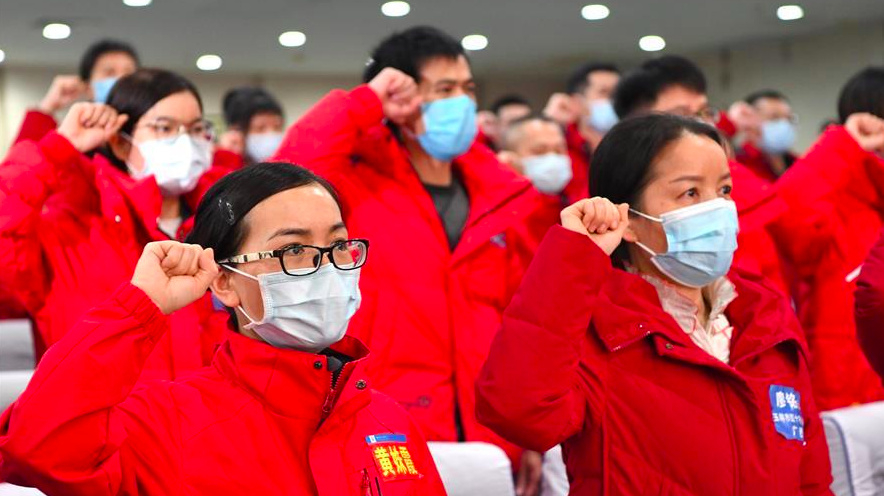
To start with, not only has the government mobilized medical workers and resources nationwide to support the localities at the epicenter of the outbreak, but temporary allowances of health care workers involved in the outbreak had increased at one fold and the temporary salary had doubled in central Hubei Province.
China has implemented large scale and long duration quarantine. Meetings are held soon after the outbreak decided to upgrade health care and emergency response systems in China.
To meet the challenges in the economic sector, the government has lowered taxes and provided exemptions to protect and support startups and small and medium enterprises.
An array of policies has been launched to support the employment of university graduates and migrant workers. A total of 18,900 new positions are offered to increase the amount of enrollment of master degree graduates, lowering the risk of unemployment and boosting the quality of human capital.
Yet there are more challenges down the road that call for innovative and resilient policies to recover the economy, sustain economic growth, and protect and ensure the harmonious well-being of its people in China and other countries as well.
In the past half century the world has seen more progress in improving the human condition than has occurred at any other time in history. In particular, China has improved the quality of health, nutrition, education, and other social services through investing in human capital development.
Evidently, facing the risk of disease outbreak as COVID-19, stronger and resilient public health and medical care structure and services are more critical than ever among nations in a growing inter-connected and inter-dependent world.
Countries need economic growth to generate more opportunities for people to improve their way to a better life and human capital. Only with advanced governance system can reinforce one another and optimize the route to efficient, equitable, and sustainable goals.





