



Despite hurdles, biggest wish of Afghans remains peace









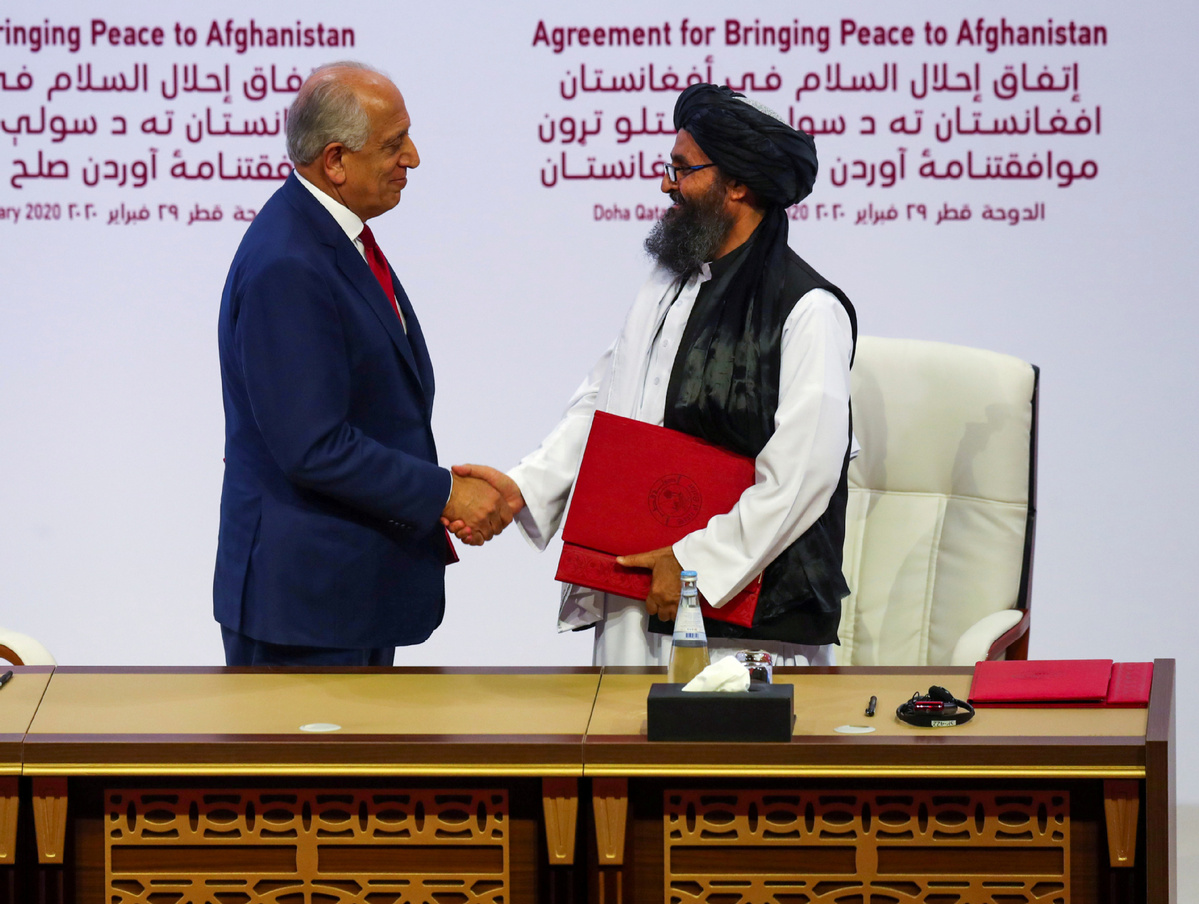
The United States inked a historic peace deal with the Taliban on Feb 29 after more than one year of negotiations, setting in motion the potential of complete withdrawal of US troops from Afghanistan in 14 months.
The deal requires the Taliban to stop harboring terrorists and start intra-Afghan talks with all Afghan parties to reach a cease-fire agreement.
Yet the Taliban attacked the Afghan army just four days after the deal, prompting the US to launch air strikes on the militant group's camps, heightening doubts on whether the US can withdraw all its troops from Afghanistan and bring its longest fought war to an end.
The intra-Afghan peace process, too, is faltering. While the Taliban said it will not participate in any domestic peace talks unless the Afghan government agrees to release 5,000 Taliban prisoners, Afghan President Ashraf Ghani Ahmadzai refused to do so. As a result, the intra-Afghan peace talks scheduled for March 10 could not be held.
The political power play in the war-torn country has further endangered the peace process, especially because the presidential election results have led to a fierce war of words between President Ghani and former chief executive Abdullah Abdullah, both of whom were sworn in as "head of state" on March 9.
Which shows that the possibility of bringing permanent peace in Afghanistan, despite the US-Taliban peace deal, is not so high. Many analysts say Afghan politics could become even more turbulent as the withdrawal of all foreign troops will make domestic issues a bigger sticking point leading to fights between political groups, and thus create a power vacuum.
Some observers, however, say that given the large number of social woes due to years of sluggish economic growth, extremist forces could gain more popular support and grab power in the country. Especially, radicals within the Taliban opposed to the peace talks with the US could seek the help of terrorist outfits such as al-Qaeda and the Islamic State group to grab power in Afghanistan. Such a scenario will take the country closer to partition and pose a new security threat to the Afghan people as well as the people in neighboring countries and regions.
Notwithstanding the many misgivings about the peace process, however, peace remains the biggest wish of the Afghan people, most of whom also want the cease-fire talks to replace the war. In this sense, the prospect for peace appears bright, particularly because the US-Taliban peace deal is an important step toward that reality.
The Afghan war has inflicted deep wounds on the people and deprived them of the chance to see the economic development of Afghanistan and improvement of their livelihoods. To a large extent, the presence and intervention of the US in Afghanistan seems to be thwarting the peace process. This is to say, the withdrawal of all US forces is a prerequisite for the start of any peace process.
In the long term, the real challenge is to integrate all the Afghan parties. As the US reduces its troops, almost all parties in Afghanistan are seeking after the Taliban. The Ghani administration and Abdullah both have shown a positive attitude toward the Taliban in a bid to lead the intra-Afghan talks. Although this will not necessarily lead to reconciliation among all parties, it could accelerate the dialogue between the Taliban and the Afghan administration and promote the peace process.
But some say it is highly unlikely that the Afghan administration and the Taliban will reach an agreement even if they hold talks, because they have serious differences on many issues including secularization, political system, governance philosophy and values.
Hence, all parties should first establish mutual trust, in order to start the intra-Afghan peace talks. And once the talks start, they should try to reach a consensus on the constitution of power, while keeping in mind that good governance and values are pivotal to Afghanistan's long-term development.
Looking ahead, the different parties will fight fiercely to dominate the development agenda in Afghanistan. But instead of a feud, this should be seen as a process of adapting to each other, which is essential to establish peace in Afghanistan.
The author is a researcher at Institute for Foreign Policy Studies of Shanghai Institutes for International Studies and vice president of Middle East Society of China. The views don't necessarily represent those of China Daily.





