



Handle return of native students carefully









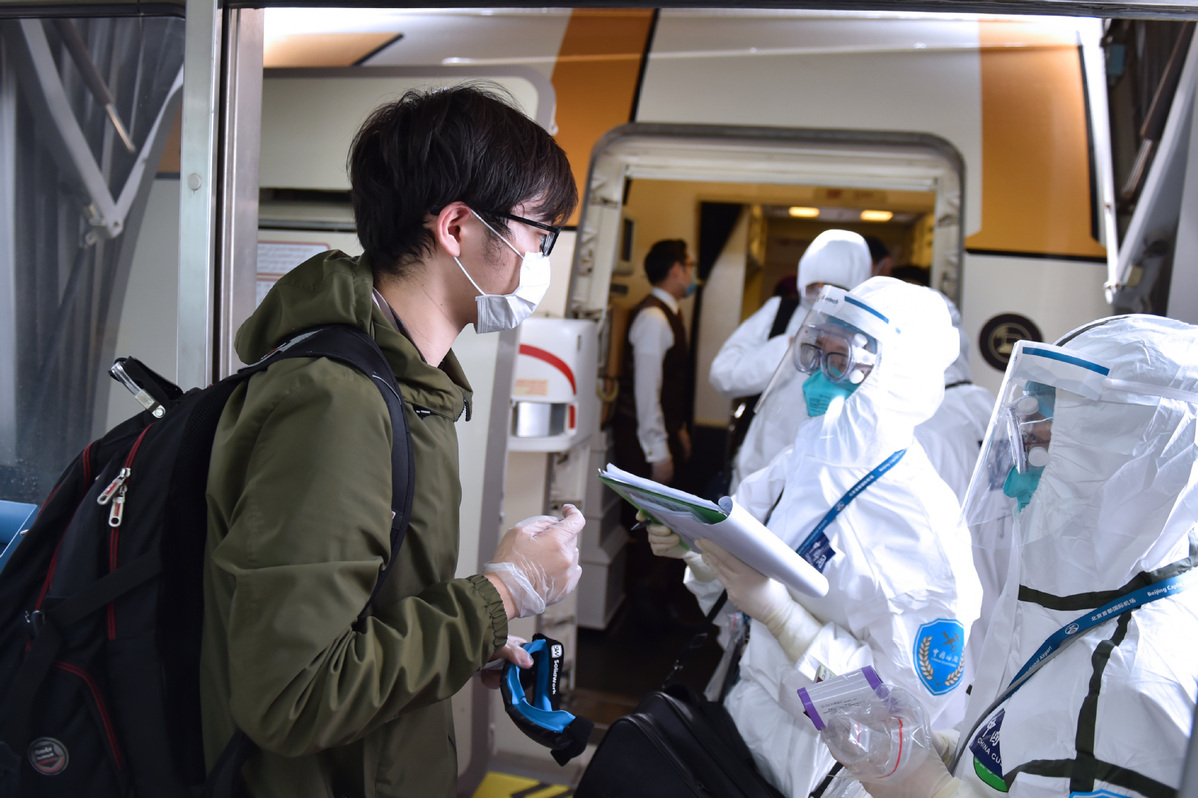
The rapidly worsening situation around the world due to the novel coronavirus pandemic has forced many countries to close down schools to curb the spread of the virus, which has affected Chinese students studying there, particularly those in the worsthit countries and regions.
Aside from the threat posed by the novel coronavirus, a number of these students have also become the target of social discrimination and xenophobia in some places. As such, a large number of Chinese students studying overseas are returning home, putting additional pressure on China's epidemic control work.
According to the Ministry of Education statistics, in 2018 about 1.53 million Chinese students were studying overseas, most of them in Europe and the United States which have become the new epicenters of the pandemic.
A large number of such passengers are arriving at China's major airports, especially those in Beijing, Shanghai and Guangzhou, Guangdong province, where the quarantine and public health departments are obliged to screen all international arrivals to ensure that all infected arrivals are quarantined.
Yet, despite the efforts of the inspection and quarantine departments, about 700 people infected with the virus had entered the country up to Sunday, many of whom were Chinese students studying abroad. This has made it even more difficult for the Chinese authorities to contain the epidemic in the country, where local cases of infection have not been reported for days in most provinces and regions.
Many countries have banned international travel, resulting in a sharp reduction in flights and a drastic rise in air fare. That some people have to transfer several times before reaching their country of origin further exposes them to infections. Still, that does not justify the call of some people to shut the door on incoming Chinese nationals. Those opposing the return of Chinese nationals should know that panic will not win the battle against the virus.
It is important to keep in mind that, by constantly improving and adjusting its measures due to mounting pressure from imported infections for more than a month, the customs, airport, quarantine, public health departments and local governments in provinces and cities have implemented a set of closed-loop management system that have effectively prevented infected cases from entering China, and minimized their impact on the domestic epidemic control measures.
For instance, all international arrivals are required to undergo mandatory 14-day quarantine at their own cost. And the seamless cooperation among different departments and grass-roots authorities is crucial to make the system function smoothly.
That said, the arrangement to handle international arrivals should be seen as a valuable public good and therefore must be tilted toward the most needy groups, such as Chinese students returning from overseas-who since the launch of reform and opening-up in the late 1970s have played an important role in boosting China's development and will continue to do while acting as a bridge between China and the world.
So the Chinese government should take multiple measures to help such students meet the challenge posed by the pandemic, particularly those returning home from the worst-affected countries and regions.
And the returning students must strictly abide by the 14-day mandatory quarantine and other norms upon arrival. This will not only better protect the students but also help contain imported infections.
The State, on its part, can establish a database where such students can register themselves and submit details of their health condition, which will allow the authorities to monitor their health even after the mandatory quarantine period. Also, the database can be linked to the information declaration platform of all inbound passengers to make the health screening of the returning students more effective.
In fact, Zhejiang province has tried to do so, showing that China has the technological and institutional expertise to especially help the overseas Chinese students to return home.
The worsening pandemic situation worldwide has made this even more important for China, and the measures taken by China in this regard will allow other countries to learn from China's experience.
Yang Jingmin is a researcher at the Institute of Urban Governance at Shenzhen University, and Yang Xuedong is a Beijingbased researcher.
The views do not necessarily represent those of China Daily.





