



Save lives but also avoid global recession









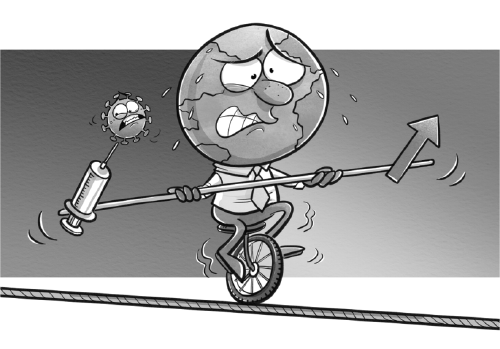
The potential impact of the novel coronavirus pandemic is enormous. But extreme policies to contain the spread of the virus also have colossal costs. Ignoring the trade-offs could land us with one of the worst possible outcomes.
An Imperial College study on death impacts from different policies might have made both US President Donald Trump and British Prime Minister Boris Johnson change their minds on imposing lockdowns. The absence of prevention and control measures means most people falling sick at the same time, which would overwhelm the healthcare system.
Without restrictions, infections would peak in early June in the United Kingdom, with 280,000 people needing hospitalization when only about 8,000 new beds could be made available. That is why it is crucial to "flatten the curve". Policies to reduce the speed of infection can help spread and stagger the confirmed cases and thus make hospital beds available for more people who need it.
Strict rules can flatten curve but have serious side effects
Smart policies like self-isolation and home quarantine for the most vulnerable groups have little cost and can flatten the curve somewhat, reducing deaths by 50 percent. Still, they would leave tens of thousands of people dead in the UK. So almost all societies have decided that stronger, general policies are needed to fight the pandemic.
The Imperial College defines social distancing to mean that students still go to school and people to work, while curtailing other social interactions such as going to restaurants, cinemas and bars by about 75 percent. Together with the other smart policies, this could flatten the curve to such an extent that almost enough beds would be available for everyone who needs them over the next five months.
Unfortunately, the study also shows that such a successful reduction in infection cases means few people have gained immunity. So if restrictions are lifted, say, in September, a second wave of infections could once again overwhelm society and kill more people.
Thus, to keep the number of deaths low, the Imperial College study says we might have to maintain social restrictions for most of what could be a two-year wait before vaccinations are hopefully available. But up to two years of stringent social restrictions will not only be phenomenally costly but also hard to keep in place.
US economy could shrink by 30 percent
Let's look at the costs first. Most of the early predictions were moderate, but the world's much stronger policies have substantially hiked the costs. According to JP Morgan, China's economy will shrink by an unprecedented 40 percent in the first quarter of 2020. For the US, Goldman Sachs has forecast a 24 percent GDP reduction in the second quarter with Morgan Stanley predicting a 30 percent drop. This, coupled with the fact that 10 million Americans have filed for unemployment benefits in the past two weeks, is a very worrying sign.
Moreover, most governments seem to be committed to extreme policies to keep the number of deaths low in the long run. Yet such policies will cost much, much more. If China resumes normal economic activities, it risks a second wave of infections; if it doesn't, the economic contraction could continue, even get worse. Economists are now suggesting the costs of continued extreme policies could be comparable to Germany in the 1920s or the United States during the Great Depression, with a third of the workforce unemployed and a generational loss of opportunities.
The current raft of extreme shutdown policies spanning much of the world includes closing of borders, suspending travel and closing schools, entertainment venues, restaurants, bars, malls, sports facilities, and therefore suspending employment.
Shutdowns cannot be sustained for months
These policies cannot be sustained for months. Already, cell phone tracking shows that 40 percent of Italians still move around despite the lockdown. In France, "virus rebels" are defying bans, and youths are holding "corona parties" in Germany.
As weeks of shutdown turn into months, this will get much worse. With many more people at home, this will likely lead to higher levels of domestic violence and substance abuse. As schools stay closed, the skills of the next generation will erode. One study shows closing schools for just 13 weeks could initially cost an economy 8.1 percent of GDP. As more people become unemployed and the economy plunges, we will be able to afford much less, leading to lower-quality healthcare for everyone. Politically, the outcome could be dire-the previous long-term recessions in the 1920s and 1930s didn't end well.
So we need to discuss the trade-offs between tougher shutdowns and economic calamity openly. The US administration has irresponsibly been itching to end most restrictions by Easter. It could help the economy in the short term, but in the long run it could lead to a catastrophe as forecast by the Imperial College.
Long-term shutdown policies can similarly lead to devastation: first destroying the economy, and then with policies' support withering and health regulations unraveling by September, a secondary, huge wave of deaths could follow.
Middle ground needed to fight the pandemic
Fortunately, the Imperial College study maps out more of a middle ground. It doesn't advocate the complete shutdown policies that many countries have imposed. The researchers envision that students continue studying and most people continue working while reducing their social interactions. They also say that cancelling mass gatherings have "little impact".
This middle ground is more like what Sweden has been doing-recommending people to work from home if possible, and asking those who are sick and above 70 to avoid social contacts. But most people still work, children go to school, most of society is still running. This is sustainable in the long term. Shutting everything down-like France, New Zealand and California-is not.
We need to map a middle course that would save most lives and avoid a catastrophic recession.
The author is president of the Copenhagen Consensus, visiting fellow at the Hoover Institution, Stanford University, and visiting professor at the Copenhagen Business School. The views don't necessarily reflect those of China Daily.


Today's Top News
- Shared Journey: Chinese new energy vehicles in Europe: competition or co-creation?
- Deep sea needs down-to-earth scientific research
- Deeper opening-up promised for steady growth
- China to rebalance growth with domestic demand boost
- Consultative suggestions provide policymakers with essential inputs to finalize five-year plan
- Decoding China: How the people run the country





