



How outbreak is changing manufacturing









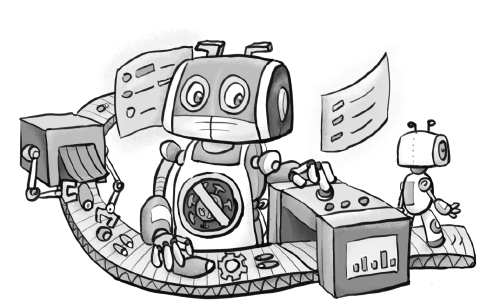
With the COVID-19 pandemic escalating, the risks inherent in global supply chains have become more apparent than ever. Rather than await a return to business as usual, with manufacturing activities concentrated in countries where labor is cheap and plentiful, companies in advanced economies are shifting their focus to the lowest-wage workers of all: robots.
Enterprises began relocating production to low-wage countries in the early 1990s, aided by the fall of the Iron Curtain, China's global integration and eventual accession to the World Trade Organization, and the rise of containerization. The period between 1990 and the 2008-09 global financial crisis has been called an era of hyper-globalization in which global value chains counted for about 60 percent of global trade.
The global financial crisis marked the beginning of the end of this era of hyper-globalization. In 2011, global value chains stopped expanding. They have not grown since.
This reversal was driven by uncertainty. From 2008 to 2011, the World Uncertainty Index-constructed by Hites Ahir, Nicholas Bloom, and Davide Furceri-increased by 200 percent. While during the 2002-03 severe acute respiratory syndrome outbreak, the WUI rose by only 70 percent, and after the United Kingdom voted in the 2016 referendum to leave the European Union, it surged by 250 percent.
When uncertainty rises, global value chains suffer. Based on past data, one can predict that a 300 percent increase in uncertainty-as the coronavirus pandemic seems likely to produce-would reduce global supply chain activity by 35.4 percent. Companies no longer consider the cost savings of offshoring to be worth the risk.
At a time when adopting robots is cheaper than ever, the incentive to reshore production is even stronger. The arithmetic is simple. A company in, say, the United States would have to pay an American worker a lot more than, say, a Vietnamese or Bangladeshi one. But a US-based robot would not demand wages at all, let alone benefits such as health insurance or sick leave.
Investment in robots is not new. Enterprises based in advanced economies have been pursuing it since the mid-1990s, led by the automobile industry, which can account for 50-60 percent of a country's robot stock. In Germany-a global leader in robot adoption-robots per 10,000 workers in manufacturing stood at 322 in 2017. Only the Republic of Korea (710 robots per 10,000 workers) and Singapore (658 per 10,000) have a higher ratio. The US has 200 robots per 10,000 workers.
In fact, when the global financial crisis struck, some countries, such as Germany, already had enough robots to minimize the importance of labor costs in production. Many others, aided by the sharp post-2008 decline in interest rates relative to wages, boosted robot adoption and reshored a larger share of production.
The same is likely to happen today. Based on monetary policy so far, a 30 percent drop in interest rates can be expected, as central banks try to offset the damage caused by the pandemic. Past data indicate that this could bring a 75.7 percent acceleration in robot adoption. (It will not bring an unbridled boom in robot adoption, though, because rising uncertainty also deters investment.)
This trend will be concentrated in the sectors that are most exposed to global value chains. In Germany, that means autos and transport equipment, electronics and textiles-industries that import around 12 percent of their inputs from low-wage countries. Overall, the German economy imports 6.5 percent of the inputs it uses.
Globally, the industries where the most reshoring activity is taking place are chemicals, metal products, and electrical products and electronics. The chemical industry stands out as the top reshorer in France, Germany, Italy and the US.
This trend poses a major threat to many developing countries' growth models, which depend on low-cost manufacturing and exports of intermediate inputs. In Central and Eastern Europe, some countries have responded to this challenge by investing in robots themselves. The Czech Republic, Slovakia and Slovenia (which have large foreign-owned auto sectors) now have more robots per 10,000 workers than the US or France. And the strategy seems to be working: they remain an attractive offshoring destination for rich countries.
Low-cost manufacturing hubs in Asia may have a harder time, especially in the wake of the pandemic. China, which secured its economic rise by establishing itself at the center of many global value chains, will face particularly serious challenges, despite its plans to shift to higher-value-added activities and boost domestic consumption.
Between rising protectionism (especially in the US) and the COVID-19 pandemic, the advanced economies seem to be geared up for a manufacturing renaissance. But while this may reduce risks for large companies, it probably will not benefit very many workers in the advanced economies, let alone the developing countries from which production is being shifted. For that, governments will need to implement policies suited to this new economic order.
The author is chair of International Economics at the University of Munich and a research fellow at the Center for Economic Policy Research.
Project Syndicate
The views don't necessarily reflect those of China Daily.


Today's Top News
- Shared Journey: Chinese new energy vehicles in Europe: competition or co-creation?
- Deep sea needs down-to-earth scientific research
- Deeper opening-up promised for steady growth
- China to rebalance growth with domestic demand boost
- Consultative suggestions provide policymakers with essential inputs to finalize five-year plan
- Decoding China: How the people run the country





