China, Japan, South Korea should fight crisis together









The COVID-19 pandemic has resulted in almost complete disruption of economic activities in every country, a crisis that is worse than the 2008 financial meltdown.
Therefore, China, Japan and South Korea should work together to lift all barriers to prevent the collapse of supply chains, restore intraregional tourism and revive cross-border investments.
China has managed to control the spread of the virus, but the number of cases is still climbing. South Korea seems to have flattened out the curve in terms of the number of confirmed cases, and Japan appears to be facing a rising infection curve.
The priority should be to fight the pandemic together and save lives first. Then steps should be taken to prevent a free fall of the economy and ensure economic recovery once the pandemic is brought under control.
China has adopted lockdown, mass testing and isolation to keep the virus in check, while South Korea has relied on mass testing and isolation. Japan has opted for selective, targeted testing as well as isolation.
The three countries need to contain the spread of the virus first, restore intraregional travel, and then revive supply chains and other economic activities.
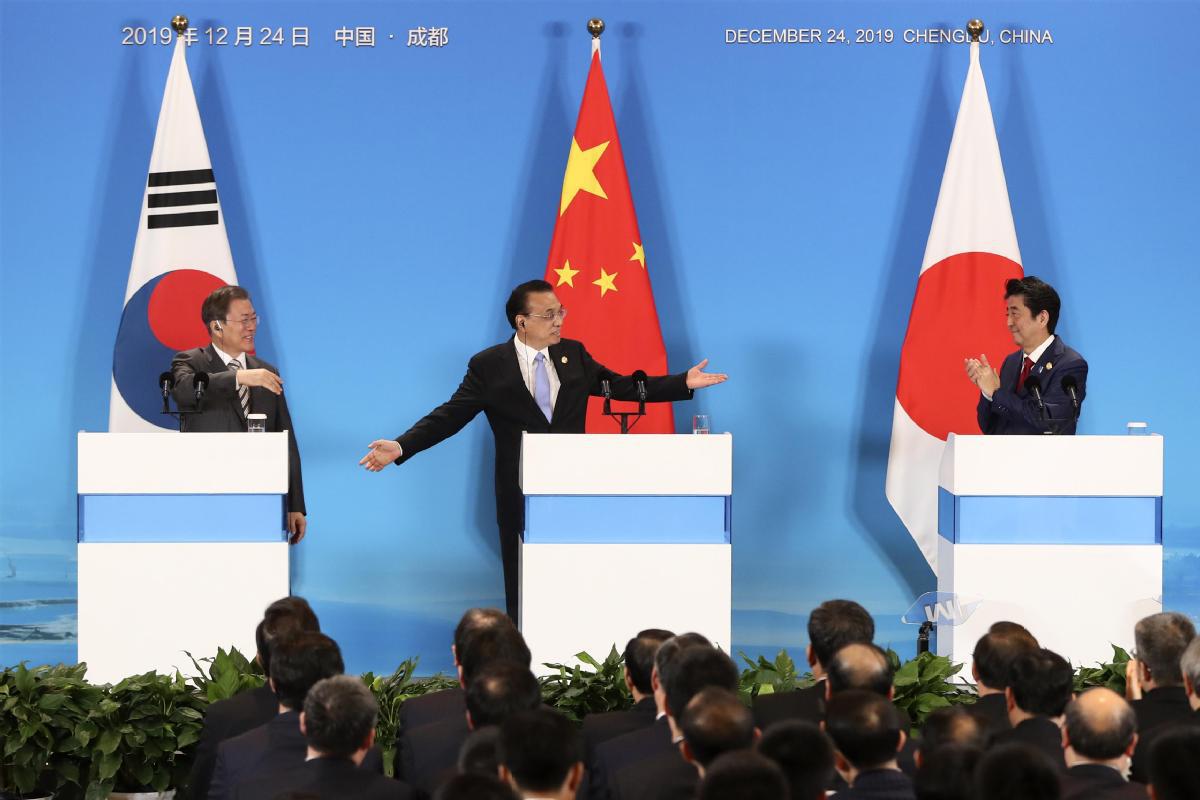
At the trilateral summit in Chengdu in December, leaders of the three countries unveiled the Trilateral Cooperation Vision for the Next Decade, in which they committed to realizing a "free, nondiscriminatory, transparent, predictable and stable trade and investment environment".
In the fight against the novel coronavirus, the leaders must commit themselves to the pledge they made at the summit.
In this regard, they should first establish a trilateral public health ministerial meeting under the trilateral summit framework as quickly as possible to address the urgent collective agenda. In doing so, they should be able to control the pandemic first and then move on to economic matters.
It is crucial for these countries to share accurate data on the coronavirus spread so they can learn from one another to devise effective preventive mechanisms.
They also need to share information with one another about how the testing of people has been conducted in each country, how many people have been isolated, and how the patients have been treated. This would be helpful in developing effective methods to control the virus.
Since these nations were among the first to experience the outbreak, they have a big database that could be used to achieve several objectives, including devising preventive strategies and working on joint vaccine development.
They should collaborate to manufacture medical supplies and equipment. Some of the key components should not be subject to export controls.
As the virus is likely to be contained in the three countries in the months ahead, they need to agree on when travel bans could be lifted. Restrictions on business travel should be lifted first, and travelers should be issued health cards certified by health authorities of the respective governments.
Then the restrictions should be eased for tourists visiting each other's country, followed by removal of tariff and nontariff barriers for the recovery of supply chains, even before the conclusion of the Regional Comprehensive Economic Partnership, a proposed free trade agreement in the Asia-Pacific region, or before they announce a free trade agreement among the three countries.
Second, they should be prepared for financial fallouts, such as international liquidity shortage and exchange rate volatility. Expansion of the currency swap mechanism among the three countries is recommended. Japan and South Korea should reinstate the currency swap agreement that expired three years ago.
This crisis could provide a new opportunity for these countries to deepen mutual trust and confidence building.
They will succeed in controlling the current wave of the pandemic, sooner or later. However, they should not risk any second wave of pandemic and should look for preventive measures not only for the current pandemic, but also for natural disasters such as climate change.
We are likely to face a different world in the post-coronavirus era, which will make it all the more challenging to foster cooperation and collaboration among these countries. We need to think about things together.