Opening a window to his soul









"With all the support, help and encouragement from my family, friends, doctors and good-hearted strangers, I don't just survive, I am reborn," he says.
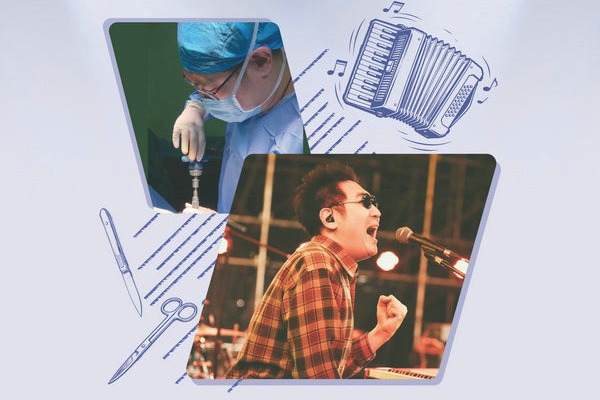
Tao was born in Fuzhou, Jiangxi province, in 1980. At the age of 7, he witnessed an oculist use a fine needle to pick more than 20 white "sand grains" from the eyes of his mother, who had been suffering from painful trachoma for years. She had contracted the condition from Tao's grandmother, who went blind as a result. However, his mother's pain was soon relieved through the doctor's precise handiwork, an action that inspired Tao to become an oculist 20 years later.
Among his 30,000 peers, he is now one of the very few domestic oculists capable of treating uveitis-the inflammation of the uvea, the layer of tissue that lies beneath the white of the eye-one of the most difficult ocular diseases to treat, and one of the major causes of blindness today.
According to professor Wei Wenbin, director of the ophthalmology department of Beijing Tongren Hospital, even with great effort in treating uveitis, there might be no obvious improvement. Not to mention that, after years of expensive treatment, patients are usually reduced to poverty.
But, taking Chinese microbiologist and virologist Tang Feifan-who, in 1957, was the first person to culture and isolate Chlamydia trachomatis, the bacterial agent that causes trachoma-as his model, Tao says his lifelong goal is to make an original contribution to the development of ophthalmology. Thus, precision medicine that accurately and quickly treats uveitis is his religion.
"We have developed a method that can more precisely and quickly find the causes of uveitis by examining fluids in the eyes," he says. He has published 79 papers on SCI journals, and cooperated with scientists from Germany, the United States and Japan.
Tao is a very diligent, hardworking person, according to Wei in an interview with Southern Weekly magazine.
"Very few oculists in China study uveitis. Without passion and devotion, it's really hard to continue," Wei said.
Tao has made best use of his time, working even during holidays. He is also happy to share his knowledge and experience with others.
His colleague Wang Hui, who joined Tao's team two years ago, says Tao has an open mind and heart, giving young people like her a chance to operate with him.
"The power of one individual is always limited, so I have been nurturing my team so that more people can perform operations independently. I also gave lectures about uveitis around the country," Tao says.
Apart from knowledge, what he has been trying to pass on to more people is the "positive power" that has supported him through the darkest days of his life, which is also his way of combating the issues that lead to frequent attacks on doctors in China.
"I don't believe people are born good or evil. People need to be shepherded to goodness," he says.
Tao does that by recounting warm stories that have inspired him.
In 2009, Tao joined Lifeline Express, an annual nonprofit medical excursion that carries oculists in trains around the country to provide free medical services to patients in remote locations.
The train arrived in Jiangxi province, where his hometown is, and an elderly woman, surnamed Wang, came to him, her back bent to nearly 90 degrees. Her small, sunken eyes appeared cloudy due to serious cataracts and Tao decided that the woman's situation was too complicated to operate in a train carriage. She couldn't even lie flat on the operating table.
The excursion's coordinator persuaded Tao to do her a favor, because Grandma Wang's husband and son had both died, leaving her alone. She was on borrowed time, with a tumor growing in her belly and this was probably her last chance to restore her eyesight.
While Tao was still hesitating, he heard her say in the local dialect: "I want to sew burial clothes for myself."
Tao understood, knowing that in Jiangxi, elderly women usually make their own burial clothes using cloth from their dowry. She also wanted to take a last look at the village where she lived all her life and see the villagers who had looked after her. Deeply moved, Tao operated on both of her eyes at the same time. Grandma Wang was very satisfied.
Later, as Tao was about to return to Beijing, he was told that a week after the surgery, Wang had died, but she was happy and had been able to sew her own grave clothes. She asked the coordinator to thank Tao for giving her seven days of light and helping her to find the way back home.
"This case taught me that the hearts yearning for light are always the same, no matter the circumstances, rich or poor, young or old," said Tao in a speech.
Modest and astute, Tao always takes inspiration from his patients. During a recent livestream, he said that, compared with his patients, his suffering was nothing.
He told of a 6-year-old girl who had undergone a bone-marrow transplant to treat leukemia. In order to treat her blindness, doctors needed to inject medicine into her eyes during treatment, but the girl refused general anesthesia.
"I asked her why. She said she needed to save money so that her family can live better," he says.
Later, she turned this painful experience into colorful and brave paintings, winning first prize in a competition.
"What amazed me the most is that she took 1,000 yuan ($141) from the 5,000 yuan prize and donated it to a boy whose procedure she thought was more difficult than hers," Tao says.
The boy's father, upon hearing of Tao's plight, attempted to gift him 1,000 yuan.
"I declined his donation. He has spent 10 years seeking treatment for his son in Beijing, sleeping in underpasses or on railway stations. He is very poor, but still tried to help me. I was so touched," Tao says.
"Confronted with such pain, they manage to live resiliently with open optimistic hearts, and pass love on to other people," he says.
"Patients are the best teacher."
Talking about resilience, Tao says he loves reading books like To Live by Yu Hua and The Cowshed: Memories of the Chinese Cultural Revolution by Ji Xianlin, both about people thriving in the face of misery.
"They show me that even in the driest desert, flowers can bloom," he says.