



Virus offers a way out of Thucydides trap









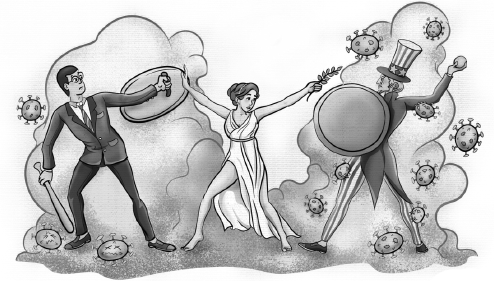
As Graham Allison, Douglas Dillon professor of government at Harvard University, has warned, "when a rising power like Athens, or China, threatens to displace a ruling power like Sparta, which had been the dominant power in Greece for a hundred years, or the US, basically alarm bells should sound". Nowadays, the alarm bells are sounding so loud that they are drowning out ideas that would allow the United States and China to escape what Allison called the "Thucydides trap".
There are three paths forward: one may be a dead end, another will lead to ruin, and the third could bring about a global recovery. The first path runs in the direction of what British historian Niall Ferguson has deemed the "Chimerica" model: a marriage of the Chinese and US economies. This perspective acknowledges the reality of the 21st century economy, which is deeply integrated through global value chains.
Difficult to deepen Sino-US integration
But the "Chimerica" model may no longer be feasible, owing to economic imbalances. Given the widespread backlash against globalization and China, particularly in the US, it is increasingly unlikely that a process of deepening Sino-US integration can be revived. If anything, a broad-based "decoupling" is already underway.
The second path would lead to a more adversarial arrangement, with China and the US each seeking to weaken the other. This could happen passively: one power might watch with folded arms as the other experiences difficulties. Or one or both sides could actively encourage domestic upheavals against the other, or even engage in outright sabotage. It should go without saying that choosing this route would be not only immoral but also dangerous. No responsible politician should advocate such a ruinous race to the bottom.
The third path leads toward restored mutual trust, by focusing on common interests and fighting common enemies. Returning to Allison's historical paradigm, it is worth remembering that while Sparta emerged as the winner of the Peloponnesian War, it nonetheless suffered a subsequent decline, opening the way for the peripheral Greek kingdom of Macedon to rise to power under Philip II.
In today's case, once China determined that the novel coronavirus posed a serious threat, it made huge sacrifices to contain the virus, thereby creating a window of opportunity for the US and the rest of the world to start preparing. Having flattened the contagion curve within its own borders, China is now demonstrating global solidarity by sending medical professionals and equipment to other countries in need.
Rather than recognizing China's decisiveness and thanking it for its help, the US has doubled down on disparaging the country. As Malaysian economist Andrew Sheng has observed, "Anything that China does that is supposed to be good will be treated as a conspiracy for China to grab power. China in the eyes of the West cannot do anything right." This predisposition is most unfortunate: the history of which Allison reminds us should not be forgotten, especially when it is repeating itself.
It doesn't have to be this way. China and the US could begin to rebuild their relationship through bilateral and jointly-led global initiatives to stem the novel coronavirus pandemic and put the global economy back on a sustainable growth path.
Although Sino-US relations have been strained for some time now, the two countries have a history of coming together to fight common enemies. After the Sept 11, 2001, terrorist attacks against the US, Beijing and Washington worked side by side to counter the threat posed by al-Qaida and its ilk. After the 2008 global financial crisis, too, the two sides came together to pull the world back from the brink of global depression. And in 2014, they signed a deal that paved the way for the 2015 Paris climate agreement.
China, US should treat virus as a common enemy
As a global crisis, the pandemic, too, should be treated as a common enemy. No country acting on its own can win the war against this virus. For now, at least, our common interest in defeating COVID-19 far outweighs our differences. By demanding that China and the US take the third path, the pandemic has offered the two sides a way out of the Thucydides trap.
To be sure, any two large countries with histories as rich and varied as those of China and the US are bound to have their differences. In recent years, those differences have accentuated tensions between China and the US. But there is no denying that the two sides have the same core interests in combating global challenges like the coronavirus pandemic, climate change, financial instability, and any number of other common enemies that may emerge in the future.
Unlike China and the US, emerging markets and developing countries lack the wherewithal to protect themselves against the pandemic. So, together, China and the US should offer bold proposals for more financing through a new issue of the International Monetary Fund's global reserve currency, Special Drawing Rights, as well as debt relief for poorer countries. Only then will struggling governments have the fiscal space to fight the pandemic and then restart their economies. If the virus and the economic crisis are still present anywhere, they will pose a risk everywhere, including China and the US.
Yu Yongding, a former president of the China Society of World Economics and director of the Institute of World Economics and Politics at the Chinese Academy of Social Sciences, served on the Monetary Policy Committee of the People's Bank of China from 2004 to 2006. And Kevin P. Gallagher is a professor of Global Development Policy at Boston University's Frederick S. Pardee School of Global Studies.
Project Syndicate
The views don't necessarily reflect those of China Daily.


Today's Top News
- Need for reshaping academic structure
- Shared Journey: Chinese new energy vehicles in Europe: competition or co-creation?
- Deep sea needs down-to-earth scientific research
- Deeper opening-up promised for steady growth
- China to rebalance growth with domestic demand boost
- Consultative suggestions provide policymakers with essential inputs to finalize five-year plan





