Wuhan showed the way to beat the pandemic









The whole world was taken by surprise by a new virus strain that was first brought to public attention in the outbreak in Wuhan on Dec 31. What initially was described by Wuhan authorities as "a cluster of pneumonia cases" still "of an unknown origin," by Jan 7 was determined to be a new strain of a coronavirus, similar to SARS, and within a week Chinese researchers had succeeded in deciphering the genome sequence that they immediately made available to the World Health Organization. Inspection teams were sent to Wuhan, and as soon as it was clear that there was human-to-human transmission, Chinese authorities, on Jan 23, simply shut down the entire city of 11 million people. All traffic in and out was effectively halted. This would soon be extended to the entire province of Hubei. Appropriate measures were also taken in other parts of the country.
Almost immediately, aid came from other parts of the country. Vice-Premier Sun Chunlan was sent from Beijing on Jan 27 to guide epidemic control in Hubei and she would remain there until Wuhan was declared free of the spread on April 8. There were voices from abroad critical of the Chinese measures. But what it did was to "quarantine" the epidemic, preventing the "community spread" in Wuhan from becoming a country-wide spread. More importantly it reduced the possible spread of the virus from China to the rest of the world.
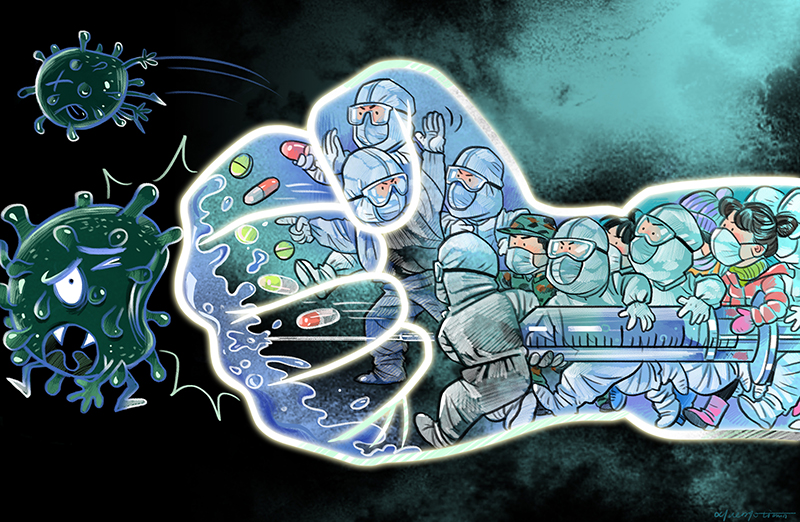
But with the mobilization of the central government, there was also a movement of the entire people. Everyone was focused on the looming danger and swung into motion. Over 40,000 medical personnel came to Wuhan to serve on the front lines. While people were forced to stay at home, they did not remain isolated. Community services saw to it that people were able to get food, with someone from their family able to leave to shop or to have food delivered.
And from start to finish, there was an adherence to the basics of disease prevention: Donning masks, taking temperatures, extensive testing to determine those who may be carrying the disease without symptoms and contact tracing. China also had a distinct advantage over the rest of the world for the country had developed a very sophisticated IT network that was far more advanced than any other country. Cell phones, communications apps, artificial intelligence and big data were all utilized in fighting the virus, in monitoring those who were sick, and in informing the population of what measures the authorities were taking and what people needed to do themselves to stay well. Press conferences were held each day, both at the national level and at the local level, to give the latest updates in the progress of the fight.
The fundamental commitment of the authorities was to save as many lives as possible, and compared to the lives lost in the fight with the virus in other countries, not least of all, in the US, the cost for China in human life, while tragic, was far less. As the virus began to hit other countries, the "Wuhan model" became the paradigm. And as the fight subsided in China, Chinese teams were sent to other countries to aid them with equipment and with sound advice on combating the spread. While China had to crank up its own production of medical equipment to meet the needs of its own medical workers, it could then utilize this capability to meet the needs of the world.
Disgruntled voices in the US and elsewhere have criticized this help as a form of "influence peddling." But those same voices have made many promises in aiding others, which they simply cannot keep. In the US the battle with the coronavirus that has infected over 1 million people, is far from over, with the death toll over 8,000. And the call now in the United States to "open up", with insufficient testing and general disregard for many of the "social distancing" measures that must remain in place, could very well lead to another major outbreak. The sooner the "political class" in the United States ceases with the name-calling and the China "blame game", the sooner the world can devote its attention to the real test in fighting the epidemic, namely preventing the millions of lives that are threatened in Africa, where health conditions are far from adequate in resolving the situation on their own.
William Jones is Washington bureau chief for the Executive Intelligence Review and a non-resident fellow of the Chongyang Institute for Financial Studies, Renmin University of China.
The opinions expressed here are those of the writer and do not represent the views of China Daily and China Daily website.