



Battery makers in demand with global carmakers









Volkswagen, Daimler among those to invest in manufacturing in order to secure supply
Global auto groups are seeking more cooperation with Chinese battery makers with the aim of ensuring a stable supply of batteries and ramping up electric vehicle production.
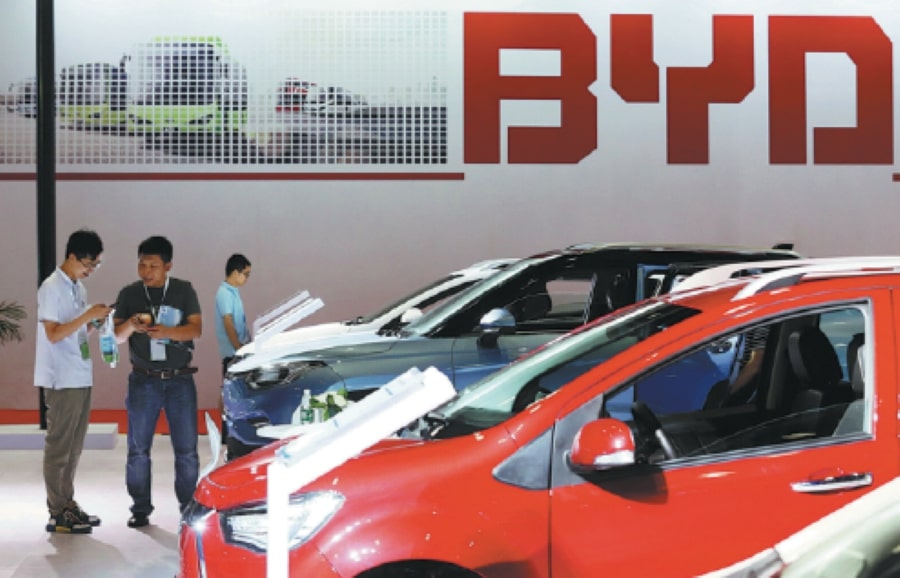
Chinese new energy vehicle and battery maker, BYD, will supply batteries to the United States automaker Ford, a document of the Ministry of Industry and Information Technology showed last week.
Ford's China venture with Changan Automobile is seeking government approval to build a plug-in hybrid model equipped with BYD batteries. In 2019, Ford said it planned to launch more than 30 new or significantly redesigned models in China by the end of 2021, of which more than a third will be electric.
BYD said it supplies electric vehicle components including batteries and power management devices. The deal marks BYD's first-known battery supply to a major global automaker.
The company announced the establishment of its battery subsidiary called Fudi Battery Company in April. It will focus on the design, R&D and manufacture of power and storage batteries.
Yale Zhang, managing director of Shanghai-based consulting firm Automotive Foresight, said it is an important strategy of BYD to become an independent battery supplier and provide its batteries to more carmakers.
BYD has ambitions in battery supply, which are supported by its Chongqing battery factory with an annual capacity of 20 gigawatt-hours.
BYD CEO Wang Chuanfu once said they plan to list its battery business on the stock market by 2022 to raise funds and expand.
The International Energy Agency predicted there would be 125 million electric vehicles on the road worldwide and sales will reach 21.5 million by 2030.
China sold 1.2 million new energy vehicles in 2019 and this is expected to hit 15 million units by 2030.
The growing electric vehicle market will drive demand for a large number of batteries. Tesla, Audi, Jaguar Land Rover and some other carmakers suspended production due to supply problems at one time.
"To ensure adequate battery supply, carmakers would like to cooperate with more than one battery supplier and explore stable and suitable partners for the long term," Zhang said.
In 2019, China accounted for more than half of the market share of power battery capacity, which also attracted global auto groups to work with domestic battery makers.
In China, CATL and BYD are the first choices for global carmakers. But they are being asked to provide batteries for more companies than they can supply. CATL alone provides batteries for more than 20 auto companies, including Volkswagen, BMW and Daimler.
This has led to global carmakers seeking cooperation with second-tier battery suppliers in China.
In May, Volkswagen invested 1.1 billion euros ($1.24 billion) in China's third-largest electric vehicle battery maker, Gotion High-Tech Company. Volkswagen became the biggest shareholder in Gotion with a 26.5 percent stake.
Within a week of this, Reuters reported that Daimler wanted to invest in the planned $480 million initial public offering of Chinese battery maker, Farasis Energy.
The two firms struck a deal in 2019 for Farasis to supply Daimler with lithium-ion battery cells. Farasis is now building a factory in Germany.
An industry insider said that with Volkswagen and Daimler becoming shareholders in battery makers, they are aiming to create controllable battery supply chains and ensure battery quality.
Traditional carmakers, who control the "heart" of a gasoline vehicle-the engine-cannot produce the battery, the core of new energy vehicles.
This is because the two have totally different manufacturing processes, Zhang said.
Carmakers have also made efforts to build their own battery factories. In early May, Volkswagen announced an investment of 450 million euros to build a lithium battery plant in Germany.
It is expected to begin official production in 2024, with a production capacity of approximately 16 GWh.
It may take at least 10 years to find out which way-cooperating with professional battery makers or establishing their own battery plants-is better for a carmaker, Zhang said.
John Zeng, managing director of the LMC Shanghai consultancy, said carmakers have no advantages to develop a battery, which is about electrochemistry and the cell technology is developing fast.
However, carmakers should focus on developing the technologies of battery management systems and package methods, which are even more important than the cells for electric vehicles, Zeng suggested.




















