



Stronger materials vital for lunar plans









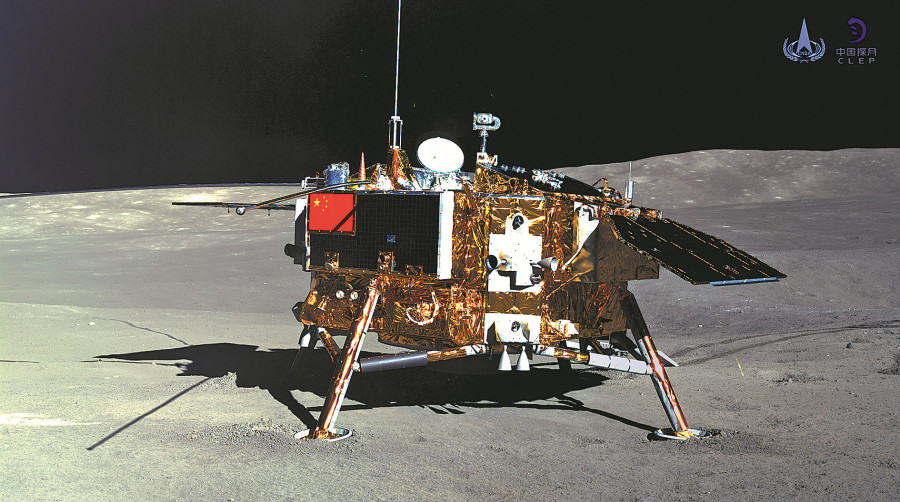
I would love to see a permanent human base or settlement on the moon or even Mars within my lifetime.
As the Russian scientist Konstantin Tsiolkovsky once said, Earth is the cradle of humanity, but one cannot stay in a cradle forever.
With sporadic political interest in space development and research throughout history, new breakthroughs in the field are a welcome relief to a sector that is often stagnated by funding difficulties, as well as sheer technological barriers.
A research team in the west of China has said it has developed a material from artificial lunar dust that could be strong enough to build a solid base on the moon.
Doing this successfully would prevent the astronomical costs of such a project from rising still farther.
Currently, it costs around $20,000 to send 1 kilogram into space from the Earth. Sending building materials for a settlement capable of housing a group of people with current rocket technology would be out of the question.
Scientists from the Xinjiang Technical Institute of Physics and Chemistry have successfully converted artificial lunar raw material into basalt fiber.
The South China Morning Post reports that the material has a tensile strength of up to 14,000 megapascals. Compared to attempts by the European Space Agency, where attempts to manipulate lunar dust into a high-strength material resulted in a tensile resistance strength of around 32 megapascals, it is a great success.
To put this into perspective, 1 megapascal is about the same amount of pressure as that of a fully inflated bicycle tire.
One of the major aims of any structure on the moon would be to provide protection from micrometeoroid impacts, which plague the moon's airless surface. Micrometeoroid craters are numerous and range from the microscopic to more than one centimeter long. Traveling at hyper-velocity, the tiny particles that create them have the potential to damage infrastructure and rupture vital materials with deadly consequences. Inspections of spacewalks conducted by NASA have found evidence of damage from micrometeoroids, particularly in vulnerable areas such as external handrails. The fact that basalt fiber has the potential to withstand this constant cosmos battering.
On Earth, we are privileged with an atmosphere that provides friction that burns away unwanted pellets from outer-space, so they cannot rain down on us. A lunar settlement would not have this luxury, and so must be built from a much more sturdy material than would be needed on Earth.
The process of making basalt fiber from artificial lunar dust originates in the Changbai mountains on the China-Democratic People's Republic of Korea border. The dust there is chemically extremely similar to that on the moon, with a composition that includes around 48 percent silicon dioxide and 17 percent aluminum oxide. The dust is superheated and pressed out as a fiber.
The concept of producing vital ingredients needed for life from raw lunar materials is nothing new. Chinese scientists have also been looking into using the moon's natural materials to produce oxygen there as well.
China's plans in space are seen as a vital part of the expanding of horizons in the fast-developing nation.
The quest could lead to mass innovations and breakthroughs for all humanity.
Innovations such as the computer mouse, the CAT scanner, and even sports sneakers all originated in the 20th century's space race.
This century's innovations are set to come from China, with the nation's fast-growing private wing of the space sector progressing quickly to cater for the next step forward.
Companies including ispace are rapidly progressing, alongside their counterparts from the United States such as SpaceX.
The future of space exploration and travel is set to be more lucrative and rewarding than ever, but challenges remain and still start with the fundamental struggle to ensure building materials can withstand the harsh environment of space.
The struggle to find the right materials is an old one and began when our ancestors made homes of wood and straw capable of protecting us from the rain.










