



Remembering Brazil's darkest day
Seventy years on from its most shocking defeat, South American nation still haunted by trauma of the 'Maracanazo'









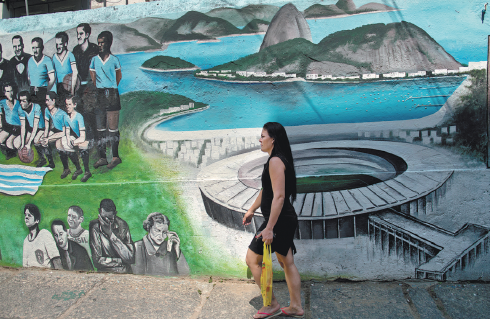
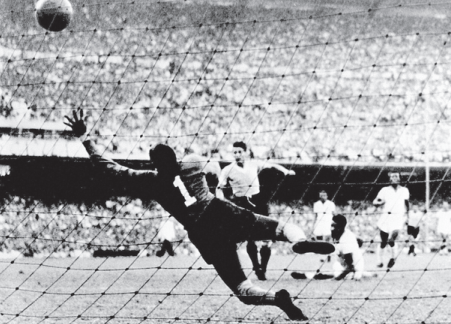
Brazil great Pele was 9 years old when his country suffered the "Maracanazo" trauma as Uruguay came from behind to win 2-1 in Rio de Janeiro to claim the 1950 World Cup.
Pele's father burst into tears when the winning goal was scored by Alcides Ghiggia. The young Pele promised his father he would win a World Cup to make up for the disappointment.
The shock of defeat was palpable in and out of the stadium.
"It was the first time in my life that I heard something that wasn't noise," Uruguay's Juan Alberto Schiaffino, who scored his country's first goal, said years later.
Brazil's trauma over the defeat can be explained by the fact the country was looking for its place in the world while trying to consolidate itself as a nation state, says Ronaldo George Helal, a sociologist and professor at Rio de Janeiro State University.
The result of the match was viewed as "the victory or defeat of the Brazilian nation project", based on the idea of a racially harmonious country united by soccer.
"Until the 1930s, there was no concept in Brazil about what the Brazilian nation was," Helal told AFP.
By 1950 the country was heralded by UNESCO as the "exemplary situation" of "harmony" with soccer at its core.
The reality was a little different and black goalkeeper Moacir Barbosa was deemed the culprit by many.
"The maximum (prison) sentence (in Brazil) is 30 years, but I've already done 40 years," Barbosa said in the 1990s.
Uruguay underrated
In Uruguay, the victory was turned into a metaphor for how the small can overcome a giant.
While "Maracanazo" means a national tragedy in Brazil, in Uruguay it is used to describe a victory against the odds or the overcoming of adversity.
In reality, though, despite the difference in the size of the two countries-Brazil's population was around 23 times greater than Uruguay's in 1950-this was no David defeating Goliath.
Uruguay was still a soccer superpower at the time having won the Olympic Games in 1924 and 1928 and the first World Cup in 1930.
"With the Maracanazo, sometimes the emphasis is put on a 'great feat' ... and the fact that Uruguay had a great team is brushed aside," said Uruguayan journalist Atilio Garrido, author of Maracana, A Secret History.
For sociologist Felipe Arocena, from the Uruguay's University of the Republic, what happened in the "Maracana was a confirmation for those that experienced it".
Uruguay's position in world soccer "was much more than just the 1950 final, although the Maracana epic ended up overshadowing" three decades of success.
That's not the way the Brazilians-hungry for a first world title-saw things.
For Helal, the trauma lasted until Brazil's third World Cup triumph, when Pele inspired the Selecao to glory in Mexico in 1970-their third success in four tournaments.
That was greeted "as a victory for the Brazilian nation".
With the passage of time, Brazilian society has come to understand that "national team matches are (just) sporting victories or defeats".
That change in mentality was evident in 2014 when Brazil suffered its most humiliating experience on the pitch-hammered 7-1 at home in the World Cup semifinal by a rampant Germany.
"In 1950 it was a tragedy; in 2014 it was a satire that became a meme, because people didn't take it so seriously anymore," said Helal, who added that the 2014 reaction shows "a greater maturity in society".
For Uruguay, that moment was a peak the country has been unable to match since, either on the pitch or from an economic perspective.
Uruguay's best results at a World Cup since have been fourth-place finishes in 1954, 1970 and 2010.
"As a small country without great resources it's become ever more difficult to compete in a sport where the importance of money is growing," said journalist Luis Prats, an author of several soccer books.
And once Uruguay began its economic decline from the heady days of the 1950s, "sport in general was no longer given the same importance by the state that it had at the beginning of the (20th) century," added Arocena.
Today, that result is seen through the lens of a tiny country dwarfed by two regional giants-both from a soccer and economic perspective-Brazil and Argentina.
"It's an episode that summons national pride, with aspects that seem legendary," said Prats.
AGENCE FRANCE-PRESSE



Today's Top News
- Deep sea needs down-to-earth scientific research
- Deeper opening-up promised for steady growth
- China to rebalance growth with domestic demand boost
- Consultative suggestions provide policymakers with essential inputs to finalize five-year plan
- Decoding China: How the people run the country
- AI helping to redefine entrepreneurship





