



National security law for HK fully justified









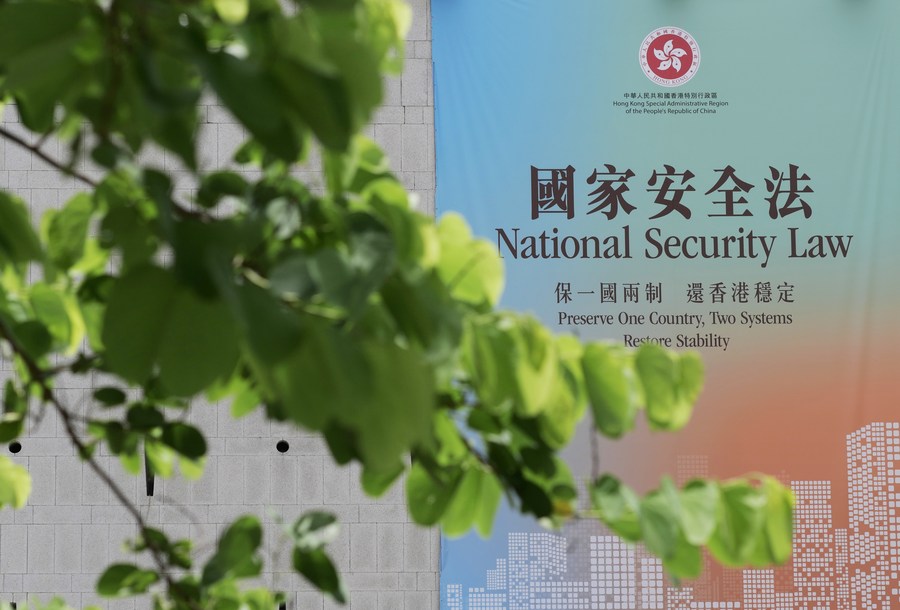
The United Kingdom claims that by promulgating the Law of the People's Republic of China on Safeguarding National Security in the Hong Kong Special Administrative Region, China has violated the terms of the Sino-British Joint Declaration, and that the law lacks legal basis and is a violation of the principle of "one country, two systems" and a "high degree of autonomy" for Hong Kong.
Such accusations do not conform to the Sino-British Joint Declaration and are thus baseless from the legal point of view. With the return of Hong Kong to China and the implementation of the principles of "one country, two systems" and a "high degree of autonomy" in Hong Kong, China and Britain fulfilled their commitments according to the joint declaration. And after the National People's Congress, China's top legislature, promulgated the Basic Law of the SAR, China fulfilled its duties under the joint declaration.
The implementation of national security legislation in Hong Kong is in accordance with China's Constitution and the Basic Law of the SAR. The national security law in the SAR stipulates four serious crimes that endanger national security-secession, subversion, terrorism and colluding with foreign and external forces to endanger the country-which is a significant move to improve "one country, two systems".
The Sino-British Joint Declaration is a bilateral treaty signed by China and UK in 1984. It was registered as a treaty at the United Nations by the Chinese and British governments on June 12, 1985. And accordingly, China resumed exercising sovereignty over the SAR on July 1, 1997.
So the question is whether the commitments agreed by both sides in the joint declaration have been implemented. The answer is "yes" as far as China is concerned.
Before Hong Kong's return to the motherland in 1997, China fulfilled its commitments according to the joint declaration, including putting in place the arrangements during the transitional period. China has not only implemented the "one country, two systems" principle and granted a "high degree of autonomy" to Hong Kong as part of the Basic Law of the SAR, but also helped maintain the economic prosperity and social stability of the SAR during and after the transitional period, which means it has fulfilled all its commitments according to the joint declaration.
Whether or not the central government has promoted a "high degree of autonomy" in Hong Kong should be judged based on China's Constitution and the Basic Law of the SAR. Viewed from this perspective, China has fulfilled all its commitments in the Sino-British Joint Declaration. More important, there is no clause in the joint declaration that says China cannot implement national security legislation in the SAR.
The implementation of the national security law is completely in accordance with China's Constitution, which is the basis of the Basic Law of the SAR. The NPC authorized its Standing Committee to enact the national security law for Hong Kong, which was attached to Annex III of the Basic Law to be implemented in the SAR.
Since the national security law for Hong Kong is targeted at subversion, secessionism, terrorism and collusion with foreign and external forces, which are different from general crimes, it is aimed at dealing with criminal behaviors and activities that seriously endanger national security.
In short, the national security law promulgated in Hong Kong is aimed at strengthening the "one country, two systems" principle and safeguarding national security and protecting Hong Kong residents' rights and interests under the framework of the Basic Law of the SAR.
The author is a researcher at the Center for Basic Laws of Hong Kong and Macao Special Administrative Regions, Shenzhen University. The views don't necessarily represent those of China Daily.





