



US itching to trigger a new 'Cold War'









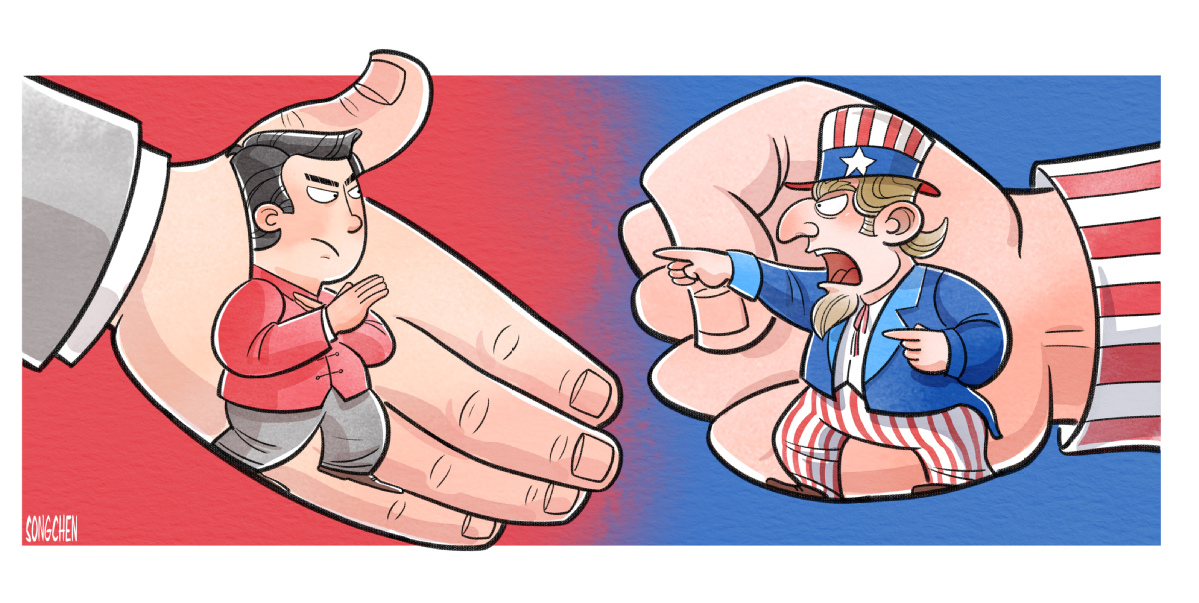
After the US ordered the closure of the Chinese consulate in Houston, Texas, on July 21, China had to respond in equal measure, which it did by asking the US on Friday to close its consulate in Chengdu, Sichuan province. This is a rare diplomatic row in contemporary international relations.
The United States administration has not presented any evidence to support its claim of China stealing US intellectual property and personal information, which it said was the reason for ordering the closure of the Chinese consulate in Houston.
Prior to this, the US had taken a number of steps pushing bilateral ties to the brink of a cliff. The White House report on the US' strategic approach to China concludes that its engagement-with-China policy has failed. It has therefore opened fire on almost all fronts against China, including human rights issues in the Xinjiang Uygur autonomous region and Hong Kong Special Administrative Region, trade and tariff war against Beijing, tech and financial war with Chinese entities, media and students war due to the so-called "Chinese agents", and challenging China's sovereignty rights in South China Sea, not to mention raising tensions across the Taiwan Straits.
Recently, US Secretary of State Mike Pompeo made his "iron curtain" speech, labeling China as an "abnormal country"-and claiming its root cause lies with the top echelon of the Communist Party of China. Most strikingly, he has openly called for a change in Chinese leadership.
The US seems intent on triggering a new "Cold War", this time with China. Which is against the momentum of international relations, building trust and engagement to attain common development and prosperity.
The US' attempt to reverse the post-Cold War trend of globalization is contrary to the principle of the UN Charter, which stresses equality and mutual respect among nations, and its order to close China's consulate in Houston without any presentable reason and proper diplomatic protocol is a violation of the UN Charter and Vienna Convention on Diplomatic Relations.
Although China wants to avoid a new "Cold War", it should be prepared to respond to the US' attempt to start one. Given its political need to blame China to improve the president's chances of re-election, the US administration may make more dangerous moves, which would further deteriorate bilateral ties. In fact, the White House could ask more Chinese diplomatic missions in the US to close, bar more Chinese citizens from entering the US, and ignite flashpoints across the Straits and in the South China Sea.
Some expect Sino-US relations to improve after the US presidential election, scheduled for November. But given the high bipartisan consensus on the China policy in the US, even a Democrat president may not be able to dramatically change the direction of down-spiraling Sino-US ties.
So Beijing should be prepared for the coming icy relations with Washington and, as a consequence, an overall more challenging international environment. From the day it opened up its economy to the outside world and embraced the US market to the present when it is looking forward to a "dual circulation" development pattern, China has been calm about its economic future.
Despite this, however, the Chinese economy today is far robust than what it was four decades ago, and China trusts that the rest of the world will not close its door on it. Even the US will not do so as it still expects China to implement the "first phase" of the bilateral trade deal the two sides inked on Jan 15. And according to the arrangement of high-level bi-annual meeting, Chinese Vice-Premier Liu He is likely to meet with senior US officials soon for this purpose.
Although China has no choice but to respond to the US' attempt to trigger a new "Cold War", Washington and Beijing need to bear in mind that there is distance between a cold war and a hot war. And during the Cold War, the US and the Soviet Union managed to avoid a hot war despite several crises. Even during the Korean War (1950-53) and Vietnam War (1955-75), Washington and Moscow avoided a direct US-Soviet conflict. Moreover, they also managed the Cuban Missile Crisis in a face-saving manner, though with risks.
China and the US, too, have to manage such crises. And though unfortunate, they at least need to manage some "cold peace". Given the advanced technologies they are in possession of, maintaining proper communication and avoiding a military conflict due to lack of trust, will be crucial for peace in the future.
The author is a professor at and former executive dean of the Institute of International Studies, Fudan University.
The views don't necessarily reflect those of China Daily.





