



Effective points of reference









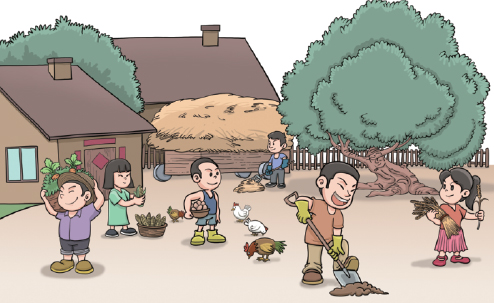
China's success in poverty alleviation offers inspiration and tangible models for other developing countries
The implementation of the reform and opening-up policy in 1978 helped 800 million people in China shake off poverty, contributing over 70 percent of the global poverty reduction over the past 40 years. Now, as it implements its strategy of targeted poverty alleviation, China has announced the goal of helping all living under the current poverty line shake off poverty and to eliminate absolute poverty by the end of 2020.
In light of the country's achievements, its policies and practices on poverty alleviation are of great reference value for many developing countries.
First, the Chinese government has formulated medium-and long-term poverty alleviation plans based on identifying and keeping track of every household and individual still living in poverty and analyzing the reasons for their poverty. The plans propose clear targets and set the priorities, fundamental principles, contents and approaches for poverty alleviation work and establish policy guarantees.
Other developing countries can draw on China's experience by formulating medium-and long-term plans to achieve their poverty alleviation goals, and persisting with their implementation. While some developing countries have outlined detailed road maps for poverty alleviation, the plans have either been shelved for the lack of funds or dropped due to a change in leadership.
Second, China's practices show that the institutional system plays a key role in meeting its poverty alleviation goals. The country has developed a completed system consisting of poverty alleviation departments at all levels. Based on the country's administrative system, the central government has established the State Council Leading Group of Poverty Alleviation and Development for overall planning of poverty alleviation and development across the country, and provincial, city, county and township-level departments for efficient poverty alleviation. However, lower-level administrative departments in some developing countries often show limited capabilities to carry through poverty alleviation plans. Governments in other developing countries can establish similar systems based on their domestic institutional systems and cooperate with communities to launch poverty alleviation plans more effectively.
Third, China's down-to-earth methods have also proved effective. Since China is the world's largest developing country, its economic and social situation before shaking off poverty has been similar to that of many other developing countries. Therefore, China's methods and modes of poverty alleviation can provide models for the practices of other developing countries.
During the drought in Ethiopia in 2011, staff members of the China Foundation for Poverty Alleviation working in Ethiopia found through field surveys that local poor rural households mainly got access to drinking water through water transported by trucks or digging wells, both of which were costly. The former is not sustainable for assistance providers often fail to meet the costs of drivers' salaries and fuel consistently, while the promotion of the latter is also hard due to high input on facilities and difficulties of repair in the isolated regions. To cope with the problems, the staff tried building water cellars commonly seen in arid regions in China, collecting rainwater during the rainy season, storing it in cellars and extracting the water during the dry season to address difficulties of accessing drinking water of poor households. The project with low costs has been embraced by poor rural households in Ethiopia, with its third phase implemented and the construction of 120 water cellars completed. This is an example of a Chinese poverty alleviation method being easily and successfully adapted for use by another developing country.
Fourth, China has provided references on identifying and registering poor households through procedures including public appraisal, on-site surveys, public notices, random examination and information registration. After precisely identifying the poor population and departments that are held accountable, targeted measures are employed. This practice is of great significance to other developing countries, as it can greatly reduce the costs of poverty alleviation. In some developing countries, large amounts of aid funds are consumed before reaching the poor, greatly affecting their sense of gain. The reason is that all international development organizations tend to spend funds on selecting beneficiaries by hiring part-time workers to identify the poor households through questionnaire surveys and community consultations to ensure equity, largely consuming the resources for poverty alleviation. The number of surveyed people is often more than twice that of those receiving aids. If the governments of other developing countries can draw on China's experience of identifying and registering the poor population, poverty alleviation organizations can provide targeted support for the identified households and benefit them more with the saved costs.
China has nearly eliminated absolute poverty in a little more than 40 years, which has brought hope to the international community that poverty can be eradicated. Both the Chinese government and communities are willing to share their experience with other countries to help them eliminate poverty in the shortest possible time.
The author is the director of the International Development Department at the China Foundation for Poverty Alleviation. The author contributed this article to China Watch, a think tank powered by China Daily. The views do not necessarily reflect those of China Daily.





