Tourism at Jiuzhaigou National Park rebounds after massive 2017 earthquake









"Three, two, one. Go!"
Less than two minutes after a livestreaming host and an official kicked off a flash sale on the e-commerce platform Pinduoduo, 100 discount tickets to four renowned tourist attractions priced at 1 yuan ($0.14) had sold out.
The promotion of tickets to scenic areas hosted by Yang Kening, the head of Sichuan province's Aba Tibetan and Qiang autonomous prefecture, was the highlight of the show, held last month to boost local tourism and the sale of agricultural products. A total of 1,800 discount tickets at different prices to Jiuzhaigou National Park, Huanglong Valley, Siguniang Mountain and Dagu Glacier were snapped up as soon as they were offered.
The highly acclaimed Jiuzhaigou National Park, a UNESCO World Heritage site also known as Jiuzhaigou Valley, attracted a lot attention from the audience.
"Jiuzhaigou Valley is really amazing," one viewer said, before asking "has it recovered from the quake?"
Yang replied: "Three years of restoration work has basically been completed. Jiuzhaigou Valley has emerged as more attractive after touch-ups. You are welcome to visit and may have a different feeling compared to the past."
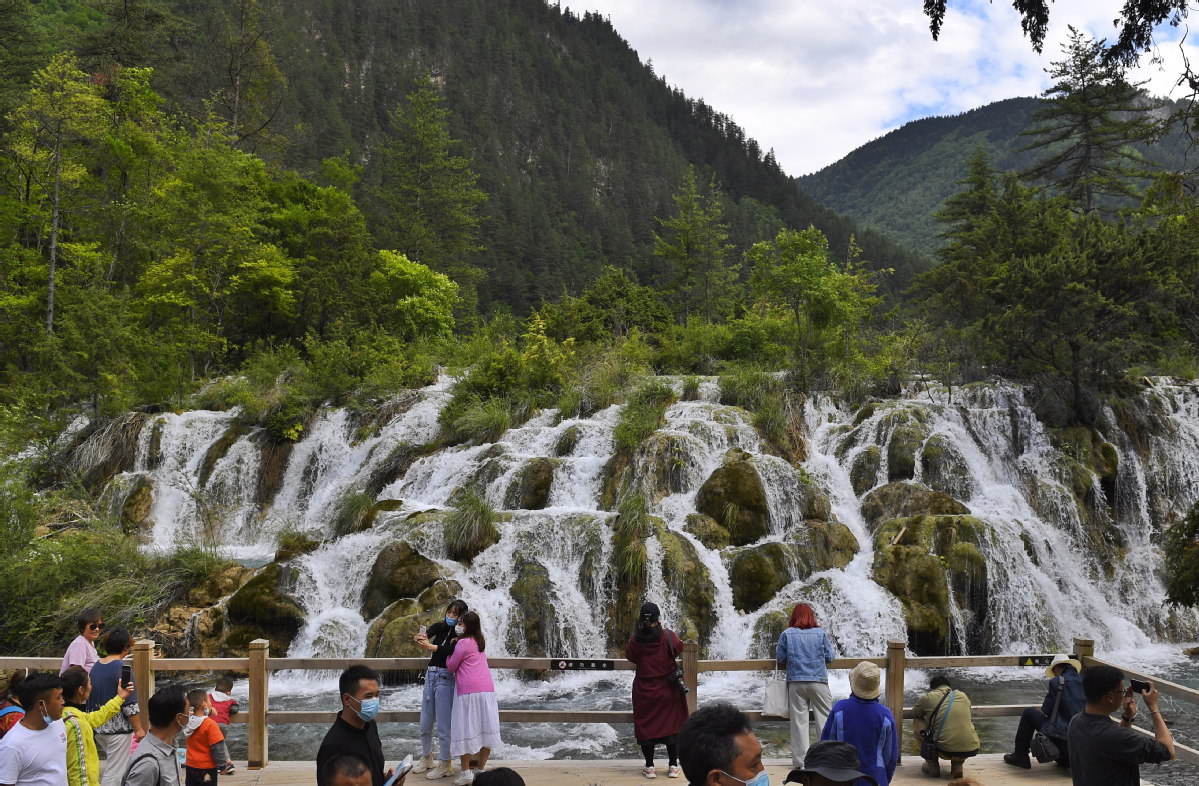
Located in Zhangzha township in the prefecture's Jiuzhaigou county, the park is famous for its spectacular waterfalls, lush forests, serene plateau lakes and karst rock formations.
But the pristine scenery was left scarred by landslides and falling rocks triggered by a magnitude 7 earthquake on Aug 8, 2017, and the park closed for two years. Many people feared that the region's breathtaking scenery would be destroyed forever.
Their worries disappeared when it reopened on Sept 27 last year. By then, 85 percent of the park was accessible to tourists.
During the restoration, the recovery of the landscape mainly relied on nature's own ability to repair itself, complemented by manual interventions. Most of the affected tourist spots recovered one year after the quake.
The glassy waters of Wuhua Lake, or Five Flower Lake, one of the most beautiful in the valley, turned brown after the quake. But the lake soon regained its original splendor and now shines like a sapphire embedded among the valleys.
"The water in Jiuzhaigou comes from underground rivers, and it can purify itself since 85.5 percent of the park is covered in vegetation," said Chang Xingqiang, who works with the park's management bureau.
The Nuorilang Waterfall cracked down the middle and stopped flowing after the temblor. After evaluation, experts used crushed carbonate rocks to repair the fissure, and now the falls are back.
"If we hadn't repaired it, it might have threatened the safety of 19 upstream lakes," said Zhu Zhongfu, senior engineer at the park's management bureau. "Now that the water has resumed its flow, new layers of carbonate rocks will gradually form. We will continue monitoring its recovery status."
The impact of the quake was not all negative.
Aside from the damage it caused, it also helped improve the Double Dragon Lake Waterfall, which was originally hidden away from sight in deep forest. After the quake, the hydrological environment changed and the water flow increased, making the waterfall a more magnificent sight.
Along with scenery restoration, a number of improvements were made to safety, infrastructure and tourist services at the park.
A total of 141 spots identified as having geological hazards have been restored, and more parapets and rockfall barriers have been set up.
Forty-five kilometers of walkways and 52 km of roads were upgraded, 47 public toilets and rest pavilions were renovated, and 68 percent of a comprehensive tourist complex-including a visitor center, an exhibition center, an international exchange center, an emergency shelter and other buildings-h(huán)as been completed.
Following investment of 1.87 billion yuan, 19 out of 38 restoration projects after the quake have been finished and others are seeing steady progress.
The valley experienced another two months of closure this year due to the COVID-19 pandemic and reopened on March 31. The daily cap on the number of tourists has increased to 17,000 recently.
Just 3 km from the scenic area, Tashi, a villager in Zhangzha, is running a family inn, a business that has heavily relied on park tourists.
Wide cracks appeared in the walls of his two-story wooden house, and he and his guests were transferred to a safe place the night after the quake, he recalled.
In the wake of the disaster, the hospitality and catering industry in the tourist town came to a standstill, including his homestay.
"I have been doing business here for more than a decade, and I decided to stay and rebuild my house," said Tashi, 36.
In March 2018, Tashi started to build a new house with a 3 million yuan low-interest loan provided by the government and a bank.
Fourteen months later, a brandnew four-story family inn built with reinforced concrete stood on the site of his former house.
When Jiuzhaigou Valley reopened last September, Tashi's business also resumed operation.
"My new house can receive 300 to 400 visitors a day, but due to the epidemic this year, the average number decreased to about 100," he said.
"But I still have confidence in local tourism since Jiuzhaigou Valley is as beautiful as before and the infrastructure and public service facilities have undergone significant improvements. Within five to six years, I will be able to pay off my debt," he said.
A total of 17,000 quake-affected houses, mostly in rural areas, have been repaired and reinforced and another 104 rebuilt since the county began its restoration work.
The rebuilt Jiuzhaigou Second People's Hospital, mainly designed to serve millions of tourists and two local villages in Zhangzha town, has been upgraded with a parking apron for emergency medical transfers and hyperbaric oxygen chambers.
Fifteen homestay businesses and 110 hotels have resumed operation.
On Saturday, four scenic areas developed after the quake officially opened as part of efforts to increase the diversity of local attractions and further boost tourism.
Three of them-Ganhaizi, Jiawuhai and Shenxianchi scenic areas-are noted for their natural lakes. The other is Chaimenguan Pass, an ancient road site on the border with Gansu province.



- Villagers enjoy Spring Festival gala in Jinggangshan, Jiangxi
- Robotic sector shifts from prototypes to production
- China boosts access to quality healthcare with online initial consultations
- AI innovations to bolster Xizang's digital economy
- Mediation to end disputes advocated
- Couriers help drive Spring Festival sales